
ExtraBrain Blog
Does CodeSignal Detect AI? The Suspicion Score, Proctoring and Cosmo Explained
Short answer
Yes, CodeSignal says it looks for AI use. Its Suspicion Score flags paste events, copied task descriptions, unusual typing and code that resembles other or leaked answers, and proctored tests record your camera, microphone and screen for a human review team. A flag is not proof, and employers decide what it means. Some tests let you use CodeSignal's own AI assistant, Cosmo; outside AI stays off-limits unless the test says otherwise.
What CodeSignal's own docs say about AI use: the Suspicion Score, proctored test reviews, the syntax-only search rule, and tests where AI is allowed.
CodeSignal is unusually open about how it looks for AI use. Its help center explains the Suspicion Score that employers see, its proctoring article says exactly who watches the recording, and a February 2026 press release reports what its systems flagged in 2025. Its rules also changed: some CodeSignal tests now hand you an AI assistant on purpose. This guide covers what CodeSignal documents, what it doesn’t, and how to stay on the right side of the rules for your specific test.
ExtraBrain makes an AI interview assistant, so we have a stake in this question; we checked every claim below against public sources on November 21, 2026.
If you only want to know what gets recorded in a proctored session, our earlier guide to whether CodeSignal records your screen covers that in detail. This post is about detection.
The signals CodeSignal documents
| Signal | What CodeSignal says | Where it shows up |
|---|---|---|
| Paste events | Suspicious pastes are counted per question; size, timing and frequency matter | Suspicion Score breakdown and code replay |
| Description copy | Copying the task text is flagged | Suspicion Score |
| Similarity | Code is compared with other submissions and leaked answers | Similarity score with a View Diff button |
| Typing and telemetry | Telemetry is a listed fraud signal, and unusually linear typing shows up in flagged sessions | Integrity dashboard and AI proctoring |
| Language switches | Switching language around paste events is called highly suspicious | Code replay |
| Proctoring | Camera, microphone and screen are recorded for the whole test, plus a photo ID | Reviewed by CodeSignal’s verification team |
| AI chat (Cosmo) | When the employer enables it, every conversation is logged | Coding report |
Sources: Using Suspicion Score, the cheating and fraud page, What is proctoring and Evaluate test-takers’ AI skills with Cosmo.
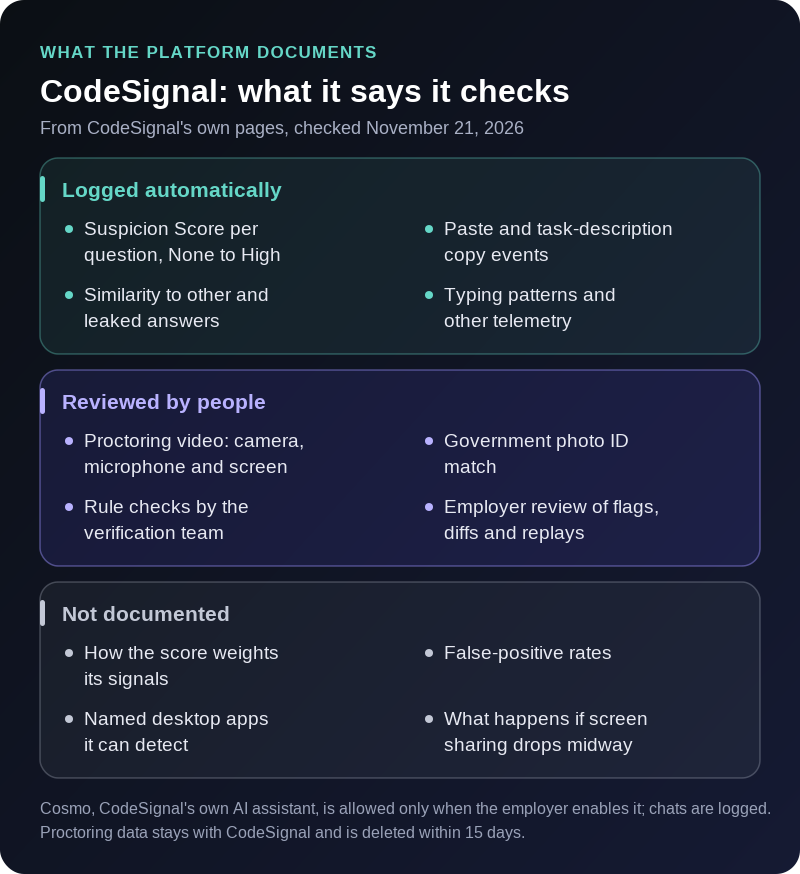
How the Suspicion Score works
The Suspicion Score is assigned per question, from None to High, and an overall Integrity Flagged value of Yes, No, N/A or Pending sits on top. CodeSignal’s help article is careful about what Yes means: enough suspicious activity to justify a closer look, not proof that someone cheated. It tells employers that a flag could come from copying another test-taker, using leaked material or using generative AI to write code.
The review advice is revealing because it shows what a reviewer actually checks. For a high score with no suspicious pastes, look at the similarity diff, since a simple task can produce similar code by coincidence. With pastes, watch the replay: large or frequent pastes, a paste after a long quiet stretch, or a paste right after copying the task description are described as common cheating patterns.
The February 2026 release adds numbers. CodeSignal says cheating and fraud attempt rates in proctored assessments rose from 16% in 2024 to 35% in 2025. Among flagged sessions, 35% involved frequent off-screen referencing, 23% unusually linear typing and 15% high similarity to known or leaked answers. These are CodeSignal’s own figures about attempts it flagged, with no published false-positive rate.
Proctored tests add people
Proctoring is an employer option, and your Assessments page shows whether a test requires it before you start. Setup asks you to close unrelated tabs, windows and applications, share your camera, microphone and screen, and show a government photo ID. Afterward, CodeSignal’s proctoring verification team checks that sharing stayed on, the ID is valid and you followed the displayed rules. The assessments quick start says a clean review is verified in one to three business days, and a failed one shows as “Proctoring rejected” on the report.
Two details candidates rarely know. CodeSignal says proctoring data is reviewed by CodeSignal only, deleted within 15 days and not shared with the company, which receives the result and score. And proctoring does not change your score; it decides whether the score is verified.
The rules: syntax lookups yes, AI no (unless the test says so)
The GCA rules article draws a precise line. Web searches for syntax reference are allowed, like checking which methods a C++ queue has. A page that explains how to build the data structure the question asks for is not. And it states that AI is not allowed, even for syntax search. You must tick a box next to each rule before the timer starts, and you can reread them from the IDE menu.
The exception is Cosmo. Employers can switch on CodeSignal’s built-in assistant per assessment, in versions ranging from strict hints to a full copilot. Cosmo tells you the chat is recorded and visible to CodeSignal and the employer. CodeSignal’s May 2025 announcement of AI-assisted assessments describes the same idea: AI inside the IDE, with transcripts for the hiring team. Permission covers Cosmo, not an AI tool running in another window.
One habit trips up honest candidates. If you normally draft code in your own editor and paste it in, know that pasted code is one of the main things the score counts, and a big paste after a quiet stretch is the exact pattern reviewers are told to examine. Write in the CodeSignal IDE unless the rules say otherwise, and if something unusual happens, like a crash that forces you to paste back your own work, tell the recruiter the same day.
What CodeSignal does not publish
We found no CodeSignal documentation of how the Suspicion Score weights its signals, its false-positive rate, or a list of desktop apps it can recognize. The proctoring article does not say what happens if screen sharing drops midway. None of that means a gap you can use: a full recording of your camera and screen is reviewed by people, and a later live round tests whether you can explain your own code.
Where ExtraBrain fits
ExtraBrain is a desktop app for Mac and Windows that helps during live conversations and with preparation. On a CodeSignal test, it has no place unless your instructions say outside tools are fine, and the GCA rules say they are not. Where it helps is before the test: talk through timed practice problems out loud, capture a screenshot of your own practice code, and ask what you missed, then review the transcript of how you explained it. CodeSignal’s own practice assessment, offered before the GCA, is the right place to learn the IDE. If your next round runs on another platform, our HackerRank detection guide and CoderPad guide cover those.
FAQ
Can CodeSignal detect ChatGPT?
CodeSignal says its Suspicion Score and AI proctoring look for patterns linked to AI use, such as pasted code, copied task text, unusually linear typing and similarity to known answers. It does not claim to identify the tool by name.
Can I use Google during a CodeSignal test?
On the GCA, only for syntax reference. AI tools are not allowed, even for syntax. Other tests follow the rules shown during setup.
Does the company see my webcam recording?
CodeSignal says no. Its team reviews proctoring data, deletes it within 15 days and shares the result and verification status with the company.
Is a high Suspicion Score proof of cheating?
No. CodeSignal tells employers a flag means a closer look is warranted, and suggests checking diffs and replays before deciding.
Sources (checked November 21, 2026)
- CodeSignal help: Using Suspicion Score
- CodeSignal help: What is proctoring and how does it work?
- CodeSignal help: GCA rules and setup
- CodeSignal help: Quick start guide for assessments
- CodeSignal help: Evaluate test-takers’ AI skills with Cosmo
- CodeSignal: Cheating and fraud detection
- CodeSignal press release: cheating attempts in 2025 (February 2026)
- CodeSignal press release: AI-assisted assessments (May 2025)