
ExtraBrain Blog
Sherlock AI Interview Detection: Safer Ways to Use AI Help in 2026

A responsible guide to Sherlock AI interview detection, risks, preparation, and allowed AI interview help with ExtraBrain.
People search for how to cheat on a Sherlock AI interview when they are nervous, underprepared, or worried that a detection system will misread normal interview behavior. That anxiety is understandable. It is also the wrong frame.
If an interview, assessment, employer, school, or platform bans AI assistance, transcription, screenshots, outside notes, or hidden tools, you should not use them there. The safer and more useful goal is not to bypass Sherlock AI. The goal is to prepare so well that your answers sound like your own thinking because they are your own thinking.
ExtraBrain is built for that responsible workflow. It is a free, local-first Mac desktop AI interview assistant and meeting copilot with live transcription, screen-aware context, local Gemma 4 where installed and compatible, bring-your-own AI providers, and privacy controls. Use it where AI help, notes, transcription, and screen context are allowed. Use it before interviews to practice, during permitted sessions to stay organized, and after interviews to review what happened.
Why Sherlock AI makes candidates nervous
Sherlock AI is commonly discussed as an interview integrity and detection layer. Candidates worry that it may notice gaze changes, long pauses, sudden vocabulary shifts, copy-pasted answers, unusual device activity, or signs that someone else is helping. Even if the exact implementation changes, the general idea is simple: detection tools try to compare what you say, how you behave, and what happens on your device or camera feed.
That means crude cheating tactics are risky. Reading from another screen can change your eye movement. Copying generated text can change your speaking style. Waiting for an outside helper can create unnatural pauses. Using hidden devices can create visible and audible artifacts.
A better strategy is to remove the need for those tactics. Prepare your stories, technical explanations, tradeoffs, and follow-up questions ahead of time. Then you can answer naturally without trying to perform a script.
What Sherlock AI-style detection may look for
No public article should pretend to know every private signal in a specific platform. Still, most AI interview detection discussions revolve around a few categories.
| Detection area | What may look suspicious | Responsible preparation alternative |
|---|---|---|
| Eye movement | Repeatedly looking away from the interviewer or camera | Practice answering aloud while keeping notes minimal |
| Response timing | Long delays before every answer | Rehearse common prompts until your structure is automatic |
| Speech pattern | Suddenly sounding more formal, technical, or generic | Convert AI suggestions into your own examples and vocabulary |
| Environment | Extra devices, voices, reflections, or alerts | Keep your setup clean, quiet, and transparent |
| Coding behavior | Pasted blocks, unexplained jumps, or no reasoning | Think aloud, test incrementally, and explain tradeoffs |
| Interview logic | Answers that do not match your resume or experience | Build a personal story bank based on real work |
The important lesson is not how to hide these signals. The important lesson is that real preparation naturally reduces suspicious behavior.
The responsible answer to “how to cheat on Sherlock AI interview”
The honest answer is: do not cheat.
If you use AI in a setting where it is prohibited, you risk rejection, reputational damage, rescinded offers, school discipline, or loss of trust. You also risk getting a role that expects skills you did not actually demonstrate. That is bad for you and bad for the team hiring you.
A responsible AI interview assistant should help you think better, not impersonate competence. ExtraBrain is most useful when you use it to organize your own experience, practice concise explanations, and review sessions afterward.
Use AI help only where the rules allow it. When in doubt, ask the recruiter or interviewer what tools are permitted. A simple question such as “Are notes, transcription, or AI-assisted preparation allowed during this stage?” can remove a lot of risk.
How to prepare for a Sherlock AI interview without cheating
Build a real answer bank
Start with your resume, projects, and past work. For each role or project, write down the problem, your responsibility, the hard decision, the result, and what you would do differently now.
Use ExtraBrain as a focused AI second brain for interview preparation. You can practice with transcripts, notes, screen context, and review material in one desktop workflow instead of scrambling through scattered documents.
For behavioral interviews, prepare stories for these themes:
- Conflict with a teammate.
- A time you made a tradeoff under uncertainty.
- A project that failed or changed direction.
- A time you had to learn something quickly.
- A situation where you influenced without authority.
- A measurable result you helped create.
The goal is not to memorize paragraphs. The goal is to know your raw material so you can answer naturally.
Practice live phrasing instead of scripts
Detection systems and human interviewers both notice robotic answers. A polished script can sound less trustworthy than a slightly imperfect explanation that clearly comes from you.
Practice speaking in outlines:
- Start with the direct answer.
- Give the context in one or two sentences.
- Explain your action.
- Name the tradeoff.
- Close with the result or lesson.
ExtraBrain can help generate STAR outlines, technical explanations, and follow-up questions from your own context. You should still edit those outlines into words you would actually say.
Prepare for coding interviews by explaining your thinking
For coding interviews, the biggest red flag is often not a wrong answer. It is a perfect-looking answer with no reasoning.
Practice this flow:
- Restate the problem.
- Ask about constraints and edge cases.
- Propose a simple baseline.
- Improve the approach.
- Talk through complexity.
- Implement incrementally.
- Test with small examples.
- Explain what you would improve with more time.
ExtraBrain can support coding interview preparation by helping you review prompts, explain tradeoffs, and practice follow-up questions. It should not be used to secretly outsource a live assessment where that violates the rules.
Prepare for system design with tradeoffs
System design interviews are harder to fake because good answers depend on tradeoffs. A generic architecture often fails when the interviewer asks why you chose one queue, database, cache, consistency model, or scaling pattern over another.
Create reusable design notes for:
- APIs and data models.
- Read and write paths.
- Bottlenecks.
- Caching strategy.
- Failure modes.
- Observability.
- Security and privacy.
- Cost and operational tradeoffs.
Use ExtraBrain before the interview to rehearse these topics aloud. The point is to build fluency, not to read a hidden design document during a prohibited session.
Setting up your interview environment
A clean environment helps even when you are not doing anything wrong. It reduces distractions, lowers stress, and avoids misunderstandings.
Before the interview:
- Clear your desk.
- Close unrelated apps.
- Disable notifications.
- Test your microphone and camera.
- Use stable lighting.
- Keep permitted notes simple and visible if the rules allow notes.
- Confirm whether transcription, screenshots, or AI tools are allowed.
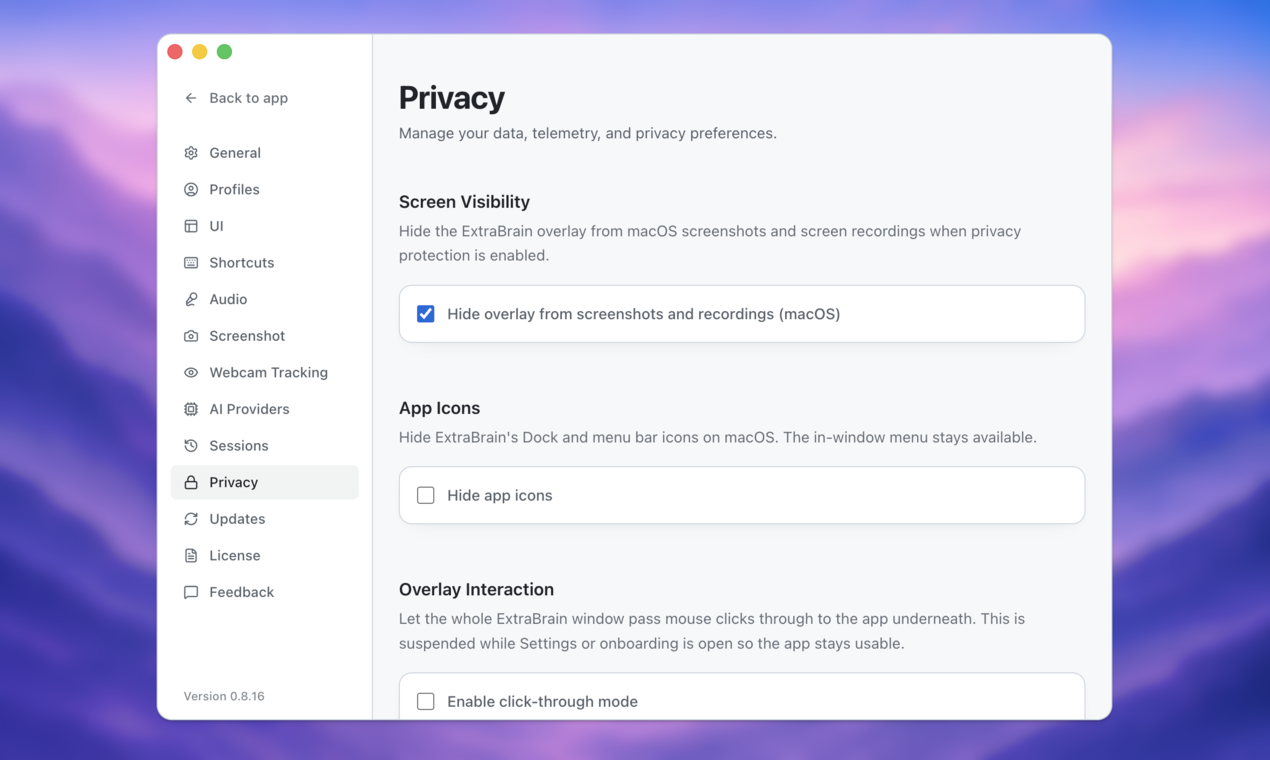
If AI support is allowed, configure it before the session. ExtraBrain supports live transcription, screen-aware context, local Parakeet transcription, optional Deepgram, local Gemma 4 where installed and compatible, and bring-your-own providers such as Anthropic, OpenAI, custom OpenAI-compatible endpoints, Claude Subscription, and Codex Subscription. External providers may receive selected prompts, transcript text, screenshots, audio, or context depending on your configuration. A fully local posture requires local Parakeet transcription plus local Gemma 4 on-device AI where installed and compatible.
What ExtraBrain is useful for before, during, and after interviews
Before the interview
Use ExtraBrain to turn scattered preparation into a practical rehearsal system. Record mock answers, review transcripts, refine examples, and practice explaining technical decisions. If you have not interviewed since before AI became common, this helps you adapt without sounding like a generated script.
During allowed interviews or meetings
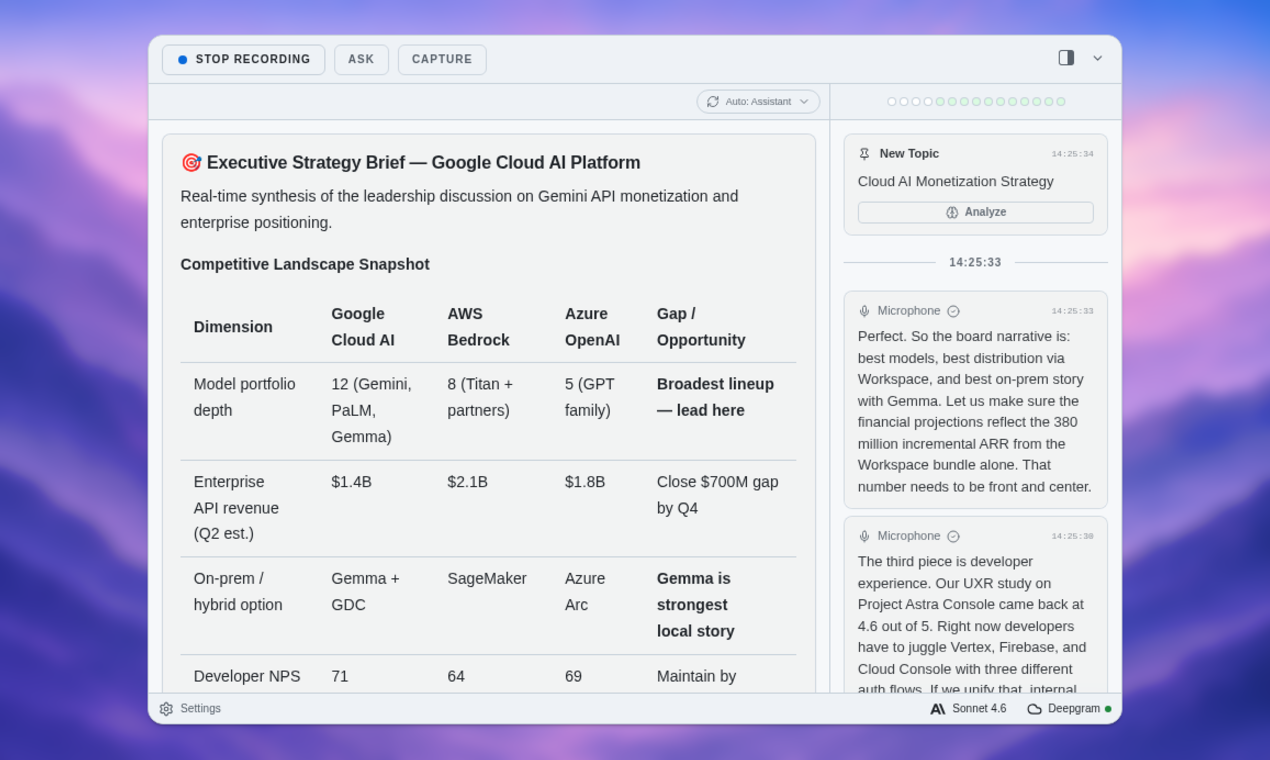
When the rules allow AI assistance, ExtraBrain can help you follow live context, identify topics, structure answers, and capture important details. It is designed as a desktop assistant for Mac, including Apple Silicon and Intel Macs. Windows and Linux are planned future platforms.
ExtraBrain is designed to stay out of screen sharing and screen recording on major meeting tools. That design is about reducing visual clutter and protecting private workspace context. It is not permission to violate interview, employer, school, or platform rules.
After the interview
The best use of AI often happens after the call. Review what you were asked. Identify weak answers. Capture follow-up questions. Write a better version of the answer while the memory is fresh. Prepare for the next round using what actually happened, not generic question lists.
That post-interview loop compounds quickly. Every interview becomes training data for the next one, while still keeping you responsible for what you say and claim.
Risk checklist for AI-assisted interviews
Use this checklist before any interview or assessment:
- Did the employer or platform explicitly allow AI assistance?
- Are notes allowed?
- Is live transcription allowed?
- Are screenshots or screen context allowed?
- Are external AI providers allowed for confidential interview content?
- Are you using only examples from your real experience?
- Can you explain every technical answer without reading it?
- Would you be comfortable telling the interviewer how you prepared?
If the answer is no or unclear, do not use live AI assistance in that setting. Use ExtraBrain for preparation and review instead.
Better alternatives to cheating
Cheating is usually a symptom of one of three problems. You either do not know the material, do not trust your ability to explain it under pressure, or do not understand what the interview is measuring. Each problem has a better fix.
| Problem | Better fix |
|---|---|
| You do not know the topic | Study the underlying skill and practice small examples |
| You freeze under pressure | Rehearse aloud with realistic timing |
| Your stories feel weak | Build a real experience bank from past work |
| You over-explain | Practice concise answer structures |
| You sound generic | Replace AI phrasing with specific details from your work |
| You fear detection tools | Follow the rules and remove ambiguity before the call |
ExtraBrain helps most when it strengthens these fundamentals. It is an assistant for thinking, rehearsal, and review. It should not become a substitute for ability or honesty.
FAQ
Can Sherlock AI detect AI help?
Sherlock AI-style systems may look for behavioral, speech, environment, and device signals that suggest outside help. You should assume that prohibited AI use may be detected or reviewed. The safer path is to use AI only where allowed and to prepare until your answers are genuinely your own.
Can I use ExtraBrain in a Sherlock AI interview?
Use ExtraBrain only if the interview, employer, school, and platform rules allow AI assistance, transcription, screenshots, notes, or desktop copilots. If live AI help is not allowed, use ExtraBrain before the interview for practice and after the interview for review.
Is ExtraBrain free?
The core ExtraBrain Mac app is free. ExtraBrain Pro is $9.99 per month $79 per year, or $149 Lifetime launch pricing. External AI and transcription provider usage is billed separately by the providers users choose.
Can ExtraBrain run fully local?
A fully local ExtraBrain posture requires local Parakeet transcription plus local Gemma 4 on-device AI where installed and compatible, with no external provider requests. Local Gemma 4 requires installation and compatible hardware and may not be available on every Mac or customer environment.
What should I do if I feel tempted to cheat?
Pause and identify the real issue. If the issue is knowledge, study and practice. If the issue is anxiety, rehearse aloud and run mock interviews. If the issue is unclear rules, ask the recruiter what is allowed. Trying to bypass a detection system creates more risk than it solves.