
ExtraBrain Blog
Invisible AI Help for Smowl Proctoring in 2026: Rules, Risks, and Safer Prep

Understand Smowl proctoring risks, common bypass claims, and safer ExtraBrain prep workflows that respect exam, school, and platform rules.
Many people search for how to bypass Smowl proctoring safely because online exams and remote assessments feel high pressure. They want invisible AI help, a second set of notes, or a calmer way to answer questions without looking unprepared.
The risk is real. Smowl is built to collect evidence from the browser, webcam, audio, device activity, and review workflow, and the final decision can involve instructors, administrators, or human proctors.
This guide keeps the practical structure of a bypass guide, but the safer conclusion is different. Do not use AI, notes, devices, transcription, screenshots, or hidden assistance in a Smowl exam unless the school, employer, certification body, or platform rules explicitly allow it. Use ExtraBrain for preparation, practice, permitted live support, and post-session review instead of trying to hide rule-breaking.
Key takeaways
- Smowl-style proctoring can monitor browser behavior, identity, webcam video, audio, environment signals, device activity, and incident reports.
- Virtual machines, video-feed manipulation, extra monitors, second devices, and hidden notes are high-risk tactics that can violate assessment rules.
- ExtraBrain can help with study prep, mock interviews, live transcription, screen-aware context, answer outlines, and review where those workflows are allowed.
- ExtraBrain is available for macOS today, including Apple Silicon and Intel Macs, with Windows and Linux planned.
- The safest way to avoid detection problems is to use AI only where interview, employer, school, workplace, meeting, and platform rules allow it.
What is Smowl and how does it detect cheating?
Smowl, developed by Smowltech, is a digital proctoring solution for online exams and remote assessments. It is commonly used to verify identity, supervise the exam environment, record evidence, and help institutions review possible integrity issues.
Smowl is not only a webcam tool. Depending on the setup, it may combine browser controls, camera checks, audio monitoring, device monitoring, screenshots, logs, and review reports. That means any attempt to get invisible AI help during a restricted Smowl exam should be treated as a serious academic or professional risk.
Core Smowl anti-cheating mechanisms
Smowl setups can include a browser extension or controlled browser flow. The purpose is to keep the exam session inside the allowed environment and reduce access to outside tools.
Common browser-level controls may include:
- Flagging or blocking new tabs.
- Detecting window switching.
- Limiting keyboard shortcuts.
- Restricting copy and paste.
- Recording browser activity during the assessment.
- Notifying the platform when the candidate leaves the expected exam screen.
Smowl can also require identity and room checks before an exam begins. That may include an ID document, a selfie, camera permission, microphone permission, and confirmation that the candidate understands the rules.
Detection capabilities
Smowl-style proctoring is usually multi-layered. It may not “know” your intent, but it can create an evidence trail for later review.
Important signal categories include:
| Signal | What it can involve | Why it matters |
|---|---|---|
| Identity | Face checks, profile comparison, periodic photos | Confirms the registered person is present |
| Environment | Webcam view, objects near the desk, extra people, room changes | Flags possible outside help or unauthorized material |
| Audio | Ambient sound, voices, calls, repeated whispers | Helps reviewers identify possible communication |
| Device activity | Apps, windows, browser behavior, connected devices | Shows whether the session stayed inside allowed tools |
| Reports | Timestamps, screenshots, clips, logs, incident categories | Gives instructors or admins reviewable evidence |
This is why internet advice about “undetectable Smowl bypasses” is unreliable. The exact configuration can vary by institution, course, exam type, browser, and proctoring tier.
Audit and monitoring features
Smowl can support different review models. Some exams are recorded and reviewed after the session. Some use automated signals to prioritize incidents. Some high-stakes settings may include live proctors who can warn a candidate, ask questions, or escalate a session.
The key point is simple. Even if a tactic does not trigger an instant warning, it can still appear in a later report. That makes “I did not get stopped during the exam” a weak test of whether the approach was safe.
Technical Smowl bypass methods people ask about
Search results often frame technical tactics as clever workarounds. In practice, they are usually brittle, detectable, and easy to misconfigure. They can also create consequences that are far worse than a bad exam score.
Virtual machines
A common idea is to open the exam in a virtual machine and use the host computer for outside help. People assume the virtual machine can make the exam environment look clean while other apps run elsewhere.
That assumption is risky. Proctoring systems may look for virtualization indicators, remote desktop artifacts, device inconsistencies, unusual display behavior, or configuration mismatches. Even when the software does not block the session immediately, a suspicious environment can be sent for review.
The practical takeaway is not “test harder until it works.” The practical takeaway is that virtual-machine bypasses are not a safe or responsible way to take a Smowl exam.
Use a virtual machine only if the assessment rules and technical requirements allow it. Otherwise, prepare outside the exam window and take the assessment in the required environment.
Video feed tools
Another tactic people discuss is using a virtual camera, prerecorded video, looped webcam feed, or video-processing tool. The goal is usually to hide a person, a second device, or abnormal behavior.
This can fail in several ways. A loop can look repetitive. Lighting and motion can mismatch the room. Audio can contradict the video. Facial position, eye movement, or timing can look unnatural. A human reviewer can notice issues even when an automated system does not.
It is also a direct integrity problem. If an exam requires live webcam supervision, replacing or manipulating the camera feed defeats the purpose of the assessment.
Real-time AI copilots
AI interview copilots and desktop assistants are useful tools when the rules allow them. They can help you follow a live prompt, structure an answer, generate clarifying questions, reason through technical tradeoffs, and review the session afterward.
ExtraBrain is a free, local-first desktop AI interview assistant and meeting copilot for Mac. It supports live transcription, screen-aware context, local Gemma 4 on-device AI where installed and compatible, bring-your-own AI providers, and privacy controls.
That does not mean you should use ExtraBrain during a restricted Smowl exam. ExtraBrain should be used only where interview, employer, school, workplace, meeting, and platform rules allow AI assistance, transcription, screenshots, or notes.
For Smowl-style assessments, the responsible workflow is usually:
- Use ExtraBrain before the exam for study, mock questions, and explanation practice.
- Use the exam platform exactly as required during the official assessment.
- Use ExtraBrain after the exam to review your memory of the session, identify gaps, and prepare for the next round.
If a live interview, open-resource assessment, tutoring session, or workplace meeting explicitly allows AI support, ExtraBrain can be configured for that permitted context. If the policy is unclear, ask before the session or keep AI out of the live assessment.
Hardware tricks and why they are risky
Hardware tactics are popular because they seem simple. In reality, they are often easier to notice than software tactics because cameras, device checks, body movement, and room scans all create visible evidence.
Extra monitors
Some candidates consider using a second monitor for notes, search results, chat, or AI output. Others talk about splitters or unusual cabling to hide a display from the main system.
This is risky for several reasons. Smowl-style monitoring can check connected displays and peripherals. The webcam can reveal unusual eye movement or desk setup changes. A room scan can expose monitors, cables, stands, reflections, or glow from another screen.
If the exam allows multiple monitors, follow the published setup instructions. If it does not, do not add one.
Second devices
Second devices are another common topic. People mention phones, tablets, smartwatches, earbuds, or another laptop outside the camera frame.
Those tactics are not dependable. Camera monitoring can pick up glances, hand movement, shadows, reflections, and objects near the desk. Audio monitoring can catch notifications, typing, or another person speaking. Some proctored workflows also require a secondary camera or mobile view of the room, which makes hidden-device tactics even less realistic.
Second devices can be useful for preparation before an exam, but they should not be used during a restricted Smowl assessment unless explicitly allowed.
Hardware risk summary
| Hardware tactic | Risk level | Detection concern |
|---|---|---|
| Extra monitor | High | Display checks, room scan, gaze patterns, reflections |
| Hardware splitter | High | Device inconsistencies, cabling, reviewable setup evidence |
| Phone or tablet | High | Camera view, movement, audio, notifications |
| Smartwatch | Medium to high | Gaze direction, wrist movement, device policy violations |
The safest hardware setup is the boring one. Use the approved computer, approved browser, approved camera, approved microphone, and only the materials the assessment rules allow.
Non-technical Smowl cheating tactics people mention
Non-technical tactics are usually presented as easier because they do not require installing anything. That does not make them safe. They still leave behavioral and environmental signals.
Hidden notes
Hidden notes can include sticky notes behind a monitor, paper under the desk, formulas on objects, or notes placed outside the camera view. These are old tactics, but remote proctoring makes them less reliable.
Smowl-style review can include head direction, repeated eye movement, room scans, object detection, and webcam footage. A reviewer does not need to see the whole note to question why a candidate keeps looking at the same off-screen location.
A better approach is to turn those notes into preparation material before the exam. Use ExtraBrain to practice explaining the concepts aloud, generate practice questions, and identify weak areas while you are still outside the official assessment.
Environment control
It is reasonable to control your environment before an exam. You should have a quiet room, stable lighting, a working camera, a working microphone, and a clean desk.
The responsible version of environment control is not about hiding unauthorized material. It is about preventing accidental flags.
Before a Smowl exam, consider:
- Removing books, notes, extra devices, and unrelated papers unless they are allowed.
- Closing windows and doors to reduce noise.
- Checking lighting so your face is visible.
- Confirming the camera captures the required area.
- Turning off notifications on devices that are not part of the assessment.
- Reading the platform rules before the session starts.
This protects you from avoidable misunderstandings and keeps the exam focused on your work.
A responsible ExtraBrain workflow for Smowl-style assessments
ExtraBrain is strongest when it helps you prepare honestly and review intelligently. It should make your own thinking easier to access, not replace your responsibility in an exam.
Before the exam
Use ExtraBrain to build a study and practice loop. That is where AI support is both useful and easier to keep within the rules.
Good preparation workflows include:
- Turn lecture transcripts into study guides.
- Practice explaining concepts aloud.
- Ask for follow-up questions after each spoken answer.
- Review coding problems for correctness, edge cases, and explanation quality.
- Convert rough notes into a checklist of weak topics.
- Practice behavioral or oral answers with STAR structure.
ExtraBrain can also work as a focused AI second brain for interviews and meetings. For exam prep, that means a workspace for transcripts, notes, screen context, and review, not a replacement for learning.
During the exam
During the official Smowl assessment, follow the rules that apply to that session. If AI assistance, notes, external websites, screenshots, transcription, or second devices are prohibited, do not use them.
If the rules explicitly allow AI or notes, keep the setup simple and documented. Use only the allowed tools. Avoid copying AI output word for word. Make sure you can explain every answer in your own reasoning.
ExtraBrain is designed to stay hidden from screen sharing and screen recording on major meeting tools, but that design detail is not permission to use it in a prohibited exam. Responsibility comes from the rules of the session, not from whether a tool can be displayed quietly.
After the exam
Post-exam review is a low-risk, high-value use case. Write down what you remember while it is fresh. Then use ExtraBrain to organize your notes and build a plan for the next assessment.
Useful prompts include:
- “Turn these remembered questions into a topic review plan.”
- “Which concepts should I study before the next timed assessment?”
- “Create five practice problems that test the same skills.”
- “Help me explain this concept more clearly without memorizing a script.”
- “Build a one-week review schedule from these weak areas.”
This is the kind of AI support that compounds over time. You improve the underlying skill instead of gambling on a risky workaround.
Privacy and provider settings
Smowl exams, school materials, interview prompts, and workplace meetings can involve sensitive data. Treat privacy settings as part of the setup, not an afterthought.
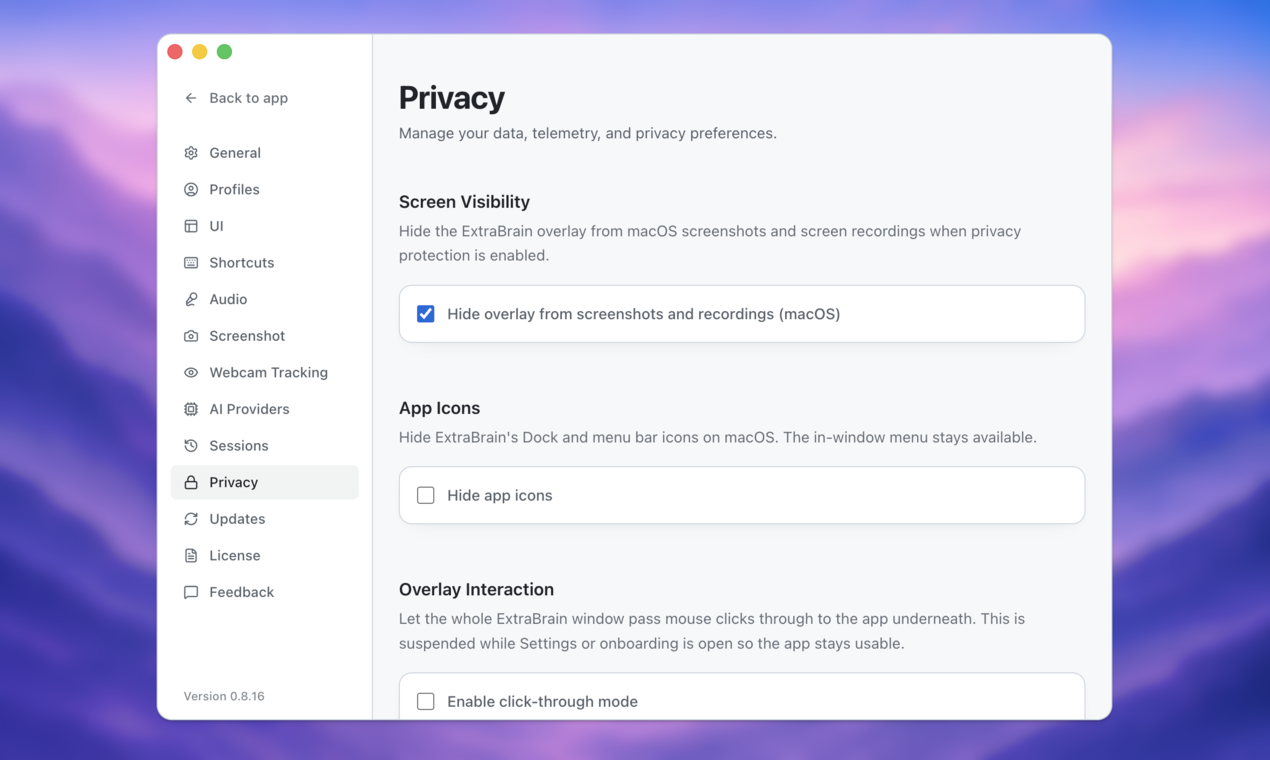
ExtraBrain can use local Parakeet transcription and local Gemma 4 on-device AI where installed and compatible. A fully local ExtraBrain posture requires local Parakeet transcription plus local Gemma 4 with no external provider requests.
ExtraBrain also supports bring-your-own AI providers, including Anthropic, OpenAI, custom OpenAI-compatible endpoints, Claude Subscription, and Codex Subscription. When you use external providers, selected prompts, transcript text, screenshots, audio, or context may leave your device depending on configuration.
Choose the setup that matches your rules, sensitivity level, and hardware. For school exams and high-stakes assessments, be especially conservative.
FAQ
What is the best way to test my device settings before a Smowl exam?
Use the official practice flow if the institution provides one. Check your browser, camera, microphone, lighting, notifications, and allowed materials in the same setup you will use for the real exam.
Do not test hidden bypass tactics. Test that your compliant setup works cleanly.
What happens if Smowl catches cheating?
The consequence depends on the school, employer, certification body, or platform. It can include a flagged report, a lost score, a required retake, academic discipline, hiring rejection, certification consequences, or other penalties.
The safest assumption is that cheating can create a permanent record in the assessment process.
Can I use my phone during a Smowl proctored exam?
Only if the exam rules explicitly allow it. Many proctored exams prohibit phones, tablets, smartwatches, headphones, and second laptops.
If your phone is not allowed, keep it away from the exam area and silence notifications before the session starts.
Is it possible to bypass Smowl without technical skills?
People discuss hidden notes, second devices, room positioning, and other non-technical tactics, but those methods can still be detected and can still violate the rules. They are not a reliable or responsible plan.
Use non-technical preparation instead. Practice aloud, clean your environment, study weak areas, and make sure your approved setup is ready.
Does Smowl record everything during the exam?
The exact recording scope depends on the institution and configuration. Smowl-style proctoring may involve webcam images or video, screen activity, audio, browser events, device activity, screenshots, logs, and post-exam reports.
Read the exam notice and privacy information before the assessment.
Can ExtraBrain help with Smowl-style assessments?
Yes, but only in allowed contexts. ExtraBrain can help you prepare before a Smowl-style assessment, practice answers, review technical material, organize notes, and debrief afterward.
During a live assessment, use ExtraBrain only if the rules allow AI assistance, transcription, screenshots, notes, or related support.