
ExtraBrain Blog
How I Use an Online AI Exam Assistant to Study Smarter in 2026

Use an online AI exam assistant for study prep, practice feedback, lecture review, and responsible test readiness with ExtraBrain.
Online AI exam assistant tools have changed how students prepare for quizzes, timed assessments, certification practice, and final exams. The best use is not to outsource learning or break exam rules. The best use is to turn lectures, notes, screenshots, practice questions, and rough explanations into a clearer study workflow before the assessment begins.
That is where ExtraBrain fits especially well for Mac users. ExtraBrain is a free, local-first desktop AI interview assistant and meeting copilot that can also support lectures, research calls, study sessions, coding practice, system design practice, and post-session review. It gives you live transcription, screen-aware context, local-first options, bring-your-own AI providers, and privacy controls, while keeping you responsible for following school, workplace, exam, and platform rules.
Choosing an online AI exam assistant
Essential features
In 2026, the most useful online AI exam assistant is not the loudest tool. It is the tool that helps you understand material faster, practice more honestly, and review your reasoning with less friction.
For exam preparation, I look for five essentials.
- Live transcription so lectures, tutoring calls, study groups, and spoken practice answers become searchable notes.
- Screen-aware context so the assistant can help explain diagrams, code snippets, slides, rubrics, or practice prompts that are already on my screen.
- Local-first privacy options so sensitive study notes and transcripts can stay on device when configured with local transcription and local AI.
- Provider choice so I can use local Gemma 4 where installed and compatible, or connect providers such as OpenAI, Anthropic, custom OpenAI-compatible endpoints, Claude Subscription, or Codex Subscription when allowed and appropriate.
- Post-session review so I can compare what I said, what I missed, and what I need to practice again.
ExtraBrain is available for macOS today, including Apple Silicon and Intel Macs. Windows and Linux are planned, so the strongest fit right now is students and professionals who already study on a Mac.

Matching your learning style
A good AI exam assistant should adapt to the way you learn. It should not force every student into the same workflow.
If you are studying STEM subjects, you may need help breaking down formulas, graphs, code, diagrams, and multi-step problem solving. ExtraBrain’s screen-aware context can help you discuss what is visible in a study session, then ask for step-by-step explanations or alternative ways to reason through the problem.
If you are studying humanities, business, law, communications, or social sciences, you may need help turning rough ideas into clearer arguments. You can practice aloud, capture a transcript, then ask for a cleaner outline, a stronger thesis, or a list of unsupported claims to review.
If you are preparing for oral exams, interviews, presentations, or live assessment conversations, transcription is especially useful. You can hear yourself explain a topic, then review where your answer wandered, where you skipped evidence, and where you sounded uncertain.
Comparing your options
Most students see three categories of AI exam help. Each has a different risk profile and a different responsible use case.
| Option | Best responsible use | Watch out for |
|---|---|---|
| Browser extensions | Quick study summaries, flashcards, grammar checks, and practice explanations in normal browsing sessions | Limited context outside the browser and possible conflicts with school or exam platform rules |
| Desktop AI assistants | Lectures, research calls, PDFs, coding practice, screen-based study, mock interviews, and review workflows across apps | You still need to follow all assessment, meeting, privacy, and recording rules |
| Human tutoring plus AI notes | Deep concept repair, feedback on weak areas, and accountability | Higher cost and slower iteration than self-guided practice |
A desktop assistant like ExtraBrain is strongest when your study context is spread across many places. That might include a Zoom lecture, a PDF syllabus, a browser-based practice set, a notes app, a coding editor, and a whiteboard diagram.
Setting up ExtraBrain for exam preparation
Build a preparation workspace
Before using any AI assistant, create a clean study workspace. Open only the materials you are allowed to use for preparation. Keep your lecture notes, practice questions, rubric, syllabus, and textbook excerpts organized.
Then decide what you want ExtraBrain to help with. Good preparation prompts include:
- “Turn this lecture transcript into a study guide with likely exam themes.”
- “Explain this formula from first principles and show a simpler example.”
- “Ask me five practice questions about the screen content, then wait for my answer.”
- “Identify the weakest assumptions in my essay outline.”
- “Compare my spoken answer with a stronger answer structure.”
- “Create a spaced repetition checklist from this transcript.”
This is more useful than asking for final answers. It trains recall, reasoning, and explanation.
Configure privacy intentionally
Exam preparation often involves sensitive information. Your notes may include school materials, private instructor feedback, unpublished assignments, screenshots, or personal performance data.
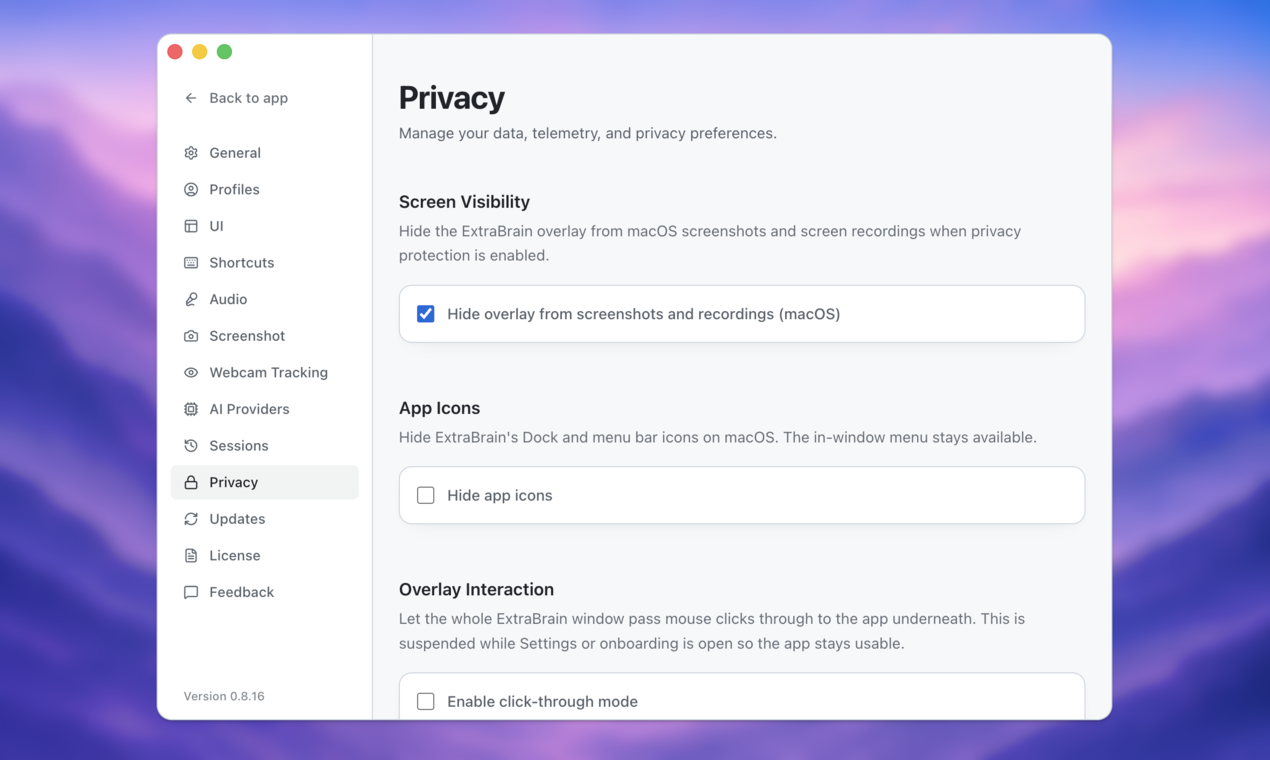
ExtraBrain gives you privacy controls and local-first options. A fully local posture requires local Parakeet transcription plus local Gemma 4 on-device AI where installed and compatible, with no external provider requests. If you choose an external provider, selected prompts, transcript text, screenshots, audio, or context may leave your device depending on configuration.
That choice should be deliberate. Use local options when you want the strongest privacy posture available in your environment. Use external providers only when the rules, data sensitivity, and your own comfort level allow it.
Use screen context for practice, not rule-breaking
ExtraBrain is designed to stay hidden from screen sharing and screen recording on major meeting tools, but that does not mean you should use it where assistance is prohibited. The responsible rule is simple. Use AI only where your school, instructor, employer, certification body, meeting host, or platform allows AI assistance, transcription, screenshots, or notes.
For many students, that means using ExtraBrain before the exam, after the exam, or during open-resource study sessions. It can help you prepare for closed-book exams without crossing a line during the exam itself.
Study and exam prep workflows with an AI assistant
Practice aloud and review the transcript
One of the highest-value workflows is active recall. Instead of rereading notes, explain the concept out loud as if you were teaching it. Let ExtraBrain capture the transcript during an allowed practice session. Then ask it to identify gaps.
Useful prompts include:
- “Where did my explanation become vague?”
- “What prerequisite concept am I missing?”
- “Turn my answer into a clearer three-part explanation.”
- “What would an instructor likely mark down here?”
- “Give me a follow-up question that tests the same concept from another angle.”
This is especially helpful for topics that feel familiar until you try to explain them. The transcript makes fuzzy knowledge visible.
Turn rough notes into practice loops
An online AI exam assistant should not only summarize. It should help you loop through practice.
A strong loop looks like this:
- Record or transcribe a lecture, study group, or solo explanation.
- Ask for the core concepts and likely confusion points.
- Generate practice questions from the material.
- Answer from memory without looking.
- Compare your answer against the rubric or source notes.
- Ask for a shorter correction plan.
- Repeat the weak sections two or three days later.
This turns AI from a shortcut into a feedback engine.
Use personalized prompts
Personalization matters because every course has its own language. A finance class may care about assumptions and formulas. A literature class may care about evidence and interpretation. A computer science class may care about tradeoffs, complexity, and edge cases. A product management course may care about prioritization and user impact.
Here are prompt patterns I would save for exam prep.
| Study goal | Prompt pattern |
|---|---|
| Concept repair | ”Explain this like I know the vocabulary but not the underlying mechanism.” |
| Coding practice | ”Review my solution for correctness, edge cases, time complexity, and explanation quality.” |
| Essay prep | ”Turn my rough thesis into three possible argument structures and list the evidence each one needs.” |
| Math reasoning | ”Show the reasoning step by step, then give me a similar problem without the answer.” |
| Oral exam practice | ”Ask one question at a time, wait for my answer, then grade clarity, accuracy, and confidence.” |
| Lecture review | ”Convert this transcript into a study guide, a glossary, and ten practice questions.” |
The goal is not to make every answer sound like AI. The goal is to make your own understanding more durable.
Responsible use and exam integrity
Know the rules before you use AI
Every assessment has its own rules. Some instructors allow AI for brainstorming and practice but not for graded work. Some allow grammar support but not answer generation. Some allow open-resource exams but prohibit live outside help. Some certification exams prohibit all assistance, recording, screen capture, transcription, or secondary devices.
Read the policy before using any tool. If the policy is unclear, ask before the exam.
ExtraBrain should be used only where interview, employer, school, workplace, meeting, and platform rules allow AI assistance, transcription, screenshots, or notes. That is not a footnote. It is the foundation of responsible use.
Avoid dependency
AI can make practice easier, but it can also hide weak understanding if you lean on it too much. Use a mix of assisted and unassisted study.
A simple rule works well. Use AI to explain, quiz, critique, and organize. Do unassisted recall to prove that the knowledge is yours.
Try this ratio during the week before an exam:
- 40 percent AI-assisted review and feedback.
- 40 percent unassisted practice problems or recall.
- 20 percent error review and targeted re-study.
If you cannot explain the concept without the assistant, you are not ready yet.
Use AI to improve judgment
The best students do not blindly accept AI output. They verify it.
When ExtraBrain gives an explanation, ask follow-up questions. Ask for assumptions. Ask for counterexamples. Ask it to solve the same problem another way. Ask it to point out where an answer might be incomplete.
This matters because AI systems can be wrong. A confident answer is not the same as a correct answer.
Results and common challenges
What improvement can look like
The biggest improvement is usually not a magical score jump. It is a better study process.
You notice weak topics earlier. You stop rereading notes passively. You practice explanations instead of memorizing phrases. You turn lecture recordings into searchable review material. You walk into the exam with clearer mental models.
That can absolutely improve grades, but the improvement comes from better preparation and feedback. It does not require breaking rules during the assessment.
Common obstacles
Students usually run into four problems.
- Too much material makes it hard to know what to study first.
- Passive review creates a false sense of confidence.
- AI overreliance makes answers look polished while understanding stays shallow.
- Privacy uncertainty makes students unsure what can safely be shared with external providers.
ExtraBrain helps most when you use it to organize, practice, transcribe, and review. It is not a replacement for learning the material.
Practical fixes
If you have too much material, ask for a ranked study plan from your transcript and syllabus. If you are stuck in passive review, switch to practice questions and spoken recall. If your answers sound generic, ask ExtraBrain to compare them against your own notes and course vocabulary. If privacy matters, configure local Parakeet transcription and local Gemma 4 where installed and compatible, or avoid sending sensitive context to external providers.
A practical ExtraBrain exam prep routine
Here is a simple routine for the final five days before an online exam.
Five days before
Collect lectures, notes, slides, rubrics, and previous practice questions. Use ExtraBrain to turn them into a topic map and a weak-area checklist.
Four days before
Practice the hardest concepts aloud. Review the transcript and ask for gaps, missing definitions, and unclear reasoning.
Three days before
Generate practice questions from your notes. Answer without looking. Then compare your answers with the source material and revise only the weak sections.
Two days before
Do a timed mock exam using only resources allowed by your course rules. Use ExtraBrain afterward to analyze mistakes and build a final review list.
One day before
Do light recall, definitions, formulas, examples, and sleep. Do not try to outsource understanding at the last minute.
FAQ
What is an online AI exam assistant?
An online AI exam assistant is an AI tool that helps with exam-related workflows such as lecture review, study planning, practice questions, explanation feedback, and note organization. ExtraBrain can support this workflow as a Mac desktop app with live transcription, screen-aware context, local-first options, and bring-your-own providers.
Can ExtraBrain help during an online exam?
Only use ExtraBrain during an online exam if your school, instructor, exam provider, employer, or platform rules clearly allow AI assistance, transcription, screenshots, and notes. If the rules do not allow it, use ExtraBrain before or after the exam for preparation and review instead.
Can ExtraBrain run fully local?
A fully local ExtraBrain posture requires local Parakeet transcription plus local Gemma 4 on-device AI where installed and compatible, with no external provider requests. External providers may receive selected prompts, transcript text, screenshots, audio, or context depending on your configuration.
What if the AI gives me wrong feedback?
Treat AI feedback as a study aid, not as an authority. Check answers against your course materials, instructor guidance, textbook, official documentation, or worked examples. Ask the assistant to show assumptions and alternative reasoning so you can evaluate the answer instead of copying it.
How do I avoid depending too much on AI?
Separate assisted review from unassisted recall. Use ExtraBrain to explain, quiz, critique, and organize. Then close the assistant and prove that you can answer from memory.
Is ExtraBrain free?
The core ExtraBrain Mac app is free. ExtraBrain Pro is available at $9.99 per month, $79 per year, or $149 Lifetime launch pricing. External AI and transcription provider usage is billed separately by the providers you choose.