
ExtraBrain Blog
Is Interview Coder Legit? Who Runs It and Why Sales Are Final
Short answer
Interview Coder is a real app from Interview Coder, Inc., created by Roy Lee, who later co-founded Cluely. It is legitimate as a business, but expensive and strict: Pro costs $299 a month or $799 for lifetime access, its refund page says all sales are final, and that page describes the product as lifetime-only even though a monthly plan is on sale. We found no Trustpilot profile for it on November 21, 2026.
Who is behind Interview Coder, what the $299 monthly and $799 lifetime plans include, why its refund page contradicts its pricing, and what review sites show.
ExtraBrain makes a competing product; we checked every claim below against public sources on November 21, 2026.
Interview Coder is probably the most famous tool in this category, for reasons its makers would happily tell you about. That fame doesn’t answer what a buyer actually needs to know: who you’re paying, whether you can get money back, and what happens to your code and screenshots. Those answers are on its own legal pages, and some of them disagree with each other.
Who built it and who runs it now
In March 2025, NBC News reported that Chungin “Roy” Lee, then a Columbia undergraduate, created Interview Coder as a desktop app for solving technical interview questions, recorded himself using it in an Amazon internship interview, and was put through a disciplinary process that he said ended in a yearlong suspension. At the time, Lee told NBC the app was already making $170,000 a month in subscriptions. As TechCrunch reported, Lee went on to co-found Cluely after the suspension.
Today the Terms of Service and Privacy Policy name Interview Coder, Inc., based in the United States. The terms send legal notices to 520 Bryant St, San Francisco, choose Delaware law, and require individual arbitration under JAMS rules. You can opt out of arbitration by mailing written notice within 30 days of first accepting the terms. One more clause is worth knowing: if you sign up with an employer’s email address, the terms say you are deemed to represent that employer and your acceptance binds it, so use a personal address. Support runs through an email address on interviewcoder.com, while the site itself lives on interviewcoder.co.
Two details connect it with Cluely. Cluely’s own terms list the same 520 Bryant St address for notices, and Cluely’s help center refund article refers interview use cases to “standalone product, Interview Coder.” Neither company’s pages describe the corporate relationship further.
Pricing, and a refund page that disagrees with it
The homepage listed three options:
| Plan | Price shown | What it says you get |
|---|---|---|
| Free Download | $0 forever | Explore the app; AI features need a paid plan |
| Monthly Pro | $299/month | Shown against an “original” $499; 1,000 usage credits a month |
| Lifetime Pro | $799 one-time | Shown against an “original” $1,598; unlimited lifetime access |
The refund and cancellation policy says Interview Coder “operates on a no-refund policy for all purchases” and that “all sales are final.” Its justification is that the product is a one-time lifetime purchase with “no recurring billing or subscription fees.” That doesn’t match the $299 monthly plan on the homepage, or the FAQ, which says AI features need “a subscription (monthly or lifetime).”
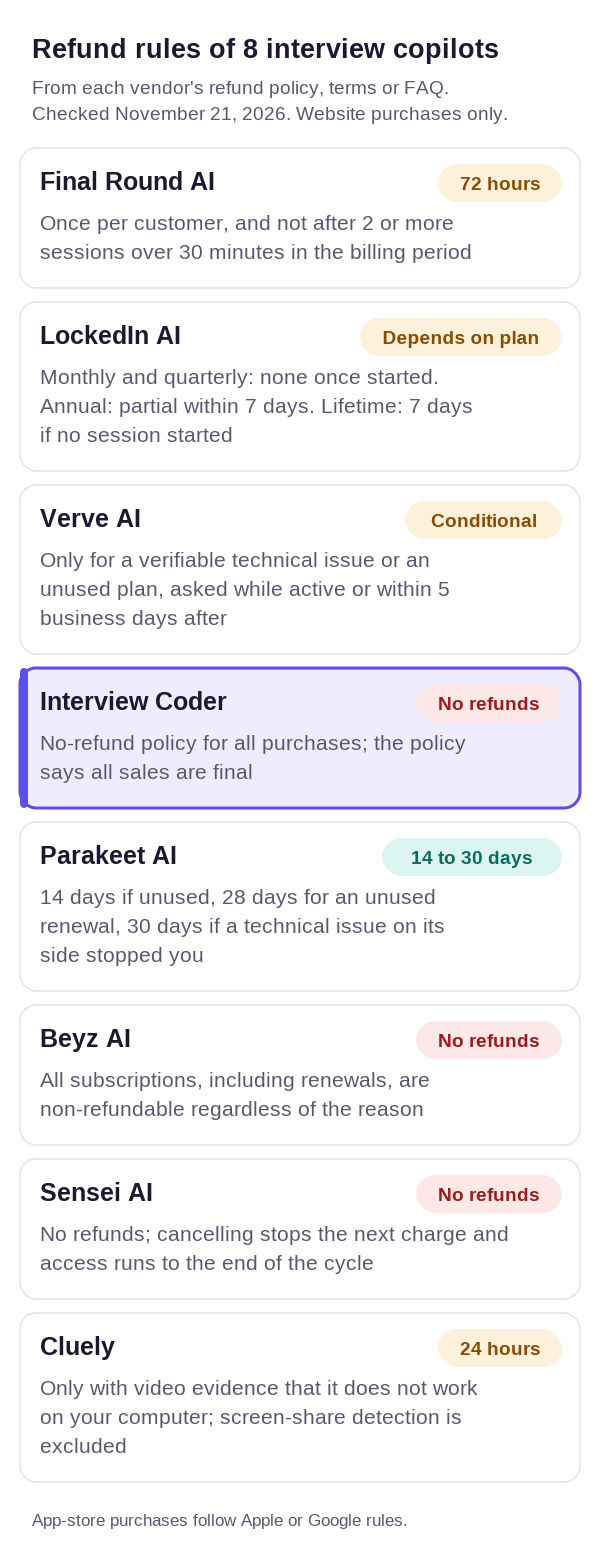
The FAQ’s own refund answer is vaguer still: if you’re not satisfied, contact support and they’ll work with you. If you buy, assume the written policy applies and that a monthly charge won’t come back. Use the free download to check that it installs and runs on your machine first, since that’s the one thing the policy explicitly invites you to test.
What happens to your data
The privacy policy says customers may submit audio recordings, transcriptions and screenshots, and that this data is governed by the terms. The terms are specific on training. For Free and Pro accounts, you grant Interview Coder and its sub-processors permission to use your data to train their AI and machine learning models. Only Enterprise customers are excluded by default.
In other words, the screenshots of the problems you solve and the code you write can become training data. The policy also says you can ask for your personal information to be deleted by email, and that account deletion is available from your account page. Even then, it reserves the right to keep deleted information in de-identified and aggregated form, or in archived and backup copies, and it doesn’t give a retention period for recordings or screenshots.
Reviews and claims you can’t check
The homepage says the app is “used by 150,000+ candidates” and shows a wall of cards claiming salaries at named employers, such as a $234k job at Apple. There’s no way to verify those cards from the page.
Independent reviews are thin. Trustpilot returned “page not found” for interviewcoder.co when we checked on November 21, 2026, and its search didn’t surface a profile for the product. G2 blocked our automated check. So the public record is mostly the press coverage around its launch and the company’s own claims.
The risk that matters more than the refund
Interview Coder’s marketing is built around interviewers not noticing it. The bigger question is whether the employer allows AI help at all. In the same NBC report, an Amazon spokesperson said candidates must acknowledge they won’t use unauthorized tools, such as generative AI, during interviews or assessments. Lee said several companies rescinded offers after he posted about his use of the tool. A product can be a legitimate business and still put your candidacy at risk if you use it where it isn’t allowed.
Before you spend $299
If you still want to buy after reading the policies, a few steps protect you:
- Install the free download on the exact computer you’ll interview on. The homepage FAQ lists known issues, including network errors on Intel Macs, so confirm it works before paying.
- Check whether your target employer allows AI help in the round. The invitation, the recruiter or the assessment’s instructions will usually say.
- Pick monthly or lifetime knowing that neither is refundable under the written policy.
- Save a copy of the refund page and your receipt on the day you buy, given that the page and the pricing disagree.
- Mail the arbitration opt-out within 30 days if you want to keep the option of going to court.
What it gets right, and where to compare
Interview Coder deserves credit for a real free download that lets you test compatibility before paying, published terms with an arbitration opt-out, and support for both Apple Silicon and Intel Macs as well as Windows.
Our Interview Coder review covers the product itself, and a better Interview Coder alternative looks at other coding workflows. The Interview Coder alternatives page and the ExtraBrain vs Interview Coder comparison set out pricing side by side; ExtraBrain’s core desktop app is free on Mac and Windows. For the Cluely side of the story, see Is Cluely still built for interviews?
FAQ
Is Interview Coder a scam?
No. It’s a real app from a named company with published terms. The issues are price, a strict no-refund policy that contradicts its own pricing page, and the risk of using it where an employer forbids AI help.
Can I get a refund from Interview Coder?
Its refund policy says no refunds on any purchase. The FAQ suggests contacting support, but the written policy is the one to plan around.
Who owns Interview Coder?
Its terms name Interview Coder, Inc. NBC News reported that Roy Lee created the app, and TechCrunch reported that he went on to co-found Cluely.
Does Interview Coder use my data for training?
Its terms say Free and Pro users grant permission to use their data to train its models and its sub-processors’ models.
Sources (checked November 21, 2026)
- Interview Coder Terms of Service
- Interview Coder Privacy Policy
- Interview Coder refund and cancellation policy
- Interview Coder homepage and pricing
- Interview Coder FAQ
- NBC News on Roy Lee and Interview Coder
- TechCrunch on Cluely and Roy Lee, March 5, 2026
- Cluely help center: refund policy
- Cluely Terms of Service