
ExtraBrain Blog
Sensei AI Review: Is It Practical for Interviews in 2026?

A practical Sensei AI review for 2026 covering live interview help, usability, privacy, pricing, refunds, and ExtraBrain as an alternative.
Sensei AI is one of the better-known AI interview assistant names for candidates who want real-time help during mock interviews, recruiter screens, behavioral rounds, and technical conversations. This Sensei AI review looks at the same core question many candidates have in 2026: does it actually help under interview pressure, or does the workflow create new risks?
The short answer is that Sensei AI can be useful for structured practice and fast answer drafting, especially when you want help turning your resume and target role into interview-ready talking points. The bigger question is whether its live workflow fits the way real interviews happen, especially when screen sharing, browser tabs, meeting windows, and platform rules are involved.
This review covers firsthand-style evaluation criteria: setup, real-time assistance, personalization, detection and visibility concerns, video meeting usability, pricing, refund friction, and when a local-first desktop tool like ExtraBrain may be a better fit.
Responsible use matters throughout. Use any AI interview assistant only where interview, employer, school, workplace, meeting, and platform rules allow AI assistance, transcription, screenshots, or notes.
Sensei AI at a glance
Sensei AI is positioned as an AI interview copilot that listens to interview questions, transcribes context, and suggests structured answers. In practice, the most useful parts are the speed of transcription, the resume-aware prompts, and the emphasis on clear answer frameworks like STAR.
The parts that need closer evaluation are the live window experience, whether the tool interrupts your flow, what happens during screen sharing, how easy it is to start the copilot at the right time, and whether the pricing and refund experience feel low-risk enough for a candidate.
| Review area | Sensei AI impression | What to check before relying on it |
|---|---|---|
| Real-time answers | Fast suggestions after questions are captured | Whether the answer style sounds like you |
| Transcription | Clear and quick in many interview-like scenarios | Whether accents, audio quality, and meeting noise affect accuracy |
| Personalization | Resume and role details can improve relevance | Whether answers still need heavy editing |
| Live workflow | Helpful in mock settings, but can feel visually busy | Whether the overlay or tab workflow gets in the way |
| Screen sharing | Needs careful testing before any high-stakes use | Whether your interview rules allow the tool at all |
| Pricing and refunds | Must be checked against current terms | Whether refund access and support are clear before purchase |
Firsthand workflow impressions
Setup and onboarding
A strong interview assistant should be easy to start when you are nervous. If the tool asks for your role, resume, company, and interview context, that can be helpful, but only if the setup feels controlled rather than distracting.
Sensei AI appears designed around this profile-first idea. You provide context about the job and your background, then the system uses that information to shape live answers. That is a sensible workflow for mock interviews and recruiter screens because generic AI advice is usually less helpful than role-specific guidance.
The tradeoff is friction. If you only want to jump into a practice session, profile setup can feel like another thing to manage. If you are preparing for a real interview, though, this same setup can help the assistant produce answers that better match your resume, projects, and target role.
Real-time interview assistance
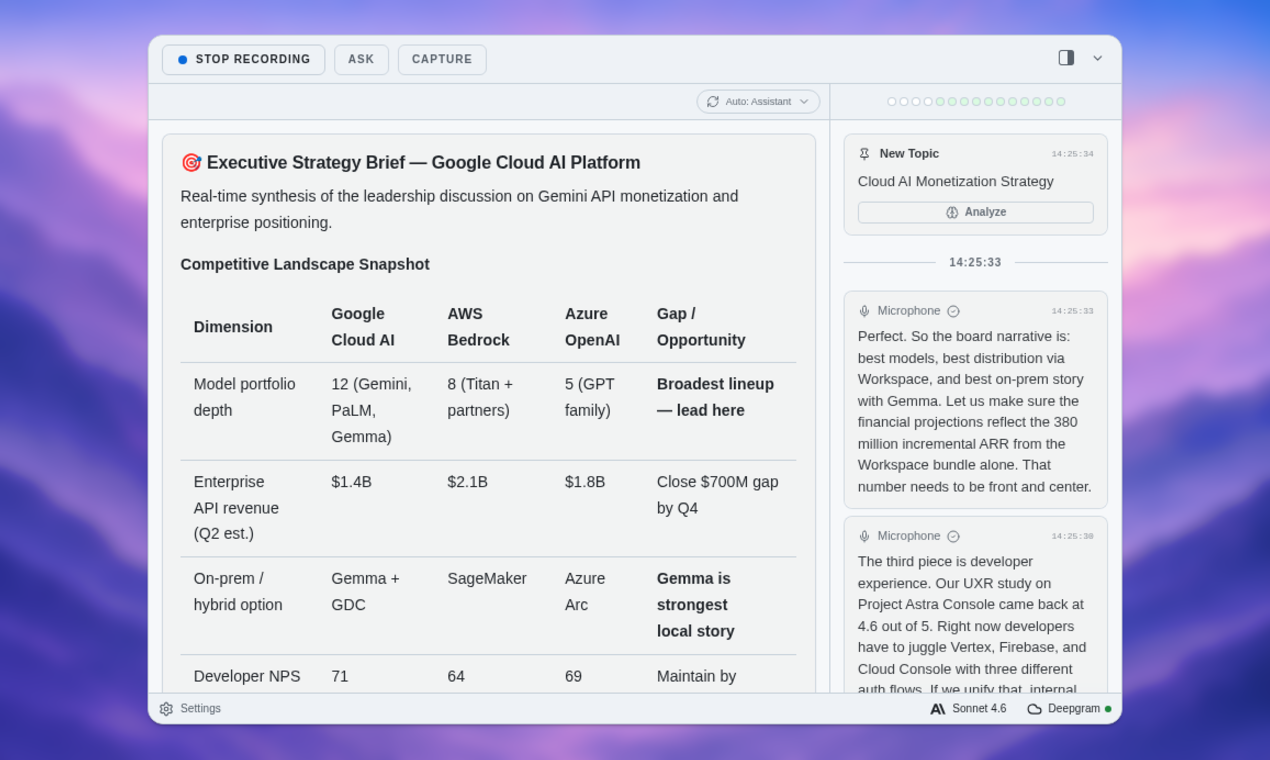
The strongest part of Sensei AI is the promise of real-time structure. When a question comes in, the tool can transcribe it and propose a response outline quickly. For behavioral questions, that can mean a STAR-shaped answer. For role-fit questions, it can mean a concise narrative based on your uploaded background. For technical questions, it can mean a list of concepts, tradeoffs, or next steps.
That is useful during practice because it helps you see what a strong answer could include. It is less useful if you read the answer word for word. Interviewers usually notice when a candidate stops thinking aloud and starts reciting polished text.
A better use is to treat the AI output as scaffolding. Take the structure, adapt it to your own words, and keep the conversation natural.
Personalized answer generation
The personalization concept is valuable. A good AI interview copilot should know the role you are targeting, the projects you want to emphasize, the technical stack you know, and the stories you want to reuse.
Sensei AI can turn job and resume context into more specific answers than a blank chatbot. That said, personalization is not the same as authenticity. Even with a resume uploaded, AI-generated answers can sound too smooth, too broad, or too detached from how you actually speak.
Before using any answer in an interview, ask three questions:
- Is this true to my actual experience?
- Can I explain every detail if the interviewer follows up?
- Does this sound like something I would naturally say aloud?
If the answer fails any of those tests, rewrite it. An AI assistant should help you remember, structure, and clarify your own experience, not invent a candidate who does not exist.
Detection, visibility, and screen sharing concerns
Many AI interview tools market themselves around being hard to notice. That framing can be misleading because there are several different issues hidden inside the word “detected.”
There is platform detection, such as tab switching, focus loss, copy-paste patterns, or browser extension behavior. There is human visibility, such as an interviewer seeing a window, answer panel, cursor movement, or awkward eye movement. There is policy detection, where the issue is not whether the tool is visible but whether the rules allowed it in the first place.
Those are separate risks. A tool can be technically hidden and still violate an interview rule. A tool can be allowed for note-taking and still become distracting if it changes how you speak.
Common monitoring signals in online interviews
Online interview and assessment environments may notice or expose different behaviors depending on the platform and meeting setup. Candidates should understand these categories before using any live assistant:
- Screen sharing can reveal visible windows, tabs, overlays, browser content, or desktop activity.
- Tab switching or window focus changes may be logged by some browser-based assessment tools.
- Webcam behavior can make constant off-screen reading look unnatural.
- Large code pastes can create suspicion during coding interviews.
- Sudden answer perfection can feel inconsistent with a candidate’s earlier thinking process.
The responsible conclusion is not “find a tool that bypasses everything.” The responsible conclusion is to know the rules, practice honestly, and use AI only in allowed ways.
Why desktop workflow matters
A browser or tab-based workflow can become awkward during live interviews because the candidate has to manage the meeting, the assessment page, the prompt, the transcript, and the generated answer at the same time. That is a lot of surface area under pressure.
A desktop app can reduce that friction when it is designed around live context rather than browser switching. ExtraBrain is built as a Mac desktop AI interview assistant and meeting copilot with live transcription, screen-aware context, local-first options, bring-your-own AI providers, and post-session review. It is designed to stay hidden from screen sharing and screen recording on major meeting tools, while users remain responsible for following all interview, workplace, school, and platform rules.
Video platform experience
Sensei AI is often evaluated in the context of Zoom, Google Meet, Microsoft Teams, and similar meeting tools. The important question is not just whether it can run alongside a meeting. The important question is whether it lets you stay present in the conversation.
During a live interview, you need to do several things at once:
- Listen to the full question.
- Maintain normal conversational rhythm.
- Think through your answer.
- Watch for interviewer reactions.
- Handle screen sharing or coding tasks if needed.
- Avoid reading in a way that looks scripted.
If the assistant panel gets in the way, requires tab switching, or forces constant mouse movement, the tool may help with content while hurting delivery. That is a real tradeoff.
For practice sessions, this may be acceptable. For high-stakes interviews, any tool that changes your body language, attention, or pacing should be tested carefully before the day of the interview.
Sensei AI pros
Fast structured suggestions
Sensei AI’s core appeal is speed. When the question is captured cleanly, quick bullet points can help you avoid freezing. That matters most in behavioral interviews, product sense discussions, and recruiter screens where structure is often half the battle.
Fast AI suggestions can also help you recover when you understand the question but cannot immediately organize your answer. Instead of rambling, you can glance at a structure and then respond in your own words.
Resume-aware personalization
A resume-aware assistant is more useful than a generic chatbot. If the tool knows your projects, role target, and company context, it can suggest examples that are at least closer to your actual background.
This is especially helpful for candidates who have strong experience but struggle to select the right story quickly. The best use case is not outsourcing the answer. The best use case is surfacing the right memory at the right moment.
STAR format support
The STAR format is still useful for behavioral interviews because it keeps stories from becoming vague. A good STAR answer covers the situation, task, action, and result without turning into a rehearsed monologue.
Sensei AI’s structured answer style can help candidates practice this muscle. The key is to keep results specific and truthful. If the AI suggests a metric, result, or responsibility that is not yours, remove it.
Sensei AI cons
Workflow can feel confusing under pressure
Live interview tools need obvious controls. If it takes too long to find the start button, launch the copilot, adjust the window, or understand which panel matters, that friction becomes part of the interview experience.
A confusing workflow is not a small issue. Under pressure, three seconds can feel long. A candidate who is looking for a button is not listening fully to the interviewer.
Generated answers may sound too AI-written
Even personalized AI answers can sound generic. They may include polished phrases, broad claims, or unnatural transitions that do not match your voice. That can be a problem in real interviews because authenticity matters.
The fix is to practice with the tool before the interview. Build a library of your own stories, rewrite suggested answers in your own style, and learn how to use outlines rather than scripts.
Live panels can interrupt focus
Any movable panel, browser tab, or overlay can become a distraction. If you have to keep repositioning it, the tool is competing with the interview. If it blocks the meeting, code editor, or prompt, it can make you slower rather than faster.
This is why the best AI interview assistant workflow is often quiet and context-aware. The tool should help you think, not make you manage another interface.
Pricing and refund considerations
Pricing for AI interview tools changes frequently, so candidates should verify Sensei AI’s current plan details directly before buying. Do not rely on screenshots, old reviews, or social posts for subscription terms.
The same advice applies to refunds. Before paying for any interview assistant, check:
- Whether there is a free trial or free tier.
- Whether monthly plans are refundable.
- Whether annual plans have different refund rules.
- Whether refund requests require a form, email, chat, or support portal.
- Whether the support channel is accessible before purchase.
- Whether external AI provider usage creates separate costs.
ExtraBrain’s core Mac app is free. ExtraBrain Pro is $9.99/month, $79/year, or $149 Lifetime launch pricing. External AI and transcription provider usage is billed separately by the providers users choose.
Where ExtraBrain fits as an alternative
ExtraBrain is a free, local-first desktop AI interview assistant and meeting copilot for Mac. It supports live transcription, screen-aware context, local Gemma 4 on-device AI where installed and compatible, bring-your-own AI providers, and clear privacy controls.
That makes it especially relevant for candidates who do not want their interview workflow trapped inside browser tabs. It also works beyond interviews, including meetings, lectures, research calls, coding discussions, system design practice, and post-session review.
Local-first privacy posture
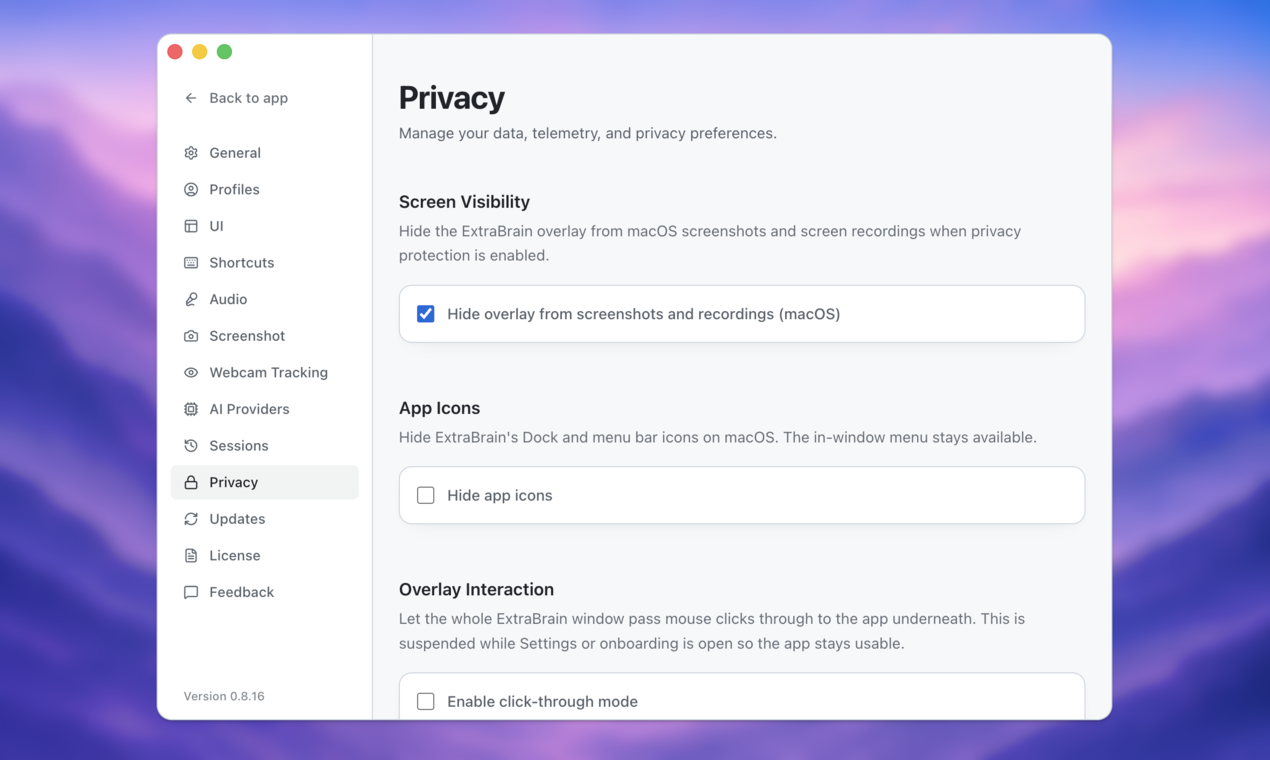
A fully local ExtraBrain posture requires local Parakeet transcription plus local Gemma 4 on-device AI where installed and compatible, with no external provider requests. When external providers are selected, prompts, transcript text, screenshots, audio, or other context may leave the device depending on configuration.
That distinction matters. Privacy is not a slogan. It is a configuration choice that depends on transcription mode, model provider, screenshots, audio handling, and user settings.
Provider control
ExtraBrain supports local Gemma 4, Anthropic, OpenAI, custom OpenAI-compatible endpoints, Claude Subscription, and Codex Subscription. This bring-your-own-provider model gives users more control over cost, latency, privacy posture, and model behavior.
For candidates preparing for different interview types, this can be useful. A coding interview may need a different model and prompt style from a behavioral interview. A system design session may need longer context and tradeoff reasoning. A recruiter screen may need concise and warm answer structure.
Coding and system design support
Sensei AI’s broad interview support may be enough for general practice. For technical interviews, the workflow matters more because you may need to follow a prompt, inspect code, explain tradeoffs, and keep talking.
ExtraBrain is built for coding interviews, system design rounds, behavioral interviews, and product interviews. Screen-aware context can help the assistant understand what is visible during a session, while live transcription preserves what was said.
This is useful when you want help with:
- Clarifying the problem statement.
- Explaining edge cases.
- Comparing system design tradeoffs.
- Turning scattered thoughts into a structured answer.
- Reviewing the transcript after the interview.
Sensei AI vs ExtraBrain
| Category | Sensei AI | ExtraBrain |
|---|---|---|
| Primary fit | AI interview assistance and practice | Mac desktop AI interview assistant and meeting copilot |
| Platform model | Reviewers often evaluate it around web or browser-style live workflows | Local-first desktop app for macOS today, with Windows and Linux planned |
| Transcription | Real-time transcription for interview questions | Local NVIDIA Parakeet and optional Deepgram |
| AI providers | Check current Sensei AI provider details directly | Local Gemma 4 where installed and compatible, Anthropic, OpenAI, custom endpoints, Claude Subscription, and Codex Subscription |
| Privacy posture | Verify current data handling and provider behavior | Can be fully local with local Parakeet plus compatible local Gemma 4, or external depending on configuration |
| Pricing | Verify current Sensei AI pricing before purchase | Free core app, with Pro options available |
| Best use | Mock interviews and structured answer practice | Live sessions, technical interviews, meetings, transcripts, screen context, and review |
Who Sensei AI may be best for
Sensei AI may be a reasonable fit if you mainly want structured interview practice and quick answer suggestions. It is most useful when you have time to edit the output, practice aloud, and turn AI-generated bullets into your own language.
It may also be helpful if you are preparing for common behavioral questions and want a tool that keeps pushing you toward organized answers. For this use case, the tool does not need to be perfect during a live interview because the main value happens during practice.
Who should consider ExtraBrain instead
ExtraBrain is a stronger fit if you want a Mac desktop workflow that covers live interviews and meetings, not just answer generation. It is also better aligned with users who care about local-first options, provider control, screen-aware context, transcripts, and post-session review.
Consider ExtraBrain if you want:
- A free core desktop app for Mac.
- Live transcription during interviews and meetings.
- Screen-aware context for technical and product discussions.
- Local Parakeet transcription.
- Local Gemma 4 on-device AI where installed and compatible.
- Bring-your-own AI provider flexibility.
- A workflow that also helps after the interview, not only during it.
Final verdict
Sensei AI can be useful for interview practice, fast transcription, structured answer drafting, and resume-aware preparation. Its main weaknesses are workflow friction, answer authenticity, live visibility concerns, and the need to verify pricing and refund terms before paying.
For mock interviews, Sensei AI may help candidates practice better structure. For real interviews, the decision is more sensitive because live tools can affect attention, delivery, screen sharing, and rule compliance.
ExtraBrain is the better fit for Mac users who want a free, local-first desktop AI interview assistant and meeting copilot with live transcription, screen-aware context, provider control, privacy settings, and post-session review. Use it responsibly, follow the rules of the interview or meeting, and treat AI as a thinking aid rather than a replacement for your own judgment.
FAQ
Is Sensei AI good for interview practice?
Sensei AI can be useful for interview practice if you want quick transcription, structured answer outlines, and resume-aware suggestions. It works best when you rehearse with the output and rewrite answers in your own voice.
Is Sensei AI safe to use during real interviews?
That depends on the rules of the interview and the meeting or assessment platform. You should only use Sensei AI or any other AI assistant when AI assistance, transcription, screenshots, or notes are allowed.
Can interviewers tell if you are using an AI assistant?
They may notice visible windows, tab switching, unnatural eye movement, scripted answers, or sudden changes in answer quality. The bigger issue is not just visibility but whether the tool is allowed under the interview rules.
Does Sensei AI help with coding interviews?
Sensei AI may help with general technical answer structure, but candidates should test its coding workflow carefully before relying on it. For coding interviews, screen context, low-friction transcription, and the ability to explain tradeoffs matter more than polished answer text.
What is the best Sensei AI alternative for Mac?
ExtraBrain is a strong Sensei AI alternative for Mac users who want a free core desktop app, live transcription, screen-aware context, local-first options, and bring-your-own provider control.
Can ExtraBrain run fully local?
A fully local ExtraBrain setup requires local Parakeet transcription plus local Gemma 4 on-device AI where installed and compatible, with no external provider requests. If you choose external providers, selected prompts, transcripts, screenshots, audio, or context may be sent to those providers depending on configuration.