
ExtraBrain Blog
Can Interviewers Tell When You Are Using AI?

Can interviewers tell when you use AI in interviews? Learn the signals they notice, how to stay authentic, and how ExtraBrain can support allowed prep.
Can interviewers tell when you are using AI? Often, yes. Not because every interviewer has magic AI-detection software, but because live interviews reveal behavior, reasoning, timing, screen habits, and personal detail. When an answer sounds polished but disconnected from how you actually think, experienced interviewers notice.
That does not mean AI has no place in interview preparation. It means the safest and most useful approach is to use AI as a thinking aid, practice partner, note system, and review tool, not as a substitute for your own judgment. ExtraBrain is built for that kind of workflow: a free, local-first desktop AI interview assistant and meeting copilot for Mac with live transcription, screen-aware context, bring-your-own AI providers, local options where installed and compatible, and privacy controls.
The real goal is not to sound like an AI wrote your answer. The goal is to understand the question, think clearly, speak in your own voice, and use allowed assistance responsibly.
Why interviewers can often spot AI use
Most interviewers do not need a formal detector to become suspicious. They compare what they see and hear with what a real candidate usually does under pressure. A person normally pauses, asks clarifying questions, self-corrects, explains tradeoffs, and connects answers to real experience. A candidate who suddenly speaks in perfect paragraphs, avoids details, or cannot explain the reasoning behind an answer can feel off.
AI use becomes obvious when it creates a gap between performance and ownership. If the answer is polished but the follow-up explanation is weak, the interviewer may conclude that the candidate is reading or repeating generated text. If the candidate appears distracted, keeps looking away, or waits strangely before every answer, the behavioral pattern can be enough to raise concern.
This is especially true in technical interviews, system design rounds, product interviews, and behavioral interviews. Those formats are not only testing final answers. They are testing how you think.
Common signs interviewers notice
Delayed or unnatural response timing
A small pause is normal. Thinking before answering is healthy. The problem is a repeated pattern where every answer begins after the same awkward delay.
For example, if you consistently wait several seconds, then launch into a very complete answer, the timing can feel rehearsed or generated. If you repeatedly blame audio lag, internet issues, or screen freezes to buy time, that can look even more suspicious.
A better pattern is to own the pause. Say something like, “Let me think through the tradeoff for a second,” or “I want to separate the user-facing issue from the system constraint.” That shows active reasoning instead of hidden lookup.
Eye movement and attention shifts
Interviewers notice where your attention goes. If your eyes repeatedly move to a second monitor, phone, off-screen note, or invisible prompt window, it can look like you are reading. If your face becomes still while your eyes scan side to side, the effect is even stronger.
This does not mean you must stare into the camera every second. Real people look away while thinking. The risk is a pattern that looks like reading instead of reasoning.
If you use any interview support tool where allowed, practice with it before the interview. You should be able to keep the conversation natural, maintain human rhythm, and avoid letting the tool control your attention.
Answers that are too perfect too quickly
A flawless answer can be less convincing than a thoughtful one. Many strong candidates start with a rough structure, ask a question, name assumptions, and then refine. A generated answer often jumps straight to a tidy conclusion.
In coding interviews, this can look like instantly knowing the optimal data structure without exploring simpler options. In system design interviews, it can look like naming caches, queues, partitions, and consistency models before understanding requirements. In behavioral interviews, it can sound like a generic STAR story that has no personal texture.
Interviewers are often more interested in how you arrived at the answer than whether the first sentence sounded impressive.
Pasted code or unexplained solutions
Copying a complete code block into a shared editor is one of the clearest red flags in a technical interview. Even if the code works, the interviewer will usually ask why it works. They may ask about complexity, edge cases, tests, or a different constraint.
If you cannot explain the code line by line, it does not matter who generated it. The interview has already exposed the gap.
A responsible AI workflow is different. Use AI during preparation to review patterns, compare solutions, and practice explanations. During a live interview, follow the rules of the interview and make sure every line you write is something you can defend.
Inconsistent depth across follow-ups
Generated answers often sound strong at the top level but thin under follow-up. A candidate might give a beautiful definition of idempotency, then struggle to explain how they handled retries in a real project. They might describe leadership principles clearly, then fail to name the actual conflict, stakeholder, metric, or decision.
Interviewers probe this on purpose. They ask, “What happened next?” They ask, “Why did you choose that?” They ask, “What would you do differently now?”
Your own experience matters because follow-up questions are where authenticity appears.
Language that does not match your normal voice
AI can produce language that is too formal, too broad, or too confident. Phrases like “leveraged cross-functional synergies” or “optimized stakeholder alignment” may be technically understandable, but they can sound artificial in a live conversation.
The best answers sound like a competent person talking clearly. Use specific nouns, plain verbs, and real examples. If you would not say a phrase naturally, do not use it in an interview.
What interviewers are really evaluating
Interviewers are not only trying to catch AI use. They are trying to answer a more important question: can this person do the work?
That usually includes four signals.
First, they evaluate reasoning. Can you break down an ambiguous problem, make assumptions explicit, and adjust when new information appears?
Second, they evaluate ownership. Can you explain what you personally did, what constraints you faced, and what tradeoffs you made?
Third, they evaluate communication. Can you speak clearly, ask good questions, and help another person follow your thinking?
Fourth, they evaluate integrity. Are you following the rules of the interview, assessment, employer, school, workplace, or platform?
AI can support some of those signals when used responsibly. It can also damage all of them when used as a hidden script.
The responsible way to use an AI interview assistant
A good AI interview assistant should help you think better, not pretend to be you. ExtraBrain is designed as a Mac desktop AI interview assistant and meeting copilot with live transcription, screen-aware context, coding and system design support, local-first options, and post-session review. That makes it useful before, during, and after interviews, but only where the relevant rules allow AI assistance, transcription, screenshots, or notes.
Before the interview
Use AI to prepare your own material. Load your resume, project notes, and role context into your practice workflow. Ask for likely questions, weak spots, follow-up prompts, and clearer ways to explain your experience.
For behavioral interviews, practice turning real examples into flexible story outlines. Do not memorize a script. Build a bank of situations, actions, tradeoffs, metrics, and lessons.
For technical interviews, practice explaining your approach out loud. A tool can help you compare brute force and optimized solutions, but you should be able to reason through both without reading.
For system design interviews, use AI to rehearse requirement gathering, scale assumptions, bottlenecks, failure modes, and tradeoffs. The best practice session sounds like a conversation, not a list of architecture buzzwords.
During an interview, if assistance is allowed
Follow the rules first. Some interviews allow notes, documentation, transcription, or accessibility tools. Some do not. Some workplaces allow AI meeting copilots. Some schools or assessment platforms prohibit them. ExtraBrain should be used only where interview, employer, school, workplace, meeting, and platform rules allow it.
If AI assistance is allowed, use it to stay organized. Live transcription can help you track the exact question. Screen-aware context can help you avoid losing details from a coding prompt or design scenario. Answer outlines can remind you to structure your thoughts, ask clarifying questions, and mention tradeoffs.
The important part is that you remain the speaker and decision-maker. Do not read long generated paragraphs. Do not claim experience you do not have. Do not paste code you cannot explain.
After the interview
Post-interview review is one of the highest-value uses of AI. A transcript can show where you rambled, missed a requirement, skipped a metric, or sounded vague. You can turn the session into a learning loop instead of relying on memory.
ExtraBrain can work as a focused AI second brain for interviews and meetings: a workspace for live sessions, transcripts, notes, screen context, and review. That is especially useful for candidates who run multiple interviews at once and need to remember what each company asked, what they answered, and what to improve next time.
How ExtraBrain helps you stay authentic
ExtraBrain is not a broad note-taking database and it is not a replacement for your own thinking. It is a desktop copilot for interviews, meetings, lectures, research calls, and other live sessions.
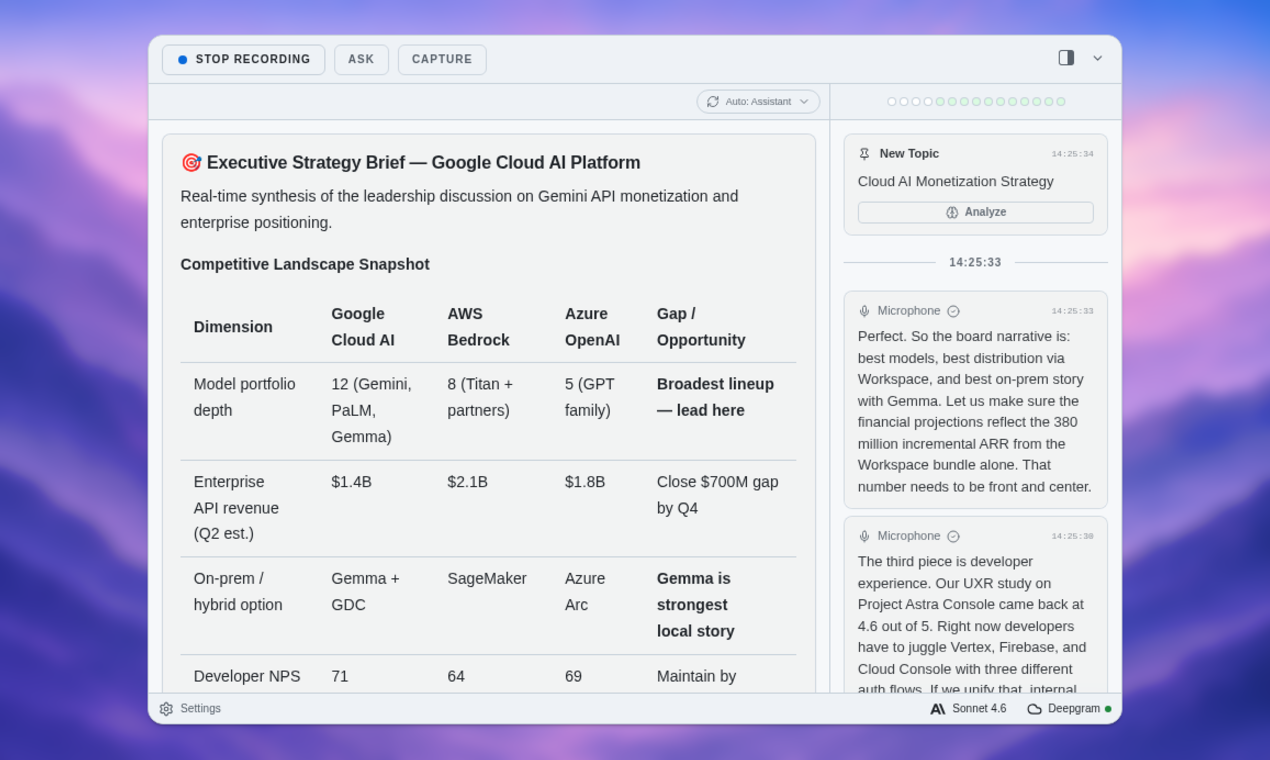
On Mac, ExtraBrain can provide live transcription, screen-aware context, local Parakeet transcription, optional Deepgram transcription, local Gemma 4 on-device AI where installed and compatible, and bring-your-own AI providers such as Anthropic, OpenAI, custom OpenAI-compatible endpoints, Claude Subscription, and Codex Subscription. Windows and Linux are planned future platforms.
Privacy controls matter because interview notes and transcripts can contain sensitive personal, company, or candidate information. With local Parakeet transcription and local Gemma 4 where installed and compatible, a fully local posture can keep transcription and AI prompts on device. If you choose an external provider, selected prompts, transcript text, screenshots, audio, or context may leave the device depending on your configuration.
ExtraBrain is also designed to stay hidden from screen sharing and screen recording on major meeting tools. That design can reduce accidental exposure during legitimate use, but it does not override rules. You remain responsible for using any AI assistant only where it is allowed.
How to sound natural when using AI to prepare
Start with your own answer first
Before asking AI for help, answer the question yourself. Record a rough version or write bullet points. Then use AI to find gaps, sharpen structure, and suggest follow-up questions.
This keeps your voice at the center. AI becomes an editor and coach, not the source of your identity.
Replace generic claims with real evidence
Generic answers are easy to spot. Real answers include constraints, numbers, names of systems, stakeholder types, mistakes, tradeoffs, and lessons.
Instead of saying, “I improved team efficiency,” say what changed. Did you reduce review time? Did you remove a manual step? Did you clarify ownership? Did you cut support tickets?
Interviewers trust evidence more than polish.
Practice follow-up questions
A strong preparation session should include interruptions. Ask AI to challenge your answer the way an interviewer would. Ask it to probe for missing details, contradictions, and unclear ownership.
This is where ExtraBrain can help after practice sessions or mock interviews. You can review the transcript, identify weak answers, and build a better version for next time.
Use plain language
Do not try to sound like a strategy memo. Use words you would actually say. If an answer feels too polished, simplify it. If a sentence is too long, split it. If a claim sounds absolute, add nuance.
A natural answer usually includes some thinking in real time. Phrases like “My first instinct is,” “The tradeoff I would check is,” and “I would want to validate that with data” sound more human than a perfect monologue.
Practical examples
Behavioral interview example
A weak AI-sounding answer might be: “I leveraged stakeholder alignment to drive a measurable cross-functional outcome.”
A stronger human answer might be: “In my last role, the product and support teams disagreed about whether a bug was urgent. I pulled together the last 30 support tickets, showed that the bug affected our highest-value onboarding flow, and proposed a two-day fix instead of a larger rewrite. That helped us ship quickly without hiding the longer-term technical debt.”
The second answer is better because it has context, action, tradeoff, and ownership.
Coding interview example
A weak AI-assisted pattern is to jump straight to optimized code. A stronger pattern is to narrate your reasoning.
You might say: “I can solve this with a nested loop first, but that would be too slow if the input grows. I want to use a hash map so I can track what I have already seen and keep lookup close to constant time. Before I write it, I want to clarify whether duplicate values are allowed.”
That answer shows process. Even if you practiced with AI, the reasoning is yours.
System design example
A weak AI-sounding answer lists components immediately: load balancer, cache, queue, database, CDN. A stronger answer starts with requirements.
You might say: “Before choosing components, I want to clarify the core read and write patterns. Are we optimizing for low-latency reads, high write throughput, or consistency after updates? Those choices would change whether I start with caching, partitioning, or stricter transaction boundaries.”
That kind of response is hard to fake because it adapts to the conversation.
What not to do
Do not use AI to invent experience. Do not use AI where the interview, employer, school, workplace, meeting, or platform rules prohibit it. Do not paste generated code you cannot explain. Do not read long answers verbatim. Do not rely on generic stories that could belong to anyone. Do not ignore privacy when transcripts, screenshots, audio, or prompts include sensitive data.
The more you treat AI as a shortcut around the interview, the easier it becomes to detect. The more you treat AI as a preparation and reflection tool, the more useful it becomes.
So, can interviewers tell?
Interviewers can often tell when AI is being used poorly. They notice delays, gaze patterns, pasted code, generic language, and weak follow-up reasoning. They notice when an answer sounds better than the candidate’s understanding.
But interviewers are not trying to punish thoughtful preparation. They want evidence that you can do the work, communicate clearly, and act with integrity.
ExtraBrain can help you prepare, stay organized, understand live context, and review your performance afterward. Used responsibly and only where allowed, it can make you more thoughtful and less anxious without replacing your own voice.
FAQ
What is the safest way to use AI in interviews?
The safest way is to follow the rules of the interview or assessment and use AI as preparation, structure, and review support. If live assistance, transcription, screenshots, or notes are not allowed, do not use them. If they are allowed, keep your own reasoning and voice in control.
Can ExtraBrain generate interview answers?
ExtraBrain can help generate answer outlines, STAR structures, technical explanations, and follow-up questions from live transcript and screen context. Candidates remain responsible for honest and allowed use.
How do I make AI-assisted answers sound like me?
Start with your own rough answer, then use AI to improve clarity. Add real examples, metrics, constraints, and lessons from your experience. Practice out loud until the answer feels natural instead of scripted.
Is ExtraBrain available on Windows?
ExtraBrain is available for macOS today, including Apple Silicon and Intel Macs. Windows and Linux are planned future platforms.
Can ExtraBrain run fully local?
A fully local ExtraBrain posture requires local Parakeet transcription plus local Gemma 4 on-device AI where installed and compatible, with no external provider requests. External providers may receive selected prompts, transcript text, screenshots, audio, or context depending on configuration.