
ExtraBrain Blog
WeCP AI Help in 2026: What Candidates Should Know Before Using a Copilot

A responsible guide to WeCP, Sherlock AI, detection risks, hidden-device myths, and allowed AI interview preparation with ExtraBrain.
People search for “how to cheat on WeCP platform” because a WeCP assessment can feel like a timer, a webcam, a locked browser, and an evaluator are all judging them at once. That pressure makes hidden AI help, second devices, and invisible interview copilots look tempting. It also makes candidates underestimate how much risk those shortcuts create.
WeCP, also known as WeCreateProblems, is commonly discussed as a hiring and technical assessment platform with proctoring, integrity checks, and Sherlock AI-related detection. The practical question for candidates is not how to beat those systems. The practical question is how to prepare, understand the likely detection surfaces, and use AI only where the employer, school, interviewer, and platform rules allow it.
ExtraBrain is a free, local-first Mac desktop AI interview assistant and meeting copilot with live transcription, screen-aware context, local Gemma 4 on-device AI where installed and compatible, bring-your-own AI providers, and clear privacy controls. Use it for coding interviews, system design rounds, behavioral interviews, meetings, lectures, and research calls where AI assistance, transcription, screenshots, notes, or screen context are allowed. If a WeCP assessment or interview forbids live AI help, use ExtraBrain before the assessment for preparation and after the assessment for review.

Key Takeaways for WeCP Cheat Searches
- WeCP cheat tactics are risky: Hidden devices, outside helpers, copied AI answers, and browser workarounds can create identity, integrity, privacy, and hiring-process consequences.
- Sherlock AI-style detection is broader than answer checking: Candidate behavior, gaze, audio, screen state, answer timing, and response consistency may all matter.
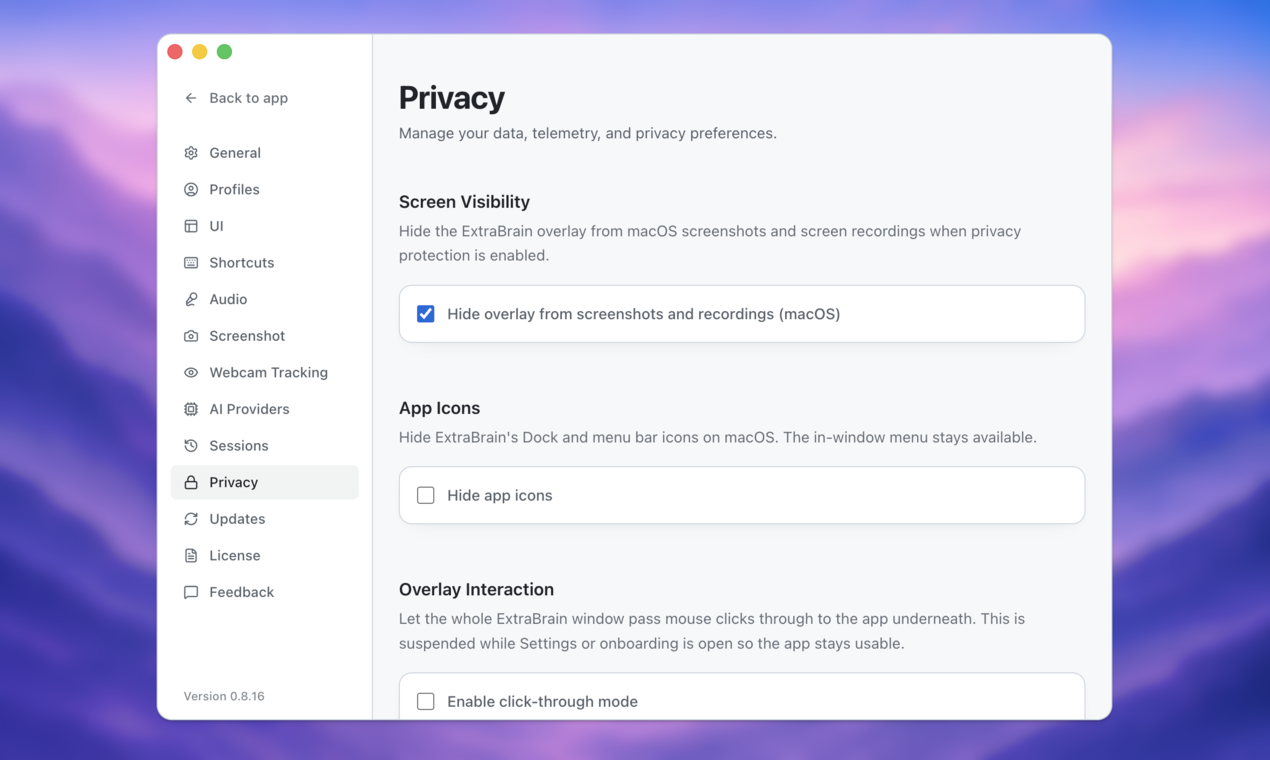
- Invisible does not mean permitted: ExtraBrain is designed to stay hidden from screen sharing and screen recording on major meeting tools, but users remain responsible for following every rule that applies.
- AI is strongest before and after restricted assessments: Use AI to practice, build answer structures, review transcripts, and identify weak spots unless live assistance is clearly allowed.
- Your own reasoning still has to carry the interview: The safest answer is one you can explain, defend, and adapt under follow-up questions.
Staying Undetected in WeCP Interviews Means Understanding the System
The phrase “staying undetected” is usually the wrong goal. If you are trying to hide a prohibited tool, the assessment has already become more about concealment than skill. A better goal is to understand what proctoring tools may watch so you can keep your setup clean, prepare honestly, and avoid behavior that looks suspicious even when you are acting in good faith.
What WeCP and Sherlock AI-Style Proctoring May Watch
No outside article can reliably describe every private signal in a live proctoring system. Still, WeCP and Sherlock AI discussions usually focus on a few detection areas that matter across online assessments.
| Detection area | What candidates worry about | Responsible alternative |
|---|---|---|
| Environmental monitoring | Webcam, microphone, room activity, background noise, and extra people | Use a quiet room, clean desk, stable lighting, and only permitted materials |
| Unauthorized materials or devices | Phones, second monitors, notes, remote helpers, and hidden screens | Read the rules and remove anything that is not explicitly allowed |
| Behavioral analysis | Eye movement, pacing, sudden pauses, and unnatural answer rhythm | Practice aloud until your structure feels natural |
| Browser or screen controls | Tab switching, copy-paste, developer tools, and unusual focus changes | Use the required browser setup and close unrelated apps |
| Answer authenticity | Polished answers, style shifts, unexplained jumps, and generic AI phrasing | Learn the concept and explain it in your own words |
Candidates often overfocus on whether a specific window can be seen. That misses the larger pattern. An assessment can look suspicious even without a visible extra window if the timing, gaze, wording, and explanation do not match normal human problem-solving.
Common WeCP Features Candidates Should Expect
WeCP-style assessment workflows may combine technical testing with identity, environment, and answer-integrity checks. Treat the following as practical risk categories rather than a guaranteed description of any one customer configuration.
| Feature | What it is meant to protect |
|---|---|
| AI-enabled proctoring | Attention, presence, unusual movement, and possible outside help |
| Face and voice checks | Candidate identity and impersonation risk |
| Browser lockdown | Tab switching, copy-paste, local files, and developer-tool abuse |
| Live or recorded monitoring | Human review, audit trails, and high-stakes verification |
| Plagiarism and AI-written answer review | Originality and consistency of submitted answers |
| Automated flags and scoring | Faster review of moments that may need human judgment |
| Time-stamped logs | Reconstruction of what happened during the session |
The takeaway is simple. If your plan depends on a proctoring blind spot, it is fragile. If your plan depends on your own preparation, it scales to the follow-up interview, the onsite round, and the actual job.
How Other AI Hiring Platforms Approach Cheating Detection
WeCP is not the only platform candidates compare against. Online assessment platforms such as iMocha and Adaface are also commonly discussed in terms of browser controls, webcam recording, screen recording, identity checks, AI flagging, and plagiarism review.
| Platform type | Typical integrity focus | Candidate lesson |
|---|---|---|
| WeCP-style technical assessment | Coding ability, technical judgment, proctoring, and Sherlock AI-style integrity review | Expect both answer quality and behavior to matter |
| iMocha-style skills assessment | Lockdown browser, screen or webcam review, and suspicious-activity flags | Keep the environment clean and follow the tool policy |
| Adaface-style assessment | Role-specific questions, plagiarism review, and remote assessment controls | Practice the underlying skill, not one leaked answer pattern |
The exact product details change over time. The candidate strategy should not. Use AI for permitted preparation, build real skill, and do not rely on a bypass you cannot verify.
What WeCP Can Detect in Practice
Most candidates think detection starts and ends with webcam monitoring. In reality, modern interview-integrity systems tend to combine multiple signals. Even when a single signal is weak, the combination can be persuasive to a reviewer.
Response Authenticity Verification
WeCP-style review may look at whether your answer sounds like your normal level of experience. It may also compare your explanation quality against follow-up answers.
- AI-style phrasing: Overly polished bullet points, generic corporate language, or sudden vocabulary changes can stand out.
- Delay and pacing: A hard problem answered too perfectly after an odd pause may raise questions.
- Semantic consistency: A candidate who gives an excellent main answer but cannot explain the same idea afterward may look assisted.
The responsible fix is not to disguise AI text. The responsible fix is to practice until the answer is genuinely yours.
Multimodal Behavioral Monitoring
Video and audio signals can make simple tricks look worse than candidates expect. Repeated side glances, downward looks, background voices, muted conversations, reflections, or strange audio artifacts can all invite review.
Eye movement matters because people often read hidden prompts differently from how they think through a problem. Audio matters because outside help can leave traces in timing, microphone pickup, and conversation rhythm. Identity matters because proxy testing and impersonation are major integrity risks.
Environment and Device Isolation
Browser lockdown and screen monitoring are meant to reduce unauthorized access to outside resources. They may notice tab switching, copy-paste behavior, focus changes, developer tools, screen-sharing artifacts, or unexpected device setups.
Cross-device help is also risky. Phones, tablets, QR handoffs, mirrors, and second screens add visible movement and create more things that can go wrong.
Integrity Scoring and Human Review
Many proctoring workflows do not simply return “cheating” or “not cheating.” They collect events, timestamps, flags, and recordings for later review.
That matters because a human reviewer may see the pattern, not just one moment. A few odd pauses may be normal. Odd pauses plus eye drift plus copied-looking answers plus inconsistent follow-up explanations can become a much bigger problem.
AI and Tech Tactics Around WeCP
Choosing the Right AI Tool
Before using any AI tool around a WeCP assessment, ask three questions. What is the assessment format? What do the written rules allow? What data will leave your device if you use this setup?
Some AI tools are useful for practice questions. Some are better at coding explanations. Some help with live transcription and screen-aware context. None of that matters if the assessment rules ban outside assistance.
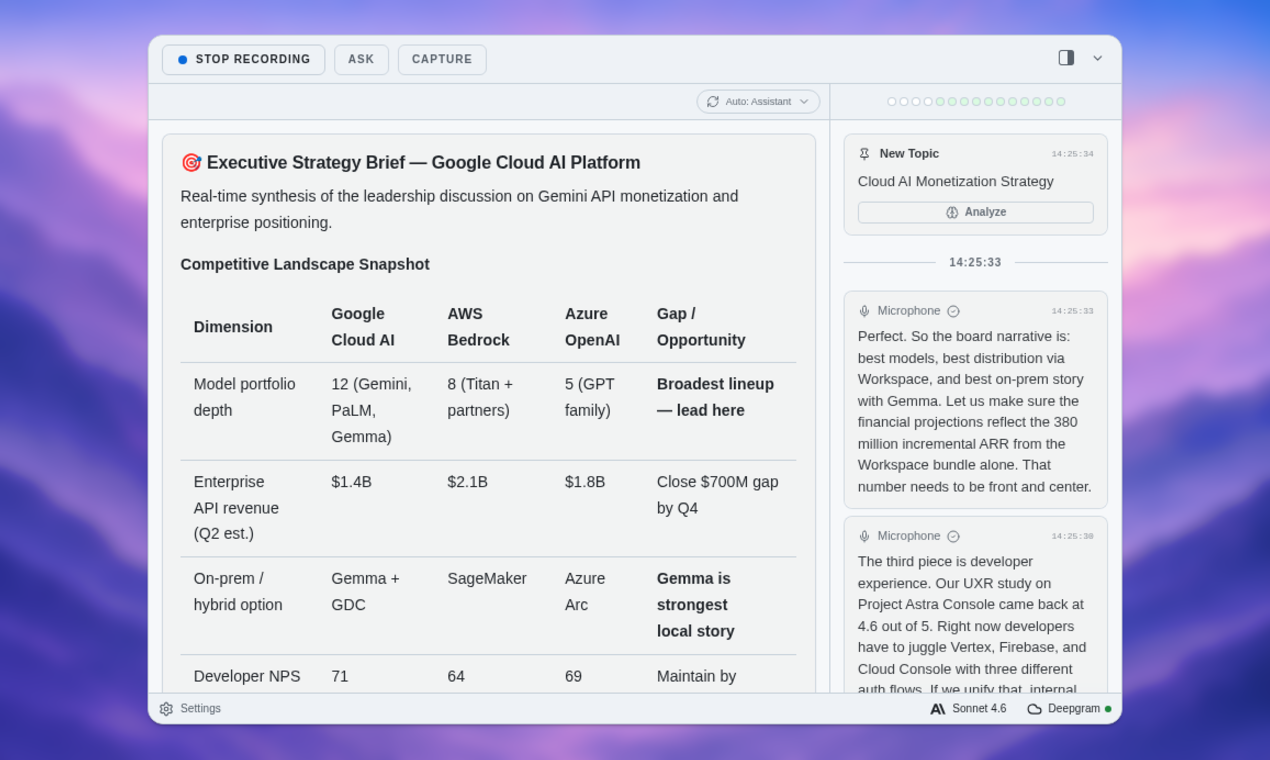
ExtraBrain is built as an AI interview copilot for Mac users who want a real desktop workflow instead of a loose browser chat. It supports live transcription, screen-aware context, coding and system design support, local-first options, bring-your-own provider setup, and post-interview review. It is available for macOS today, including Apple Silicon and Intel Macs. Windows and Linux are planned future platforms.
Using ExtraBrain Responsibly With WeCP Preparation
The strongest ExtraBrain workflow happens before the restricted moment. Use it to rehearse the exact skills the assessment is measuring.
- Build a list of likely question types from the role, job description, and assessment instructions.
- Practice coding, system design, behavioral, or domain-specific prompts aloud.
- Use transcripts and notes to find weak explanations.
- Turn AI suggestions into outlines that match your own experience and vocabulary.
- Repeat the same concept until you can explain it without reading.
If a live WeCP interview explicitly allows AI assistance, use it narrowly. Ask for structure, clarifying questions, tradeoff reminders, or review prompts. Do not use it to claim work, knowledge, or experience you do not have.
If live AI is not allowed, close the tool before the assessment and rely on your preparation. Then use ExtraBrain afterward to debrief what happened and plan the next round.
Why Reading AI Answers Usually Fails
Reading a generated answer can feel efficient, but it creates obvious weaknesses. The answer may not match your resume. It may use terms you cannot define. It may skip the reasoning that the interviewer wants to hear. It may also sound too generic to survive follow-up questions.
For coding assessments, a perfect-looking solution without incremental reasoning is suspicious. For system design, a polished architecture without tradeoffs is shallow. For behavioral interviews, a STAR answer without real details sounds hollow.
Use AI to sharpen your thinking. Do not use it as a script you cannot defend.
Hidden Devices and WeCP Workarounds
Do Hidden Devices Work?
Candidates often ask whether hidden devices can beat WeCP proctoring. The short answer is that they are risky, visible, and usually not worth it.
| Method candidates discuss | Why candidates try it | Why it is risky |
|---|---|---|
| Hidden cameras | Sending the screen to another person | Creates device, reflection, network, and identity risks |
| Mirrors | Reading notes or another display with less head movement | Still changes gaze and can appear in reflections |
| Hidden screens | Keeping answers or search results outside the webcam frame | Can create repeated eye drift and screen-focus anomalies |
| Camera manipulation | Moving the camera to hide parts of the room | May violate room-scan rules and look intentional |
| Covering the camera | Creating time to check notes or a phone | Can trigger a direct proctoring flag |
| Additional phones or tablets | Searching, messaging, or receiving answers | Adds audio, movement, notification, and account-security risk |
These tactics are also brittle. If a friend can notice that you are reading from somewhere else, a trained reviewer may notice it too. If your answer suddenly becomes better than your explanation, a hidden device does not solve the deeper mismatch.
Preparing the Test Environment the Clean Way
A clean setup helps honest candidates because it reduces accidental flags. It also lowers stress.
Before a WeCP-style assessment:
- Read the candidate instructions and proctoring policy.
- Confirm whether notes, calculators, documentation, transcription, screenshots, or AI tools are allowed.
- Close unrelated apps and browser tabs.
- Turn off notifications.
- Test your camera, microphone, speakers, power, and internet.
- Clear your desk except for permitted materials.
- Keep your phone away unless the instructions explicitly require it for authentication.
- Ask the recruiter or administrator if a rule is unclear.
This is basic test hygiene. It is not a bypass.
Risk Management
There is no perfect method for cheating on WeCP. There are only tradeoffs that can get more expensive when the stakes are high.
Possible consequences include canceled results, disqualification, rejection, school discipline, offer withdrawal, or loss of trust with a recruiter or employer. Those outcomes can matter more than one assessment score.
The safer risk-management rule is plain. If the tool is allowed, use it responsibly and be ready to explain your work. If the tool is not allowed, do not use it during the assessment.
Practical WeCP Prep With ExtraBrain
Coding Assessments
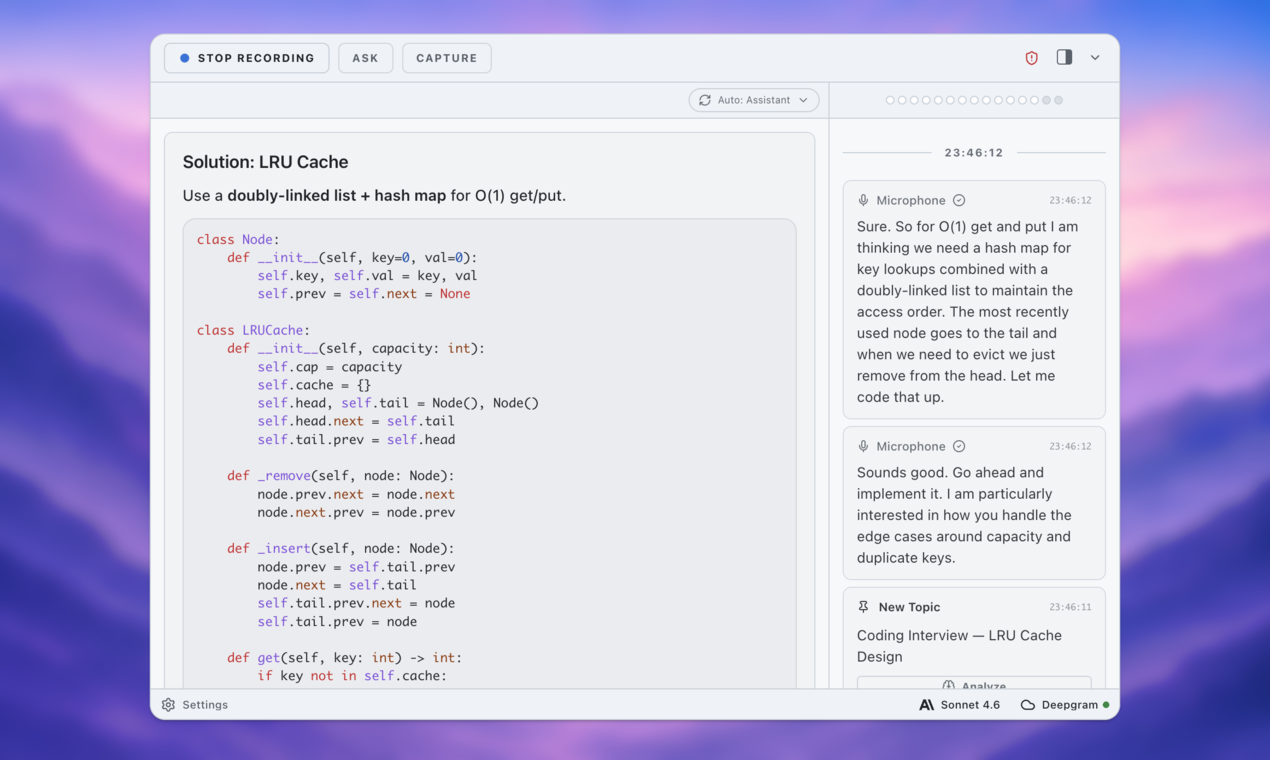
For coding interviews, practice the explanation loop rather than just the final answer. Restate the problem, ask about constraints, propose a baseline, improve the approach, discuss complexity, implement incrementally, and test edge cases.
ExtraBrain can help you prepare by generating practice prompts, outlining tradeoffs, reviewing transcript notes, and helping you identify where your reasoning got unclear. The useful outcome is not a pasted solution. The useful outcome is a solution you can build and explain under pressure.
System Design Interviews
System design rounds are difficult to fake because every choice creates a follow-up. A candidate has to explain why a cache belongs in one place, why a queue is needed, why a database fits the access pattern, and how the system fails.
Use ExtraBrain before the interview to rehearse:
- Requirements and non-goals.
- APIs and data models.
- Read and write paths.
- Scaling bottlenecks.
- Caching strategy.
- Reliability and failure modes.
- Observability.
- Privacy and security.
- Cost and operational tradeoffs.
If AI help is allowed during a live system design discussion, keep it focused on reminders and structure. The tradeoff decisions still need to be yours.
Behavioral and Recruiter Screens
Behavioral interviews are where generic AI answers are easiest to spot. The interviewer is usually checking whether your examples are real, specific, and consistent with your resume.
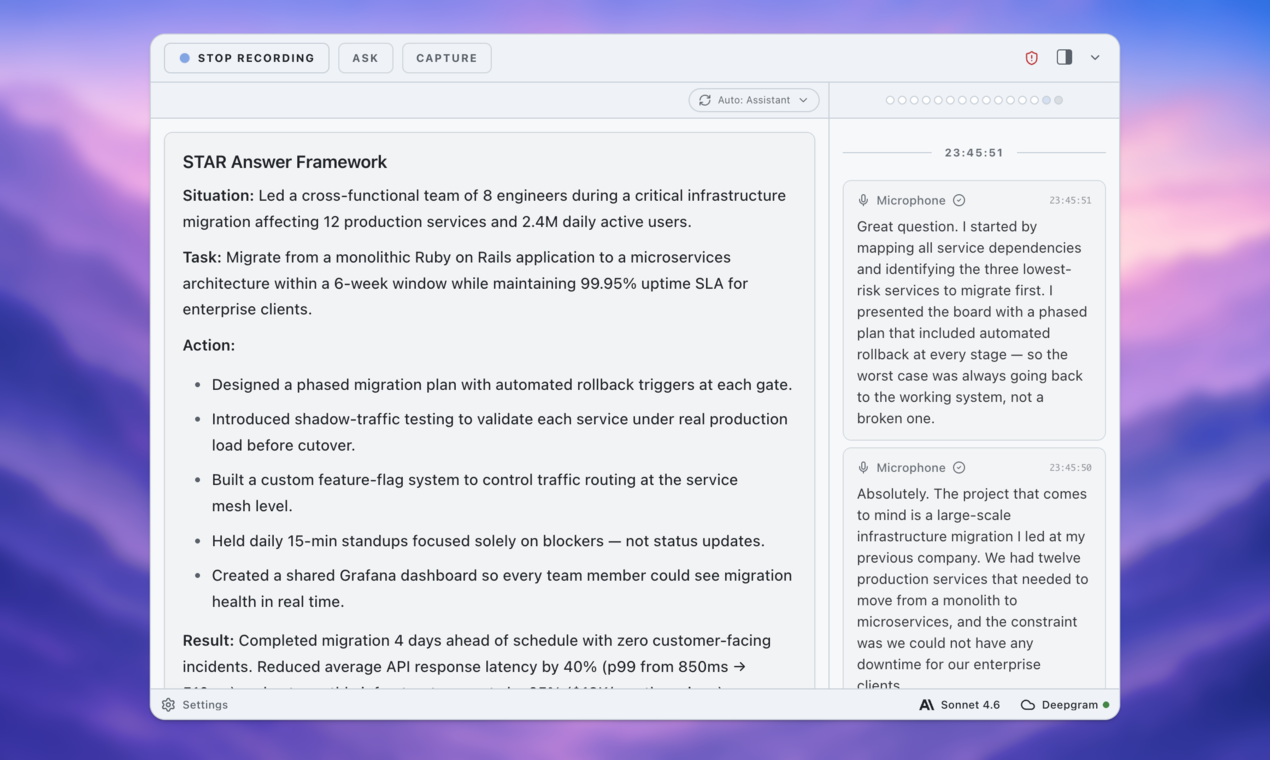
Build a personal answer bank before the call. For each project, write down the situation, your responsibility, the hard decision, the result, and what you learned.
ExtraBrain can help turn live practice into transcripts and review notes. It can also help generate STAR structures and follow-up questions from your own context. You remain responsible for honest and allowed use.
Privacy and Provider Choices
Privacy matters when you are preparing for interviews, assessments, school work, or workplace meetings. You may be handling resumes, company prompts, screen content, audio, screenshots, transcripts, or personal notes.
ExtraBrain supports local NVIDIA Parakeet transcription and optional Deepgram. It also supports Google Gemma 4 local AI, Anthropic, OpenAI, custom OpenAI-compatible endpoints, Claude Subscription, and Codex Subscription.
A fully local ExtraBrain posture requires local Parakeet transcription plus local Gemma 4 on-device AI where installed and compatible, with no external provider requests. Local Gemma 4 requires installation and compatible hardware and may not be available on every Mac or customer environment. External providers may receive selected prompts, transcript text, screenshots, audio, or context depending on configuration.
Review those settings before using any AI tool with confidential assessment, employer, school, or meeting content.
FAQ
How do I avoid getting flagged by WeCP’s AI proctor?
Do not try to hide prohibited tools. Read the rules, keep your environment clean, remove unauthorized materials, practice aloud, and use AI only where the assessment policy allows it.
Can I use ExtraBrain during a WeCP interview?
Use ExtraBrain during a WeCP interview only if the interviewer, employer, school, and platform rules allow AI assistance, transcription, screenshots, notes, or desktop copilots. If live AI help is not allowed, use ExtraBrain before the interview for preparation and after the interview for review.
Can I use my phone during a WeCP test?
Use your phone only if the WeCP instructions require or permit it. Otherwise, keep it away from the test area because phones create avoidable proctoring and integrity risk.
What happens if WeCP catches me cheating?
Possible outcomes include a canceled test, a flagged report, disqualification, rejection, school discipline, or escalation to the employer. The exact consequence depends on the assessment owner and the rules you accepted.
Is ExtraBrain free?
The core ExtraBrain Mac app is free. ExtraBrain Pro is $9.99 per month $79 per year, or $149 Lifetime launch pricing. External AI and transcription provider usage is billed separately by the providers users choose.
What is the best way to use AI for WeCP preparation?
Use AI to practice representative questions, review your explanations, build STAR stories from real experience, rehearse coding and system design tradeoffs, and debrief after the session. Do not use AI to secretly outsource a restricted assessment.
See Also
Sherlock AI interview detection: safer ways to use AI help in 2026
Online assessment cheat searches: a safer way to use AI help