
ExtraBrain Blog
Using AI in a Live Coding Interview Without Losing Your Own Voice

A practical guide to using AI responsibly in live coding interviews for problem solving, explanations, screen context, and post-interview review.
Live coding interviews are harder than ordinary coding tests because the interviewer is not only judging the final code. They are also watching how you clarify the prompt, reason through tradeoffs, recover from mistakes, explain complexity, and respond to follow-up questions in real time.
AI can help with that process when it is allowed by the interview rules. Used well, an AI interview assistant can act like a quiet preparation and coaching layer: it can help you understand the problem, structure your explanation, notice edge cases, and review the session afterward. Used badly, it can make you sound scripted, evasive, or unable to explain your own code.
This guide explains how to use ExtraBrain as a live coding interview copilot in a responsible way. The goal is not to replace your thinking. The goal is to support the parts of the interview that are easy to lose under pressure: reading carefully, thinking out loud, keeping track of constraints, and turning your approach into clear code.
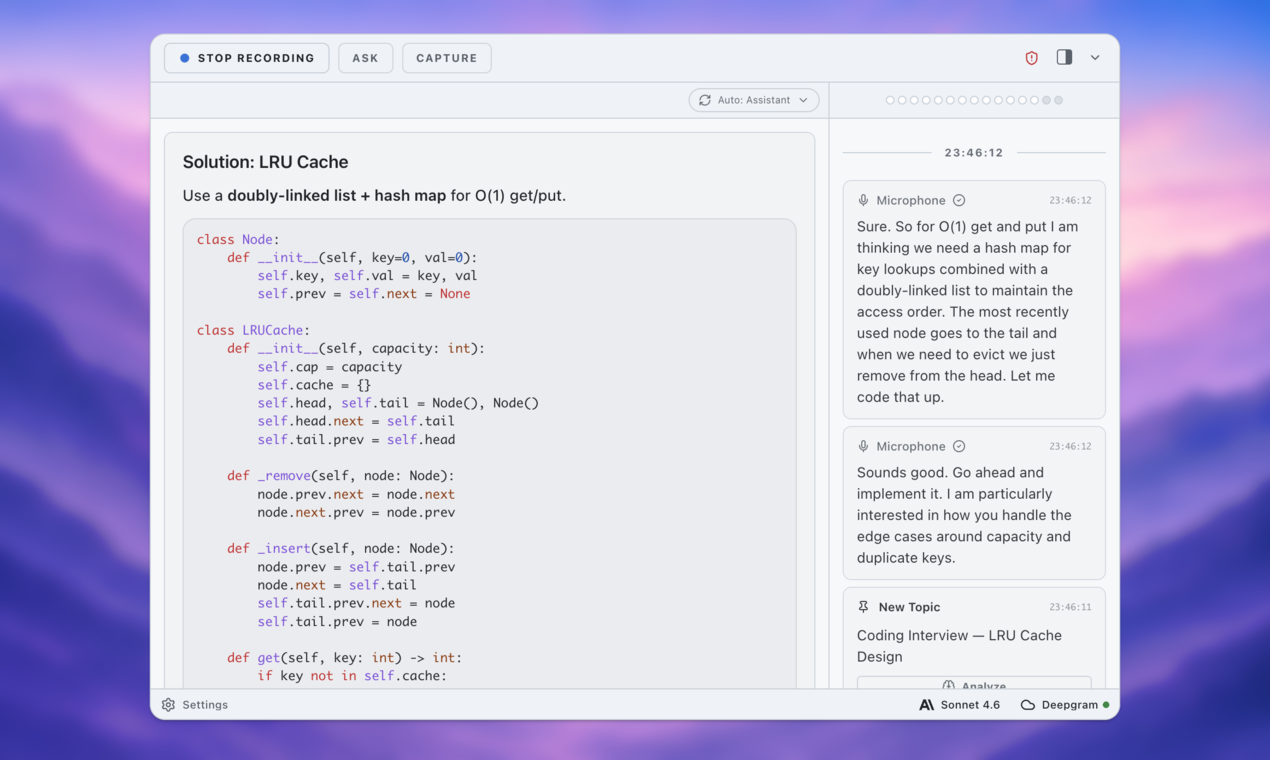
Live coding interviews are not the same as online assessments
An online assessment usually behaves like a timed coding exam. You read a prompt, write a solution, run hidden or visible tests, and are scored mostly on correctness and efficiency. Communication matters less because the platform often evaluates the code after the fact.
A live coding interview is a collaborative technical conversation. The interviewer may ask you to explain the problem, propose examples, discuss the brute-force approach, improve it, code the solution, test it manually, and then adapt it for follow-up requirements.
That difference changes how AI should be used. In a live coding round, the most valuable help is not a pasted answer. The most valuable help is a better thinking loop.
A good AI workflow helps you answer questions like these:
- What is the interviewer really asking me to solve?
- What assumptions should I confirm before coding?
- What examples reveal edge cases?
- What data structure fits this constraint?
- How do I explain the tradeoff without rambling?
- What tests should I walk through after implementing the solution?
ExtraBrain is built for that live context. It is a Mac desktop AI interview assistant and meeting copilot with live transcription, screen-aware context, local-first options, bring-your-own AI providers, and privacy controls.
Responsible use comes first
Before using AI in a live coding interview, check the rules for the company, school, platform, assessment provider, and interviewer. Some interviews allow notes, documentation, transcription, or AI-assisted tools. Some allow AI for accessibility or preparation but not during the live session. Some prohibit all external assistance.
ExtraBrain should be used only where the rules allow AI assistance, transcription, screenshots, or notes. If the rules are unclear, ask before the interview. A simple question such as “Are AI note-taking or coaching tools allowed during this interview?” is better than risking a misunderstanding.
Responsible use also means staying accountable for every answer you give. If AI suggests a solution, you still need to understand it, type it, test it, and explain it in your own words. An interviewer can usually tell when a candidate is reciting code they do not understand.
Set up your AI coding workflow before the interview
Do not wait until the interview starts to configure your tools. Live coding rounds are already stressful, and every extra setup step competes with your attention.
Prepare the app and permissions
Install ExtraBrain on your Mac before the interview and complete the first-run setup. ExtraBrain supports Apple Silicon and Intel Macs today, with Windows and Linux planned.
Check microphone, transcription, screen context, shortcuts, and provider settings before the call. If you want a local-first posture, configure local Parakeet transcription and local Gemma 4 on-device AI where installed and compatible. Local Gemma 4 requires compatible hardware and may not be available in every environment.
If you use an external provider such as Anthropic, OpenAI, a custom OpenAI-compatible endpoint, Claude Subscription, or Codex Subscription, remember that selected prompts, transcript text, screenshots, audio, or context may be sent to that provider depending on your configuration. Use the privacy settings that match your comfort level and the rules of the interview.
Add context that helps the assistant stay relevant
A live coding assistant works better when it knows the situation. Before the interview, add or keep nearby the job description, role level, target language, and interview focus if you have them.
For example, a backend interview for a senior role may need more discussion of scalability and tradeoffs. A frontend interview may require attention to state, rendering, accessibility, and browser behavior. A new graduate algorithm round may focus more on data structures, complexity, and clean implementation.
You can also prepare short personal guidelines for how you want answers framed. For live coding, useful guidance might include:
- Start with clarifying questions.
- Give a brute-force idea before optimizing.
- Prefer Python unless the prompt asks otherwise.
- Always mention time and space complexity.
- Suggest edge cases before finalizing.
- Keep explanations concise and conversational.
Practice with the same meeting and coding setup
Practice in the environment you expect to use. If the interview will happen in Zoom, Google Meet, Microsoft Teams, CoderPad, HackerRank, or a shared editor, rehearse with the same screen layout.
The goal is to remove mechanical friction. You should know where the prompt appears, where you type code, where your transcript appears, and how you will trigger or review AI assistance without breaking your flow.
How AI helps during the live coding problem
A live coding interview usually follows a predictable sequence. AI can support each step, but the candidate should remain the driver.
1. Understand the prompt
The first risk in live coding is solving the wrong problem quickly. Screen-aware context helps because the assistant can use visible prompt details along with the live transcript.
When the prompt appears, slow down and restate it. Ask about input shape, output shape, constraints, mutability, ordering, duplicates, and error cases.
For example, if the task is an LRU cache, useful clarifying questions include:
- What should
getreturn when the key is missing? - Should
putupdate recency when the key already exists? - Is capacity always positive?
- Are keys and values integers, strings, or generic objects?
- Do we need average O(1) time for both operations?
AI can help surface those questions, but you should choose the ones that fit the prompt. Do not ask every possible question just because an assistant listed them.
2. Generate examples before coding
Examples make your thinking visible. They also protect you from off-by-one errors and misunderstood requirements.
Ask the assistant to help identify a minimal example, a normal example, and an edge case. Then talk through them with the interviewer.
For an LRU cache, you might say:
capacity = 2put(1, 10)put(2, 20)get(1) -> 10, key 1 becomes most recentput(3, 30) evicts key 2get(2) -> -1This kind of trace is often more useful than jumping straight into code. It shows that you understand the state transitions.
3. Choose an approach and explain the tradeoff
The strongest live coding candidates explain why they choose a data structure. They do not just name it.
For an LRU cache, the typical answer is a hash map plus a doubly linked list. The hash map gives O(1) lookup by key. The list gives O(1) movement to the most-recent position and O(1) eviction from the least-recent position.
AI can help you phrase that explanation clearly. It can also remind you to compare against simpler alternatives, such as scanning an array or using timestamps, and explain why those approaches do not meet the desired complexity.
4. Code manually and narrate decisions
Even when AI suggests implementation details, type the code yourself and narrate the important choices. Manual coding keeps you engaged with the solution and makes it easier to debug. It also helps avoid the suspicious rhythm of pasting a complete solution and then struggling to explain it.
Good narration sounds like this:
I am going to keep dummy head and tail nodes so insertion and removal do not need separate empty-list branches.The map will point from key to node.On every get, if the key exists, I move that node to the most-recent side before returning the value.On put, if the key exists, I update it and move it.If the cache grows beyond capacity, I remove the node next to the least-recent sentinel and delete that key from the map.That is the kind of explanation AI can help you rehearse, but it must become your own understanding.
5. Test out loud
Many candidates finish the code and stop talking. That is a missed opportunity.
Use AI assistance to propose test cases, then pick the most relevant ones and walk through them yourself. For live coding, useful tests include:
- Empty or minimal input.
- Single-element input.
- Duplicate values or repeated operations.
- Boundary capacity.
- Missing keys.
- Large input behavior.
- A case that exercises the main eviction or update path.
When you test out loud, you show the interviewer that you can validate your own work. That matters in real engineering jobs.
How screen-aware context helps without breaking flow
A general chatbot often requires you to copy the prompt, switch windows, paste context, ask a question, read the answer, then return to the coding environment. That workflow is clumsy in a live interview. It also distracts from the conversation.
ExtraBrain is designed as a desktop assistant with live transcription and screen-aware context. That means the assistant can work from the conversation and visible screen context instead of relying only on manual prompt entry.
This is useful for several live coding moments:
- When the interviewer adds a constraint verbally.
- When the prompt is long and easy to misread.
- When the shared editor contains failing tests.
- When the interviewer asks for a complexity improvement.
- When you need a concise explanation of the current bug.
Screen-aware context is not a license to ignore the rules. Use it only where screen capture and AI assistance are allowed.
How live transcription helps your thinking
In live coding interviews, follow-up questions can arrive quickly. You may be debugging one line while the interviewer asks about complexity, concurrency, memory usage, or an alternate API.
Live transcription gives you a running record of what was said. That can help you recover the exact wording of a requirement or follow-up question. It can also help the assistant generate a response that matches the actual conversation rather than a vague memory of it.
For example, if the interviewer says, “Now assume the stream is too large to fit in memory,” you can use that transcript context to pivot from an in-memory solution to a streaming or heap-based approach.
What not to do with AI in a live coding interview
AI can make a strong candidate clearer, but it can also make a weak workflow worse. Avoid these mistakes.
Do not outsource the interview
If you cannot explain the code, the answer is not really yours. Live coding interviews are designed to reveal reasoning, not only final output.
Use AI for hints, structure, examples, and review. Do not use it as a substitute for understanding.
Do not paste complete answers without reading them
Pasting a complete solution often creates more risk than benefit. You may paste code that uses unfamiliar patterns, misses the platform’s function signature, or fails on a subtle edge case.
Manual implementation forces you to process the idea. It also gives you natural moments to explain what you are doing.
Do not let AI change your voice
Interviewers want to hear how you think. If your explanations suddenly become polished in a way that does not match your normal speech, it can feel unnatural.
Use AI-generated outlines as scaffolding. Then translate them into your own words.
Do not ignore privacy settings
Choose your provider setup intentionally. With local Parakeet transcription and local Gemma 4 on-device AI where installed and compatible, transcription and AI prompts can stay local. When using external providers, selected prompts, transcript text, screenshots, audio, or context may leave the device depending on configuration.
Review the privacy controls before the session, not after.
A practical live coding workflow with ExtraBrain
Here is a simple workflow you can rehearse before your next interview.
Before the call
- Confirm whether AI, transcription, screenshots, or notes are allowed.
- Install and open ExtraBrain on your Mac.
- Configure transcription, provider, shortcuts, and privacy controls.
- Add the job description or role notes if useful.
- Practice with one real coding prompt in the same screen layout.
- Prepare a short answer for how you use AI if the interviewer asks.
When the prompt appears
- Read the prompt fully before coding.
- Restate the task in your own words.
- Ask two or three useful clarifying questions.
- Create a small example and one edge case.
- Explain the brute-force approach if it is helpful.
- Propose the optimized approach and complexity.
While coding
- Keep talking at a natural pace.
- Use AI assistance for reminders, edge cases, and explanation structure.
- Type the implementation yourself.
- Pause when you make a design choice.
- Name variables clearly.
- Keep the solution simple before adding cleverness.
After coding
- Run or mentally trace the main example.
- Test edge cases.
- State time and space complexity.
- Invite the interviewer to ask for a follow-up.
- Use the transcript after the call to review what went well and what needs practice.
Example prompts you can give your assistant
You can prepare short prompts that keep AI output useful and concise. These are examples you can adapt inside your own ExtraBrain guidance or provider prompts.
Summarize the coding problem from the transcript and screen in one sentence.List the key constraints and two clarifying questions I should ask.Give me a concise solution plan for this coding prompt.Include brute force, optimized approach, time complexity, space complexity, and edge cases.Do not write full code unless I ask.Help me explain this approach out loud in a natural interview style.Keep it under 45 seconds.Review the code visible on screen for likely bugs.Focus on edge cases, state updates, and complexity.Generate a short post-interview debrief.Separate strengths, missed clarifications, coding issues, and practice topics.These prompts keep the assistant in a coaching role rather than turning it into a replacement candidate.
Why older tactics fail in live coding interviews
Many old tactics for technical assessments were built around isolation: hidden phones, second screens, copied snippets, remote helpers, browser tabs, or generic chatbots. They are poorly suited to live coding interviews because live interviews are conversational.
A real interviewer can ask why you chose a data structure. They can ask you to modify the code. They can point to a line and ask what happens on a specific input. They can watch whether your explanation matches your implementation.
That is why the better strategy is not to chase shortcuts. The better strategy is to build a workflow that makes your real reasoning easier to express.
ExtraBrain can support that workflow with live transcription, screen-aware context, local-first options, and post-session review. You still need to do the interview. The assistant helps you keep your brain organized while you do it.
Choosing an AI interview assistant for live coding
When comparing AI tools for live coding interviews, look for the features that matter during a real conversation.
| Need | Why it matters | What to look for |
|---|---|---|
| Live transcription | Captures follow-up questions and interviewer constraints | Accurate transcript with low friction |
| Screen-aware context | Helps interpret prompts, shared editors, and test failures | Desktop context that works with your interview setup |
| Privacy controls | Keeps sensitive interview and career data under your control | Local-first options and clear provider settings |
| Provider choice | Lets you use the AI models or endpoints you trust | Bring-your-own provider support |
| Post-session review | Turns the interview into practice data | Session history, transcript review, and debrief prompts |
| Natural guidance | Helps you explain instead of recite | Custom profiles or prompts for your interview style |
ExtraBrain fits this category as a free, local-first Mac desktop AI interview assistant and meeting copilot. The core Mac app is free. ExtraBrain Pro is available for users who want paid features, with external AI and transcription provider usage billed separately by the providers users choose.
FAQ
Can I use AI during a live coding interview?
Only if the interview, employer, school, workplace, meeting, and platform rules allow it. If the rules do not allow AI assistance, do not use AI during the interview. If the rules are unclear, ask before the session.
What is the best way to use AI in a coding interview?
Use it for clarification, structure, edge cases, complexity analysis, explanation practice, and post-interview review. Do not use it to replace your own reasoning or to present code you cannot explain.
Can ExtraBrain help with coding interviews?
Yes. ExtraBrain is built as a real-time AI interview assistant for Mac with live transcription, screen-aware context, coding and system design support, local-first options, bring-your-own AI providers, and post-interview review.
Can ExtraBrain run fully local?
A fully local ExtraBrain posture requires local Parakeet transcription plus local Gemma 4 on-device AI where installed and compatible, with no external provider requests. External providers may receive selected prompts, transcript text, screenshots, audio, or context depending on configuration.
Is ExtraBrain only for coding interviews?
No. ExtraBrain can also support system design interviews, behavioral interviews, product interviews, meetings, lectures, research calls, and other live sessions where transcription, notes, and AI assistance are allowed.
What should I say if an interviewer asks whether I use AI?
Be honest and concise. You can say that you use AI for preparation, note organization, transcript review, or allowed live assistance, depending on what is true and permitted. Never claim you are working without assistance if you are using assistance during the interview.