
ExtraBrain Blog
A Practical Leetcode Wizard Review for Real Tech Interviews

A practical Leetcode Wizard review for coding interview prep, mock interviews, real interview limits, and why ExtraBrain may fit broader sessions.
Leetcode Wizard is useful when I treat it as a coding interview practice tutor. It is much less convincing when I imagine using it inside a real technical interview.
That is the short version of this Leetcode Wizard review. The tool is built around Leetcode-style algorithm questions, step-by-step explanations, and fast solution guidance. For preparation, that can be genuinely helpful. For a live interview, a mock interview with a person, a proctored assessment, or any environment with rules about AI assistance, the workflow becomes much more complicated.
This review focuses on the practical question candidates actually care about: can Leetcode Wizard help with real tech interviews, or is it mostly a prep companion? I will cover setup, coding problem coverage, explanation quality, live interview friction, responsible-use concerns, and how a broader desktop AI interview assistant like ExtraBrain fits a different use case.

Quick verdict
Leetcode Wizard is strongest as a focused practice tool for Leetcode-style coding questions. It can help you see hints, understand common algorithms, compare approaches, and improve the way you explain a solution.
It is weaker as a real-time interview copilot. The more the interview looks like a live conversation, a shared coding environment, a system design round, or a workplace-style problem, the less a narrow Leetcode helper feels sufficient.
My practical conclusion is simple. Use Leetcode Wizard if you want structured algorithm practice. Use a broader AI interview assistant if you want live session context, transcription, screen-aware support, post-session review, and help across coding, system design, behavioral, product, meeting, lecture, or research-call scenarios.
ExtraBrain is built for that broader workflow. It is a free, local-first Mac desktop AI interview assistant and meeting copilot with live transcription, screen-aware context, local Gemma 4 on-device AI where installed and compatible, bring-your-own AI providers, and clear privacy controls.
What Leetcode Wizard is best at
Fast help on algorithmic prompts
The main appeal of Leetcode Wizard is speed. When you are staring at a coding prompt and cannot see the pattern, it can nudge you toward the right data structure or algorithm.
For practice, that is valuable. A good hint can prevent you from wasting an entire session on a problem where the key idea is simply sliding window, monotonic stack, binary search on answer, union find, dynamic programming, or graph traversal.
The best use case is not copying a complete answer. The best use case is asking for the next clue, attempting the solution yourself, then using the explanation to correct your reasoning.
Step-by-step explanations
Leetcode Wizard’s strongest feature is its explanation style. A candidate preparing for interviews does not only need the final code. They need to understand why the approach works, which edge cases matter, and how to talk through the tradeoffs.
That is where a tool like this can feel like an always-available tutor. It can break a solution into phases, explain time complexity, describe space complexity, and show why one approach is more efficient than another.
This matters because most real coding interviews are not silent exams. Interviewers often evaluate how you reason out loud, how you respond to hints, how you test your code, and how you explain tradeoffs.
Pattern recognition practice
Leetcode-style preparation is largely pattern recognition. After enough practice, you start seeing familiar shapes. A problem about the longest valid window often points toward two pointers or sliding window. A problem about nearest greater values often points toward a stack. A problem about connected components often points toward DFS, BFS, or union find.
Leetcode Wizard can make those patterns more explicit. That can improve learning speed if you use it responsibly. Instead of asking for the full answer immediately, ask for the category, the invariant, the key edge case, or the brute-force baseline.
Setup and user experience
Simple onboarding
The setup flow is straightforward. The basic workflow is to choose a programming language, connect the relevant input, run a quick test, and begin practicing.
That simplicity matters. Many candidates already feel anxious during interview prep, so a tool that adds configuration stress can quickly become counterproductive.
In practice, Leetcode Wizard feels easier for isolated coding drills than for complex interview simulations. If your goal is to sit down, open a coding problem, and learn the expected solution path, the product shape makes sense.
Smooth for narrow practice, awkward for real interviews
The experience changes when you move from solo practice to a realistic interview setup. Real interviews often involve a video call, a shared editor, a proctored browser, a recruiter or interviewer watching your behavior, and a platform policy that may restrict external help.
That is where narrow coding helpers can become awkward. If a tool requires switching contexts, watching another screen, checking a separate device, or hiding behavior, it stops feeling like a calm learning assistant and starts becoming operationally risky.
Responsible use is important here. Candidates should only use AI assistance, transcription, screenshots, notes, or screen-aware tools where interview, employer, school, workplace, meeting, and platform rules allow them.
Coding problem coverage
Leetcode-style strengths
Leetcode Wizard is clearly aimed at algorithmic interview problems. That means it is most useful for topics like arrays, strings, hash maps, stacks, queues, trees, graphs, heaps, recursion, dynamic programming, and complexity analysis.
For classic coding interview prep, this coverage is useful. You can practice common patterns repeatedly and get immediate feedback when your approach is too slow, too memory-heavy, or missing an edge case.
It is especially helpful when you want to compare a brute-force solution against an optimized solution. That comparison is often the difference between simply solving a problem and sounding interview-ready while solving it.
Where the coverage feels narrower
The limitation is that real technical interviews are not always pure Leetcode prompts. Many companies now use practical debugging tasks, API design questions, system design discussions, product-oriented engineering scenarios, take-home follow-ups, or messy real-world coding exercises.
In those cases, a tool trained or tuned mainly around coding challenge patterns may feel less complete. It may solve the algorithm but not help enough with requirements clarification, tradeoff framing, architectural reasoning, testing strategy, or communication.
That is one reason I prefer separating two jobs. A coding-problem tutor helps with drills. A live interview copilot helps with the broader session.
Pros
Clear explanations that support learning
The biggest advantage is not just answer generation. It is explanation.
A candidate who reads a solution without understanding it will struggle when the interviewer changes one constraint. A candidate who understands the invariant, the data structure choice, and the complexity tradeoff can adapt.
Leetcode Wizard can help build that second kind of understanding if you use it actively. Read the explanation, close the tool, reimplement the solution, then explain it back in your own words.
Good fit for repeated drills
Daily practice works best when friction is low. A focused tool can make it easier to build a routine.
For example, you can choose one topic per day. You might do sliding window on Monday, trees on Tuesday, graphs on Wednesday, dynamic programming on Thursday, and mixed review on Friday.
The tool can give quick feedback after each attempt. That makes it easier to find weak spots and revisit them before the actual interview.
Useful for complexity analysis
Big O analysis is a common interview checkpoint. Many candidates can write code but hesitate when asked to explain runtime and memory usage.
Leetcode Wizard’s explanation format can help here. When it shows time and space complexity, do not treat that as a line to memorize. Use it to understand what the loops, recursion depth, data structures, and input sizes are actually doing.
Helpful for mock interview preparation
Mock interviews are more useful when you review them afterward. If you used Leetcode Wizard during prep, you can compare your original approach with the suggested approach after the mock session.
That is a responsible and effective workflow. Do the mock interview under the rules you agreed to. Then use AI afterward to analyze what you missed, how you could have explained better, and which patterns need more practice.
Cons
Live interview use can create behavioral friction
The main weakness is live interview practicality. A real interview is not only about whether a tool can produce an answer. It is also about whether the workflow helps you stay present, natural, honest, and compliant with the rules.
If using a tool forces you to look away, switch devices, manage hidden windows, or break eye contact in strange ways, the tool may hurt more than it helps. Even if the output is correct, the candidate experience can become stressful.
Algorithm focus does not cover every interview type
Coding interviews are only one part of a technical hiring loop. Many candidates also face system design, behavioral interviews, hiring manager conversations, recruiter screens, architecture reviews, debugging exercises, product sense questions, and culture interviews.
A Leetcode-focused assistant is not designed to be a complete second brain for all of that. It can help you solve algorithmic prompts, but it may not remember your career stories, structure STAR answers, track the conversation, or help you review a full interview transcript afterward.
It may encourage passive learning if misused
Any coding assistant can become a shortcut. If you ask for a solution too early, you may feel productive while skipping the actual learning.
The better approach is to set rules for yourself. Try the problem for a fixed amount of time. Ask for a small hint. Try again. Ask for the core pattern. Try again. Only then review the full solution.
That sequence turns AI into a coach instead of a crutch.
The biggest issue: prep mode is not interview mode
There is a major difference between learning with AI and using AI during a live evaluation.
In preparation mode, the goal is to improve. You can pause, inspect, compare, and ask for explanations. You can use AI to identify weak areas and build a study plan.
In interview mode, the goal is to participate in a real evaluation under explicit or implied rules. Some interviewers allow notes, AI tools, internet search, or documentation. Others do not. Some platforms prohibit outside assistance entirely.
That means the safest default is to clarify the rules and follow them. If AI help is allowed, use it transparently and responsibly. If it is not allowed, use AI before and after the interview, not during it.
Where ExtraBrain fits differently
ExtraBrain is not positioned as a narrow Leetcode-only answer generator. It is a local-first desktop AI interview assistant and meeting copilot for Mac.
That difference matters. ExtraBrain is designed around live session context: transcription, screen-aware context, notes, follow-up questions, answer outlines, technical explanations, and review after the session.
It can help with coding interviews, system design rounds, behavioral interviews, product interviews, customer calls, lectures, and research meetings. It supports bring-your-own AI providers, including Anthropic, OpenAI, custom OpenAI-compatible endpoints, Claude Subscription, and Codex Subscription. It also supports local Gemma 4 on-device AI where installed and compatible.
For transcription, ExtraBrain supports local NVIDIA Parakeet and optional Deepgram. A fully local posture requires local Parakeet transcription plus local Gemma 4 on-device AI where installed and compatible, with no external provider requests. If you choose an external provider, selected prompts, transcript text, screenshots, audio, or context may leave the device depending on your configuration.
That privacy distinction is important. Candidates and professionals should understand where their data goes before using any AI assistant in interviews, meetings, or work contexts.
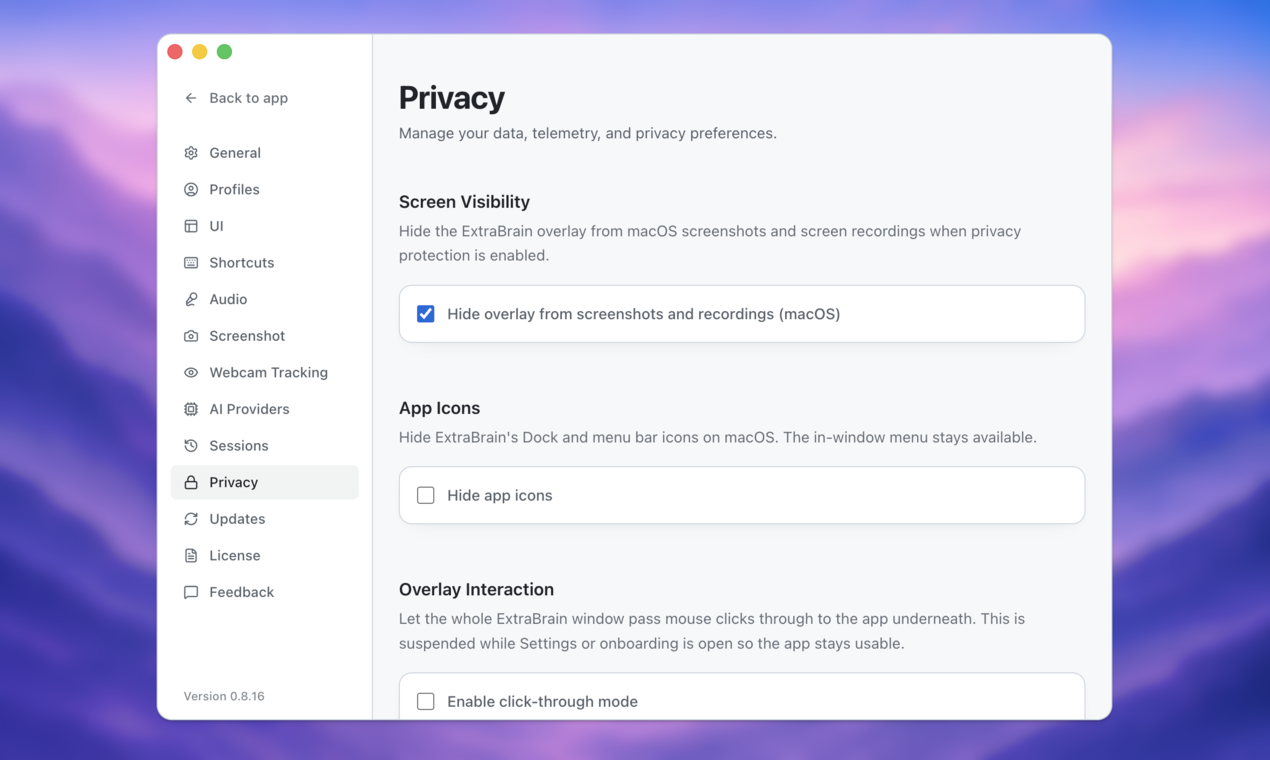
Leetcode Wizard versus ExtraBrain
Choose Leetcode Wizard when your main goal is algorithm practice
Leetcode Wizard makes sense if you want a focused coding tutor. Use it to practice common patterns, review complexity, understand edge cases, and build speed on Leetcode-style questions.
It is especially useful outside live interviews. That is where you can slow down, compare solutions, and learn without worrying about platform rules or awkward behavior.
Choose ExtraBrain when your main goal is live context and review
ExtraBrain makes more sense if you want help across the entire interview or meeting workflow. That includes live transcription, screen-aware context, answer outlines, follow-up questions, technical explanations, and session review.
For a coding interview, ExtraBrain can help you reason through the prompt and explain tradeoffs. For system design, it can help track requirements, constraints, components, risks, and follow-up questions. For behavioral interviews, it can help shape STAR-style answer outlines using your own experience. For meetings and research calls, it can help preserve context for review.
ExtraBrain is available for macOS today, including Apple Silicon and Intel Macs. Windows and Linux are planned future platforms.
Practical way to use both tools responsibly
Before the interview
Use Leetcode Wizard for algorithm drills. Focus on one topic at a time and avoid asking for the full answer immediately.
Use ExtraBrain to practice explaining your reasoning aloud. Record a mock session, review the transcript, and identify places where your explanation became vague or rushed.
You can also use ExtraBrain as a focused AI second brain for interview prep. It can organize live sessions, transcripts, notes, screen context, and review materials without trying to replace a general note-taking database.
During the interview
Follow the rules of the interview, employer, school, workplace, meeting, or platform. If AI assistance, transcription, screenshots, or notes are not allowed, do not use them.
If assistance is allowed, use tools in a way that supports communication rather than replacing your thinking. A good interview still depends on your judgment, honesty, reasoning, and ability to explain tradeoffs.
After the interview
This is one of the best places to use AI. After a coding interview, you can review what went well, which hints you needed, which edge cases you missed, and how you could have explained your approach more clearly.
After a system design or behavioral interview, you can review the transcript, extract follow-up items, and prepare better stories for the next round.
ExtraBrain is particularly useful here because post-session review is part of the broader workflow.
Is Leetcode Wizard worth it?
Leetcode Wizard can be worth it if you are actively preparing for coding-heavy interviews and want structured algorithm help. Its value depends on whether you use it to learn or simply to reveal answers.
If you already have strong fundamentals and just need targeted refreshers, it may accelerate your practice. If you are still building fundamentals, use it carefully so it does not hide gaps in your understanding.
I would not treat it as a complete interview solution. It is too narrow for the full hiring loop, and live interview use raises practical and policy concerns.
Final recommendation
Leetcode Wizard is a good practice assistant for Leetcode-style coding questions. It is not the tool I would rely on as my full interview workflow.
For algorithm drills, it can be genuinely helpful. For real technical interviews, the better strategy is to prepare deeply, follow the rules, practice explaining your reasoning, and use AI in allowed contexts.
If you want a broader Mac desktop assistant for interviews and meetings, ExtraBrain is built for live transcription, screen-aware context, local-first options, bring-your-own provider control, and post-session review. That makes it a stronger fit for candidates who want more than a coding-problem solver.
FAQ
Is Leetcode Wizard enough for all technical interviews?
No. It may help with Leetcode-style coding practice, but technical interviews often include system design, debugging, behavioral questions, communication, and real-world tradeoffs. A narrow algorithm assistant is not enough for the whole process.
Can Leetcode Wizard help me practice new coding questions?
Yes, it can help you practice coding problems and understand solution patterns. The most useful workflow is to attempt the problem first, ask for small hints, then review the full explanation after you have struggled productively.
Does Leetcode Wizard improve problem-solving speed?
It can improve speed if you use it to learn patterns rather than copy answers. Repeated exposure to common structures like sliding window, graph traversal, heaps, and dynamic programming can make you faster over time.
Will Leetcode Wizard help me explain my solutions better?
It can help if you actively rehearse the explanations. Read the step-by-step breakdown, close the tool, then explain the algorithm, edge cases, and complexity in your own words.
What is the best Leetcode Wizard alternative for Mac interviews?
For Mac users who want a broader desktop AI interview assistant, ExtraBrain is a strong alternative. It combines live transcription, screen-aware context, coding and system design support, local-first options, bring-your-own AI providers, and post-interview review.
Can ExtraBrain run fully local?
A fully local ExtraBrain posture requires local Parakeet transcription plus local Gemma 4 on-device AI where installed and compatible, with no external provider requests. External providers may receive selected prompts, transcript text, screenshots, audio, or context depending on configuration.
How much does ExtraBrain cost?
The core ExtraBrain Mac app is free. ExtraBrain Pro is $9.99/month, $79/year, or $149 Lifetime launch pricing. External AI and transcription provider usage is billed separately by the providers users choose.