
ExtraBrain Blog
A Better Interviews Chat Alternative for AI Interview Assistance

Compare ExtraBrain with Interviews Chat for live interview support, coding rounds, privacy controls, and responsible AI assistance on Mac.
A few days before an important technical interview, it is easy to start searching for an AI interview assistant that can keep up with real questions in real time. You may find clips where an interviewer asks a question and an assistant immediately drafts a structured answer, suggests clarifying questions, or explains a coding approach. That workflow is appealing because interviews are not just memory tests anymore. They are high-pressure conversations where you need to listen, reason, communicate, and adapt at the same time.
Interviews Chat is one of the tools candidates often discover during that search. It promises live interview help, AI-generated answers, and support for different interview formats. The real question is whether it feels calm and usable during an actual interview, especially when you are nervous, switching between meeting software, coding platforms, notes, and a shared screen.
For Mac users, ExtraBrain is a strong Interviews Chat alternative because it is built as a local-first desktop AI interview assistant and meeting copilot. It combines live transcription, screen-aware context, coding and system design support, bring-your-own AI providers, local AI options where installed and compatible, and privacy controls that make the workflow easier to reason about.
This comparison is written for job seekers who want practical help, not hype. It looks at the daily interview workflow: getting started, live answers, coding questions, screen context, privacy, pricing, and responsible use.
Quick verdict
ExtraBrain is the better Interviews Chat alternative if you want a Mac desktop copilot that can support live interviews, meetings, coding rounds, and post-session review from one place. It is especially compelling if you care about local-first options, provider control, screen-aware context, and a free core app.
Interviews Chat may appeal to people who want a browser-centered tool with multiple answer formats. The tradeoff is that browser-based workflows can feel more fragile during real interviews because you may need to manage tabs, buttons, credits, answer modes, and meeting windows while staying focused on the interviewer.
ExtraBrain takes a different approach. It is designed as a desktop assistant that listens to the session, understands relevant screen context when enabled, and helps you think through answers without forcing you to keep jumping between web tabs.
| Category | ExtraBrain | Interviews Chat |
|---|---|---|
| Best fit | Mac users who want a desktop AI interview and meeting copilot | Users who prefer a web-based interview assistant |
| Core workflow | Live transcription, screen context, answer outlines, notes, and review | Live answer generation through a browser-based interface |
| Coding support | Screen-aware help for coding prompts and technical tradeoffs | AI answer support for shared or captured coding prompts |
| Privacy posture | Local-first options with local Parakeet transcription and local Gemma 4 where installed and compatible | Depends on the product configuration and account workflow |
| Provider control | Bring your own providers, including OpenAI, Anthropic, custom OpenAI-compatible endpoints, Claude Subscription, Codex Subscription, and local Gemma 4 where compatible | Provider options depend on the service |
| Pricing model | Free core Mac app, with Pro options available | Typically plan or credit based, depending on current offering |
Why candidates look for an Interviews Chat alternative
The problem with many AI interview tools is not that they cannot generate text. Most modern AI products can produce a plausible answer to a behavioral or technical question. The harder problem is usability under pressure.
During a live interview, the candidate has to do several things at once. They need to listen carefully, maintain eye contact, understand the question, decide whether to ask for clarification, think through a real answer, and speak naturally. If the assistant requires too many clicks, too many tabs, or too many decisions, it can become another source of stress.
That is why the best AI interview assistant should not feel like a separate task. It should feel like a quiet support layer that helps you stay organized, remember your own experience, and explain your reasoning more clearly.
ExtraBrain is designed around that idea. It can be used for coding interviews, system design rounds, behavioral interviews, product interviews, customer calls, lectures, and research meetings. That broader workflow matters because interview preparation does not start and end inside a single browser tab.
Getting started: a calmer workflow matters
A common frustration with web-first interview assistants is onboarding. If the product page has many controls, unclear modes, and short trial limits, you may spend your first session trying to understand the tool instead of practicing the interview. That is not ideal when the real interview is close.
A good assistant should make the first session simple. You should understand how transcription works, how screen context works, how to choose an AI provider, what data might leave your device, and how to review the session afterward.
ExtraBrain is built as a Mac desktop app with a practical interview workflow. You can use live transcription to follow the conversation, add screen context when it is allowed and useful, and choose provider settings based on your privacy and quality preferences. You can also use local Parakeet transcription and local Gemma 4 on-device AI where installed and compatible for a more local posture.
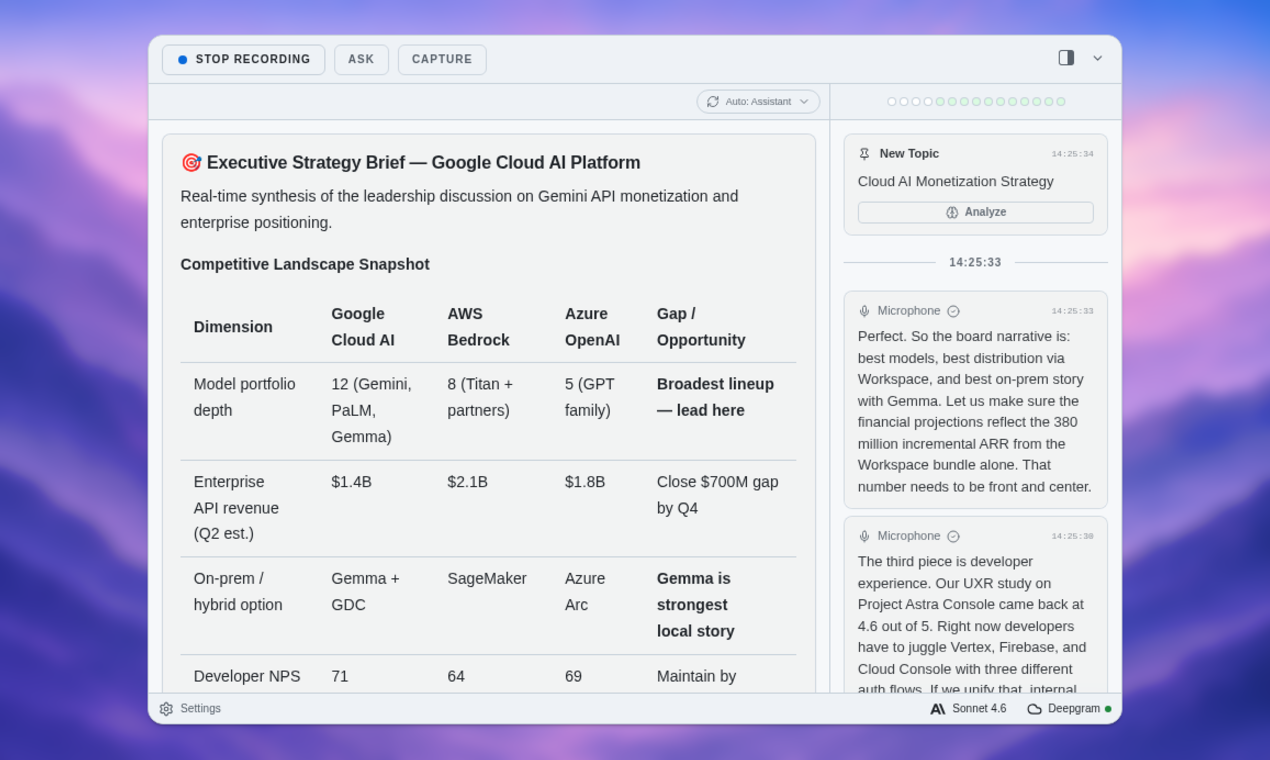
The difference is not just visual polish. The difference is cognitive load. When the tool is easier to understand before the interview, you have more attention available during the interview.
Live interview copilot experience
What matters in a live answer assistant
A live interview copilot should help with structure, not replace the candidate. For behavioral questions, it should suggest a clear STAR outline, remind you to include measurable impact, and help you avoid rambling. For product or strategy questions, it should help organize assumptions, tradeoffs, user segments, and risks. For technical questions, it should help you explain reasoning rather than jump straight to a final answer.
The best live assistant should also be careful about timing. It should not flood you with long paragraphs while you are trying to listen. It should help you produce natural answers that sound like your own thinking.
ExtraBrain supports this by combining transcript context with practical answer guidance. It can help generate answer outlines, STAR structures, technical explanations, and follow-up questions from live transcript and screen context. You remain responsible for what you say and for using AI only where the interview, employer, school, workplace, meeting, and platform rules allow it.
Where Interviews Chat can feel busy
Interviews Chat-style workflows often emphasize answer formats, modes, model choices, and manual controls. That can be useful during practice, but it can feel distracting during a real interview.
When you are nervous, you may not want to compare detailed mode with concise mode, switch models, resize panels, or decide whether to manually submit a transcript segment. You usually want one clear next step: understand the question, answer thoughtfully, and keep the conversation moving.
ExtraBrain is stronger for candidates who prefer a simpler live workflow. Instead of treating every question as a separate web operation, it supports a desktop session where transcript, context, and guidance can stay part of the same interview flow.
Coding interview support
Coding interviews create a different kind of pressure. You may need to read a long prompt, identify edge cases, explain a solution, write code, test it mentally, and discuss complexity. If your AI assistant is in another tab, you can end up switching back and forth between the coding platform and the assistant at exactly the moment you need focus.
ExtraBrain is useful here because it is screen-aware when enabled. It can help reason about coding prompts shown on screen, explain approaches, outline algorithms, and support discussion of tradeoffs. It is not just about producing code. It is about helping you communicate why a solution works.
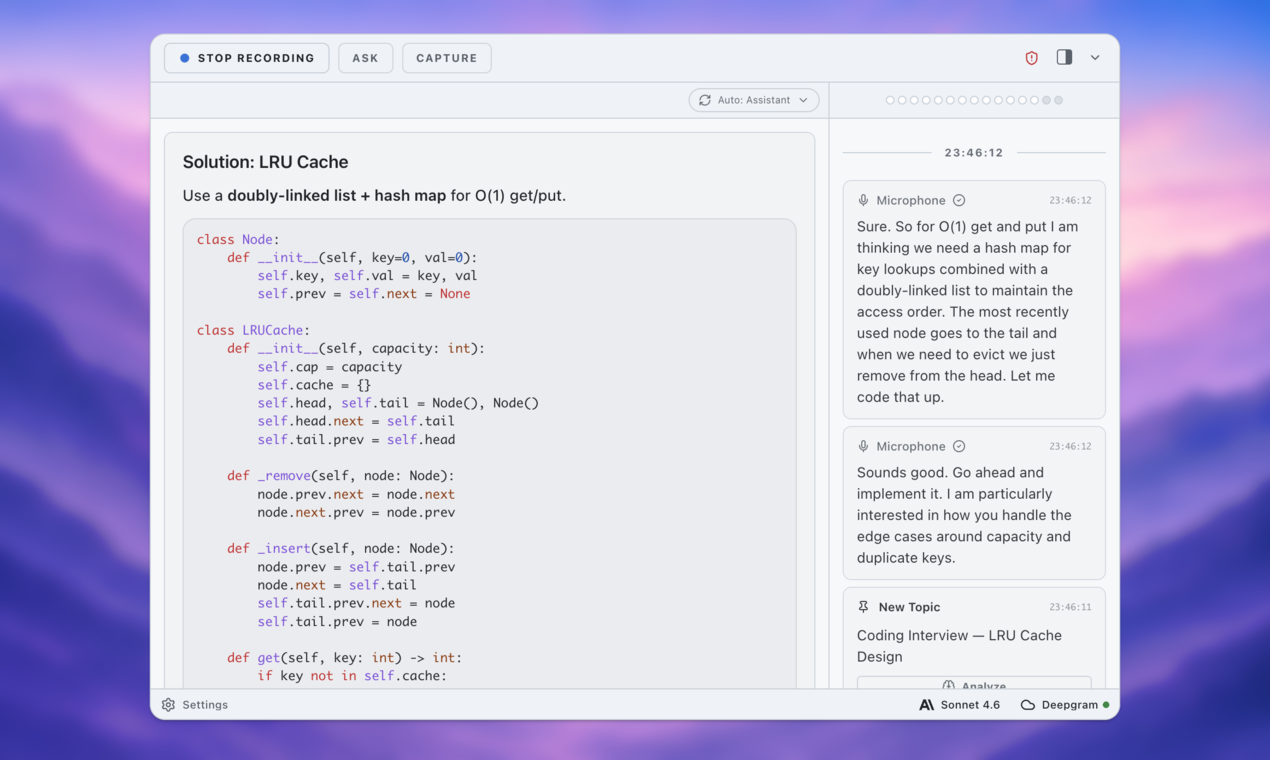
A good coding interview assistant should help you with questions like these:
- What is the brute-force solution and why is it too slow?
- What data structure fits this problem?
- What edge cases should I mention before coding?
- What should I say while I am thinking?
- How do I explain time and space complexity clearly?
- How do I recover if I realize my first approach is wrong?
ExtraBrain can help structure that thinking from live transcript and screen context. That makes it a strong Interviews Chat alternative for software engineering candidates who want interview support beyond a generic text answer.
Screen sharing and visibility
Screen sharing is one of the biggest concerns candidates have when evaluating an AI interview assistant. Some interviews require sharing a full screen. Some coding platforms expect you to stay in the active coding environment. Some interviewers may ask you to walk through your browser, IDE, or design document.
ExtraBrain is designed to stay hidden from screen sharing and screen recording on major meeting tools. That said, this feature should not be treated as permission to break rules. You should only use AI assistance, transcription, screenshots, or notes where your interview, employer, school, workplace, meeting, and platform rules allow it.
There is a practical distinction here. A privacy-conscious desktop interface can reduce accidental exposure during allowed use, such as when you are using a permitted note-taking or coaching tool. It does not remove your responsibility to be honest about what is allowed in the setting.
If an interview explicitly forbids AI assistance, do not use it during that interview. Use ExtraBrain before the interview for practice and after the interview for debriefing instead.
Active tab and browser workflow
Browser-based assistants can be convenient, but they can also create friction. If the assistant lives in a tab, you may need to switch away from the coding platform or meeting tab to read, capture, submit, or regenerate an answer. That switching can interrupt your flow.
A desktop app has a different advantage. It can support the live session without making the browser tab the center of the workflow. For candidates who already have Zoom, Google Meet, a code editor, a browser, a calendar invite, and notes open, that matters.
ExtraBrain is available for macOS today, including Apple Silicon and Intel Macs. Windows and Linux are planned future platforms. For Mac users, that makes it a more natural fit than tools that are primarily designed around a browser session.
Webcam monitoring and natural communication
No AI assistant can solve the human part of interviewing for you. Webcam monitoring, eye movement, pauses, tone, and body language are still about how you communicate. If you stare at generated text and read it word for word, the answer will often sound unnatural.
The better use of ExtraBrain is to treat it as a thinking aid. Let it help you structure a response, remember a relevant project, or identify a missing tradeoff. Then speak in your own words.
For behavioral interviews, that might mean using ExtraBrain to keep your STAR answer organized while still telling the story yourself. For system design, it might mean using it to remember categories like requirements, scale, data model, APIs, failure modes, and tradeoffs. For coding interviews, it might mean using it to check edge cases while you explain your own reasoning.
This is also where your preparation matters. The more you practice aloud before the interview, the less likely you are to sound like you are reading from a script.
Privacy and data control
Privacy should be part of the decision when choosing an AI interview assistant. Interview transcripts can include your resume history, company information, compensation details, code prompts, customer context, or personal stories. Meeting transcripts can include confidential workplace information.
ExtraBrain is local-first and gives users clear provider choices. A fully local posture requires local Parakeet transcription plus local Gemma 4 on-device AI where installed and compatible, with no external provider requests. If you choose external providers, selected prompts, transcript text, screenshots, audio, or context may leave your device depending on configuration.
That distinction is important. Some users want the best possible external model quality. Others want the most local setup they can reasonably run. ExtraBrain supports both styles by letting users bring their own providers and choose how they want the assistant to operate.
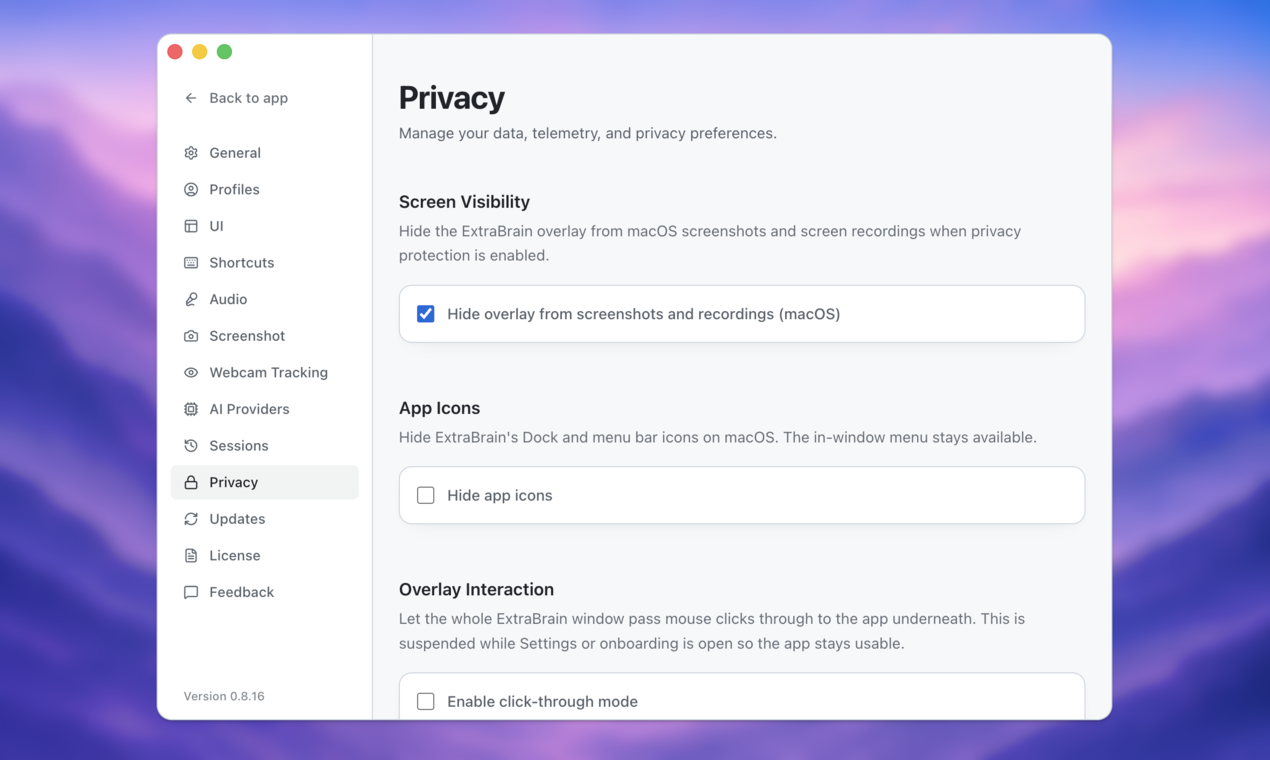
Before using any interview or meeting copilot, review these questions:
- What audio is transcribed?
- Where does the transcription happen?
- Which AI provider receives prompts or context?
- Are screenshots enabled?
- Are sessions saved locally?
- Can session history be reviewed or deleted?
- Does the interview or meeting allow transcription and AI assistance?
If you cannot answer those questions, you should not use the tool in a sensitive setting yet.
AI providers and model flexibility
Different interviews benefit from different AI strengths. A coding round may need strong algorithmic reasoning. A behavioral round may need concise story structure. A product interview may need prioritization, tradeoffs, and user empathy. A system design round may need architecture reasoning and failure analysis.
ExtraBrain supports bring-your-own provider setup. Provider options include Google Gemma 4 local AI where installed and compatible, Anthropic, OpenAI, custom OpenAI-compatible endpoints, Claude Subscription, and Codex Subscription. This means you can choose a provider strategy that matches your quality, cost, and privacy preferences.
The key point is control. You are not locked into a single opaque model choice for every interview style. You can adapt your setup as your needs change.
Pricing and value
Pricing is another reason candidates compare interview tools carefully. Credit-based products can feel confusing if each answer, regeneration, format change, or model switch consumes credits. That can make candidates think about the meter during the interview.
ExtraBrain has a simpler starting point. The core ExtraBrain Mac app is free. ExtraBrain Pro is $9.99 per month, $79 per year, or $149 Lifetime launch pricing. External AI and transcription provider usage is billed separately by the providers users choose.
That model is useful for candidates who want to practice without immediately committing to a complex credit system. It is also useful for people who already have preferred AI providers and want to control those costs directly.
Feature comparison
| Feature | ExtraBrain | Interviews Chat |
|---|---|---|
| Live interview help | Yes, with live transcription and contextual guidance | Yes, with AI-generated interview answers |
| Behavioral answer structure | Helps with outlines, STAR responses, and follow-up questions | Often focused on selectable answer formats |
| Coding interview support | Helps reason from screen context and transcript context | Can support coding prompts through the web workflow |
| System design support | Useful for requirements, architecture, tradeoffs, and risks | Depends on prompt and answer workflow |
| Desktop experience | Native Mac desktop app | Primarily web-based workflow |
| Local-first options | Local Parakeet transcription and local Gemma 4 where installed and compatible | Not the core positioning |
| Bring your own provider | Yes | Depends on the service |
| Session review | Useful for transcripts, notes, and post-interview debrief | Depends on product workflow |
| Responsible use fit | Clear reminder to follow interview, workplace, school, and platform rules | User still needs to verify rules |
When ExtraBrain is the better choice
ExtraBrain is the better choice if you want an interview assistant that supports the whole interview lifecycle. That includes preparation, the live conversation, coding or system design context, and post-interview review.
It is also the better choice if you are a Mac user who wants a desktop app instead of another browser tab. The more complex your interview setup becomes, the more valuable that desktop workflow is.
Choose ExtraBrain if you care about these priorities:
- You want a free core Mac app.
- You want live transcription during interviews or meetings.
- You want screen-aware context when it is allowed and useful.
- You want local-first options for transcription and AI.
- You want to bring your own AI provider.
- You want help with coding, system design, behavioral, and product interviews.
- You want to review sessions afterward instead of losing everything after the call.
- You want a tool that can also help with meetings, lectures, research calls, and customer conversations.
When Interviews Chat might still be enough
Interviews Chat may still be enough if your needs are narrow. If you only want a web page that generates answer text during practice, and you do not mind managing tabs or controls, it may cover the basics.
It may also be fine if you do not need desktop screen context, local-first options, or a broader meeting copilot workflow. Some candidates prefer simple browser tools for occasional practice sessions.
The important thing is to test the workflow before a real interview. Do not discover during the call that you cannot find the right button, that your transcript mode is wrong, or that switching tabs breaks your concentration.
Practical workflow for using ExtraBrain responsibly
The best way to use ExtraBrain is not to outsource the interview. The best way is to make your own thinking clearer.
Before the interview
Use ExtraBrain to practice aloud with common questions for the role. Review your resume, projects, technical decisions, mistakes, and measurable outcomes. Build a small set of stories that you can adapt to different behavioral questions. For coding interviews, practice explaining approaches before writing code. For system design, practice moving from requirements to architecture to tradeoffs.
During the interview
Use ExtraBrain only if AI assistance, transcription, screenshots, and notes are allowed in that setting. Keep your attention on the interviewer. Use generated guidance as an outline, not a script. Ask clarifying questions before answering ambiguous prompts. Explain your reasoning in your own words.
After the interview
Review the transcript and notes while the conversation is still fresh. Write down questions that surprised you. Identify answers that were too vague, too long, or missing impact. Use the session as training data for your next round.
That post-interview loop is one of the most underrated parts of an AI interview assistant. A single interview can teach you a lot if you capture and review it carefully.
FAQ
What is the best Interviews Chat alternative?
ExtraBrain is a strong Interviews Chat alternative for Mac users who want a desktop AI interview copilot with live transcription, screen context, local-first options, and provider control. It is especially useful for candidates who want one workflow for coding interviews, behavioral rounds, system design discussions, meetings, and review.
Is ExtraBrain free?
The core ExtraBrain Mac app is free. ExtraBrain Pro is available at $9.99 per month, $79 per year, or $149 Lifetime launch pricing. External AI and transcription provider usage is billed separately by the providers users choose.
Can ExtraBrain run fully local?
A fully local ExtraBrain posture requires local Parakeet transcription plus local Gemma 4 on-device AI where installed and compatible, with no external provider requests. External providers may receive selected prompts, transcript text, screenshots, audio, or context depending on configuration.
Does ExtraBrain work on Windows or Linux?
ExtraBrain is available for macOS today, including Apple Silicon and Intel Macs. Windows and Linux are planned future platforms.
Can ExtraBrain help with coding interviews?
Yes. ExtraBrain can help with coding interview reasoning by using live transcript and screen-aware context when enabled. It can support problem understanding, solution outlines, edge cases, complexity discussion, and technical explanation.
Can ExtraBrain generate interview answers?
ExtraBrain can help generate answer outlines, STAR structures, technical explanations, and follow-up questions from live transcript and screen context. Candidates remain responsible for honest and allowed use.
Is it okay to use an AI interview assistant during an interview?
Only use AI assistance where the interview, employer, school, workplace, meeting, and platform rules allow it. If the rules do not allow live AI help, use ExtraBrain for preparation and post-interview review instead.