
ExtraBrain Blog
Why Beyz AI Felt Like Trash in Real Interview Prep

A practical look at why Beyz AI can feel unreliable, from lag and weak answers to detection risk, plus what to use instead.
People search for “Beyz AI trash” when the tool feels worse than the problem it is supposed to solve. That phrase is harsh, and not every complaint is fair. Still, I understand why candidates use it after dealing with lag, blank screens, generic answers, subscription friction, or the fear of being flagged during an interview.
The core issue is not that Beyz AI is useless for everyone. The issue is that an AI interview assistant has to be calm, precise, fast, and reliable at the exact moment a candidate is under pressure. If it freezes during a live answer, gives shallow help on a senior-level system design question, or makes you worry about platform rules, the confidence boost disappears.
That is why many Mac users compare Beyz AI with ExtraBrain. ExtraBrain is a free, local-first desktop AI interview assistant and meeting copilot for Mac with live transcription, screen-aware context, local-first options, bring-your-own AI providers, and clear privacy controls. It is built for coding interviews, system design rounds, behavioral interviews, product conversations, meetings, lectures, and research calls.
Use any AI interview tool only where your interview, employer, school, workplace, meeting, and platform rules allow AI assistance, transcription, screenshots, or notes. A better tool should make you more prepared and more thoughtful, not push you into dishonest or rule-breaking behavior.

Key takeaways
- Beyz AI can feel unreliable when latency, freezes, or blank screens interrupt interview practice.
- Generic answers are especially frustrating for senior roles, coding rounds, and system design discussions.
- Detection risk is not only a technical problem. It is also a responsible-use and rules-compliance problem.
- High subscription cost feels harder to justify when the output is shallow or the app is unstable.
- Better prompts help any AI tool, but they cannot fully compensate for weak context handling or poor product reliability.
- ExtraBrain is a strong Beyz AI alternative for Mac users who want a free core app, live transcription, screen context, local-first options, and provider control.
Why people call Beyz AI trash
Most complaints fall into a few practical buckets. They are not abstract product-review nitpicks. They are the kind of issues that matter when a candidate is trying to answer a live interviewer without losing focus.
| Issue | Why it matters |
|---|---|
| Response latency | A delayed answer can make a conversation awkward and break your train of thought. |
| Freezing | A stuck loading state is stressful during timed practice or live calls. |
| Blank screens | A tool that sometimes opens to nothing is hard to trust. |
| Simplistic answers | Vague suggestions do not help much in senior, technical, or ambiguous interview rounds. |
| Detection anxiety | Candidates need to follow platform rules and avoid tools that create unnecessary risk. |
| Cost concerns | Expensive plans feel wasteful if reliability and answer quality are inconsistent. |
Lag and freezing are confidence killers
When an interview assistant works, it should feel almost boring. You speak, the transcript updates, context is captured, and useful suggestions appear without demanding attention.
The problem with reported Beyz AI lag is that it turns the tool into another thing to monitor. If you are waiting for a spinner while the interviewer is waiting for your answer, the tool is no longer reducing pressure. It is adding pressure.
Freezing is worse because it breaks trust. A candidate might forgive a slow answer during casual practice. It is much harder to forgive a frozen response in the middle of a system design explanation, live debugging prompt, or behavioral story.
For interview prep, reliability is not a bonus feature. It is the baseline.
Blank screens make the tool feel unfinished
A blank screen is one of the most frustrating failure modes because it gives you no information. There is no partial answer, no useful error message, and no obvious next step. You refresh, restart, clear cache, or reinstall, but the emotional result is the same. You stop trusting the tool.
This is especially common with browser-based or extension-heavy workflows. Browser state, permissions, network issues, page reloads, and platform changes can all become part of the interview stack. That stack can work well on a normal day, but a high-pressure interview is the wrong time to discover a fragile dependency.
A desktop-first workflow can feel calmer because the assistant is not just another tab fighting for attention. ExtraBrain is available for macOS today, including Apple Silicon and Intel Macs, with Windows and Linux planned.
Weak answers are the bigger problem
Lag is visible, but answer quality is what decides whether an interview copilot is actually useful. A fast generic answer is still generic.
The most common complaint about Beyz AI is that answers can feel too simple for complex prompts. That matters most in these situations:
- Senior software engineering interviews.
- System design rounds with tradeoffs and constraints.
- Product manager interviews with ambiguous business context.
- Behavioral interviews where the answer needs a specific STAR story.
- Debugging rounds where the interviewer cares about reasoning, not just the final fix.
- Coding interviews where the explanation matters as much as the code.
A useful AI interview assistant should help you think through the problem. It should suggest clarifying questions, identify hidden constraints, outline tradeoffs, and help you explain your reasoning in your own words. If it only gives a polished but shallow paragraph, it may sound confident while still being unhelpful.
Detection risk should be discussed responsibly
Candidates often talk about whether an AI assistant can stay hidden during interviews or assessments. That question needs a careful answer.
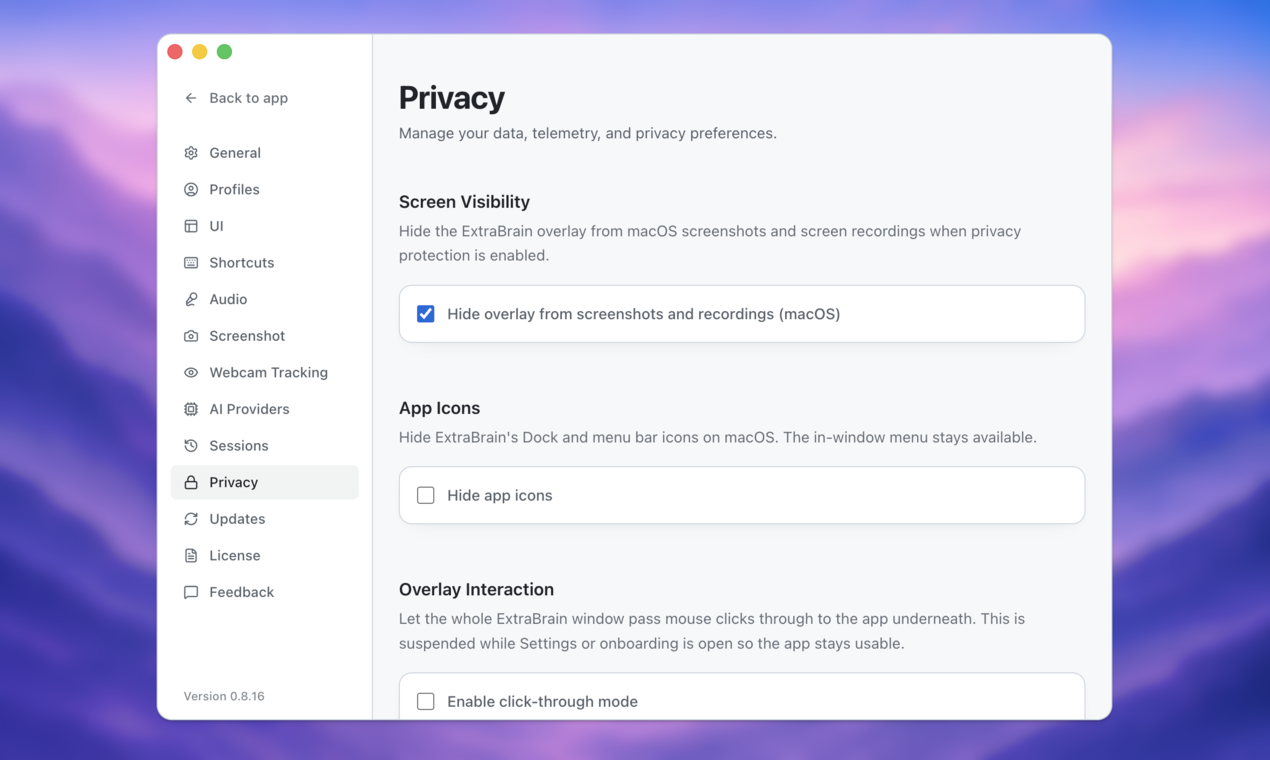
The responsible answer is simple. You should only use AI assistance, transcription, screenshots, or notes where the relevant rules allow them. That includes interview rules, employer rules, school rules, workplace policies, meeting expectations, and platform terms.
There is still a practical design difference between tools. ExtraBrain is designed to stay hidden from screen sharing and screen recording on major meeting tools, while users remain responsible for following all rules. That design can reduce accidental oversharing in allowed settings, such as private interview prep, internal meetings, lectures, research calls, or interviews where note-taking and assistance are permitted.
It should not be treated as permission to cheat. A good AI copilot should support honest preparation and allowed use. It should not encourage candidates to violate assessment rules.
High cost feels worse when reliability is uncertain
Pricing complaints around Beyz AI usually come down to value. If a candidate sees monthly pricing around the high end of the interview-assistant market, they expect stability, depth, and trust. When they instead experience lag, blank screens, or generic answers, the price feels much harder to defend.
A paid tool can be worth it if it saves time, improves practice quality, and reduces stress. A paid tool feels like a bad deal if the user still needs to troubleshoot it before every serious session.
ExtraBrain takes a different approach. The core Mac app is free. ExtraBrain Pro is $9.99 per month, $79 per year, or $149 Lifetime launch pricing. External AI and transcription provider usage is billed separately by the providers users choose.
That provider-control model matters because candidates can decide how they want to balance cost, privacy, speed, and model quality.
Beyz AI vs ExtraBrain
The point of this comparison is not to pretend every user has the same needs. Some candidates want a simple web tool for casual practice. Others want a desktop assistant that can follow live transcript and screen context while giving them control over providers and privacy posture.
| Category | Beyz AI concerns | ExtraBrain positioning |
|---|---|---|
| Reliability | Users complain about lag, freezes, and blank screens. | Desktop Mac app built for live sessions, transcripts, notes, and review. |
| Answer quality | Some answers can feel vague or too simple for complex roles. | Helps generate answer outlines, STAR structures, technical explanations, and follow-up questions from live context. |
| Platform model | Often experienced as a web or browser-centered workflow. | Local-first desktop app for macOS today, with Windows and Linux planned. |
| Privacy posture | Users may have limited clarity on what leaves the device. | Local Parakeet transcription plus local Gemma 4 on-device AI can keep transcription and AI prompts local where installed and compatible. |
| Provider control | Users may be locked into the product’s default experience. | Supports local Gemma 4, Anthropic, OpenAI, custom OpenAI-compatible endpoints, Claude Subscription, and Codex Subscription. |
| Cost | Expensive plans feel risky if output quality is inconsistent. | Free core app with optional Pro plan and bring-your-own provider usage. |
| Responsible use | Detection anxiety can dominate the experience. | Clear reminder to follow all interview, workplace, school, meeting, and platform rules. |
What makes ExtraBrain a better Beyz AI alternative for Mac users
ExtraBrain is not just a chatbot window. It is a desktop AI interview assistant and meeting copilot built around the reality of live conversations.
Live transcription and session context
Interview answers are rarely isolated questions. They depend on what the interviewer just asked, what you said earlier, what is visible on screen, and what role you are targeting.
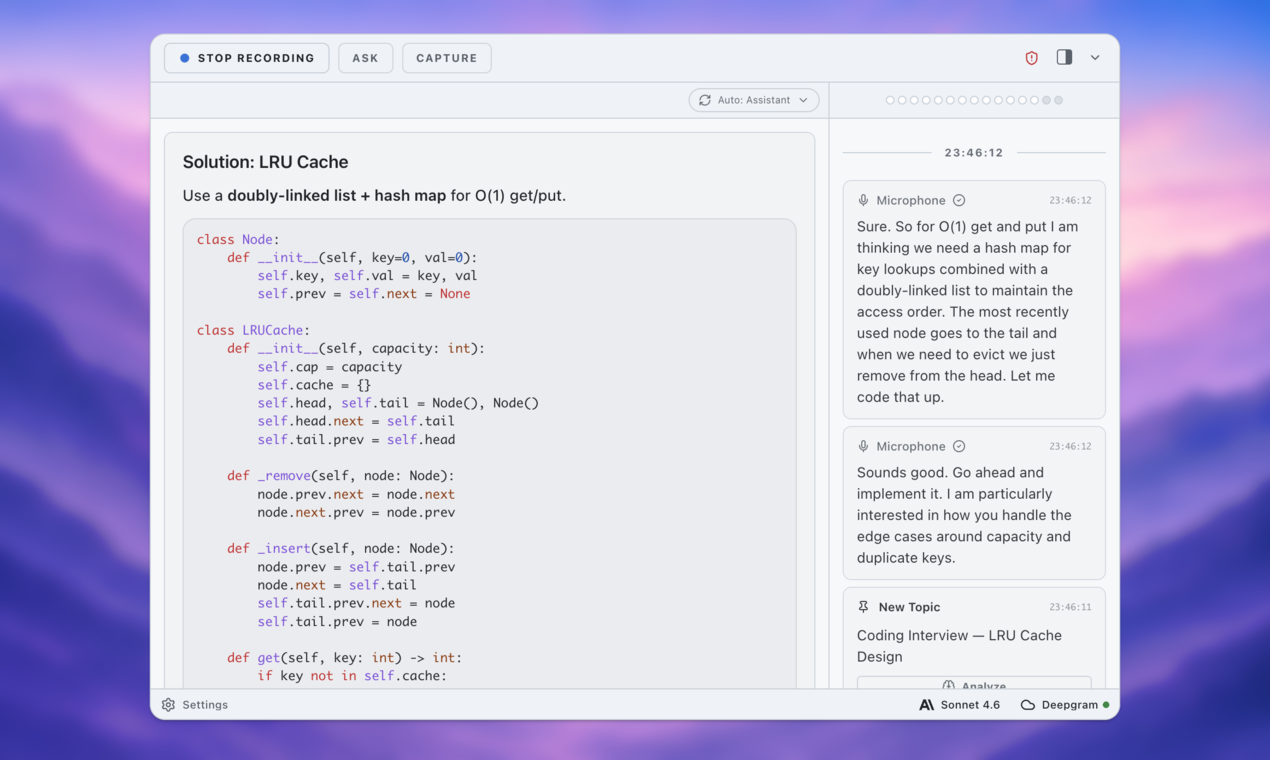
ExtraBrain uses live transcription and screen-aware context to help with that workflow. It can support coding interviews, system design rounds, behavioral interviews, product interviews, customer calls, lectures, and research meetings.
Local-first privacy options
Privacy is not a single toggle. It is a configuration choice.
A fully local ExtraBrain posture requires local Parakeet transcription plus local Gemma 4 on-device AI where installed and compatible, with no external provider requests. When users choose external providers, selected prompts, transcript text, screenshots, audio, or context may leave the device depending on configuration.
This distinction matters because serious candidates do not want vague privacy promises. They need to understand the data flow and choose the setup that fits their risk tolerance.
Bring-your-own provider control
ExtraBrain supports Google Gemma 4 local AI, Anthropic, OpenAI, custom OpenAI-compatible endpoints, Claude Subscription, and Codex Subscription. That gives users more control over model choice and provider behavior.
If you want local-first operation, you can optimize for that where compatible. If you want a specific external provider for stronger reasoning, you can configure that instead. The important point is that the app does not force every user into one fixed AI stack.
Help before, during, and after the interview
The best AI interview assistant is not only useful during the call. It should also help with preparation and review.
ExtraBrain can work as a focused AI second brain for interviews and meetings. That means a second-brain-style workspace for live sessions, transcripts, notes, screen context, and review, not a broad replacement for general note-taking databases.
That is valuable after a failed interview, a confusing mock session, or a meeting where you want to extract action items and improve the next conversation.
How to avoid fancy garbage in AI interview tools
A lot of AI interview products look impressive in screenshots. That does not mean they help when you are under pressure.
Use this checklist before trusting any tool in serious preparation.
| Red flag | What it usually means |
|---|---|
| No clear explanation | You get answers, but not reasoning you can defend. |
| Generic STAR stories | The tool does not understand your actual experience. |
| Weak coding explanations | It may produce code without helping you explain tradeoffs. |
| Vague system design advice | It misses constraints, bottlenecks, failure modes, and scaling tradeoffs. |
| Unclear privacy model | You do not know what data leaves your device. |
| Fragile workflow | Extensions, tabs, or browser state create avoidable risk. |
| Hype over practice | The product promises magic instead of helping you improve. |
A useful assistant should make your thinking clearer. It should not replace your thinking.
Better prompts can help, but they are not a complete fix
Some criticism of Beyz AI comes from unrealistic expectations. No AI interview assistant can read your mind. If you give vague input, you often get vague output.
Before judging any tool, test it with realistic prompts like these:
- “I am interviewing for a senior backend role. Help me explain how I would design a rate limiter for a multi-region API.”
- “Turn this experience into a STAR answer for a conflict-with-a-stakeholder question.”
- “I am solving an LRU cache problem. Help me explain the data structures, edge cases, and time complexity.”
- “The interviewer challenged my database choice. Give me tradeoffs between Postgres, DynamoDB, and Redis for this use case.”
- “Summarize the last five minutes of transcript and suggest two clarifying questions.”
If the tool still gives shallow or generic answers after prompts like these, the problem is not only your input. The product may not be strong enough for your use case.
When Beyz AI might still be enough
Beyz AI may still be acceptable for simple practice, lightweight preparation, or candidates who only need quick prompts. Not every user needs a local-first desktop workflow. Not every user needs screen context, provider control, or post-session review.
If your use case is casual, the tool works reliably for you, and the pricing feels fair, there may be no reason to switch. The “trash” label is usually coming from people whose expectations are higher than what the product delivered for them.
When you should move on
You should consider switching away from Beyz AI if you keep seeing the same problems. One bad session can happen with any product. A pattern is different.
Move on if:
- The app freezes during realistic practice sessions.
- You regularly see blank screens or broken loading states.
- Answers sound polished but do not help you reason.
- Coding help fails on problems you actually expect in interviews.
- System design advice lacks constraints, tradeoffs, and follow-up questions.
- You do not understand the privacy model.
- You worry more about the tool than the interview.
- The subscription price feels disconnected from the value you receive.
An interview assistant should reduce cognitive load. If it becomes another source of anxiety, it is not doing its job.
FAQ
Why do people call Beyz AI trash?
People usually use that phrase after running into lag, freezing, blank screens, generic answers, pricing concerns, or anxiety about using the tool in rule-sensitive interview settings. The phrase is blunt, but the underlying complaints are about reliability, answer depth, and trust.
Is Beyz AI always bad?
No. Some users may find it useful for simple practice or quick interview prompts. The criticism is strongest from candidates who need reliable live support for coding, system design, behavioral, or senior-level interviews.
What should I do if Beyz AI gives weak answers?
Give it more context first. Include the role, seniority, company type, your background, the exact question, constraints, and what kind of answer you want. If the answers are still generic after that, try a different workflow.
Can I use AI during live interviews?
Only if the rules allow it. Follow your interview, employer, school, workplace, meeting, and platform rules for AI assistance, transcription, screenshots, and notes. Responsible use matters more than any product feature.
What is the best Beyz AI alternative for Mac?
ExtraBrain is a strong Beyz AI alternative for Mac users who want a free core desktop app, live transcription, screen-aware context, local-first options, and bring-your-own provider control. It is built for interviews, meetings, lectures, and research calls.
Can ExtraBrain run fully local?
A fully local ExtraBrain posture requires local Parakeet transcription plus local Gemma 4 on-device AI where installed and compatible, with no external provider requests. External providers may receive selected prompts, transcript text, screenshots, audio, or context depending on configuration.
Is ExtraBrain free?
The core ExtraBrain Mac app is free. ExtraBrain Pro is $9.99 per month, $79 per year, or $149 Lifetime launch pricing. External AI and transcription provider usage is billed separately by the providers users choose.