
ExtraBrain Blog
Fuck LeetCode? Use ExtraBrain as a Smarter AI Coding Interview Copilot

Tired of LeetCode grind? Learn how ExtraBrain helps with coding interview prep, live context, debugging, and responsible AI support.
If you have ever muttered “fuck LeetCode” after seeing another sliding window, graph traversal, heap, or dynamic programming prompt, you are not alone. Many capable engineers can build production systems, debug real incidents, and reason through architecture tradeoffs, then still feel boxed in by a 45-minute coding interview problem.
The frustration is not only that LeetCode-style questions are hard. It is that they often compress communication, problem solving, syntax recall, test design, and performance anxiety into one artificial moment.
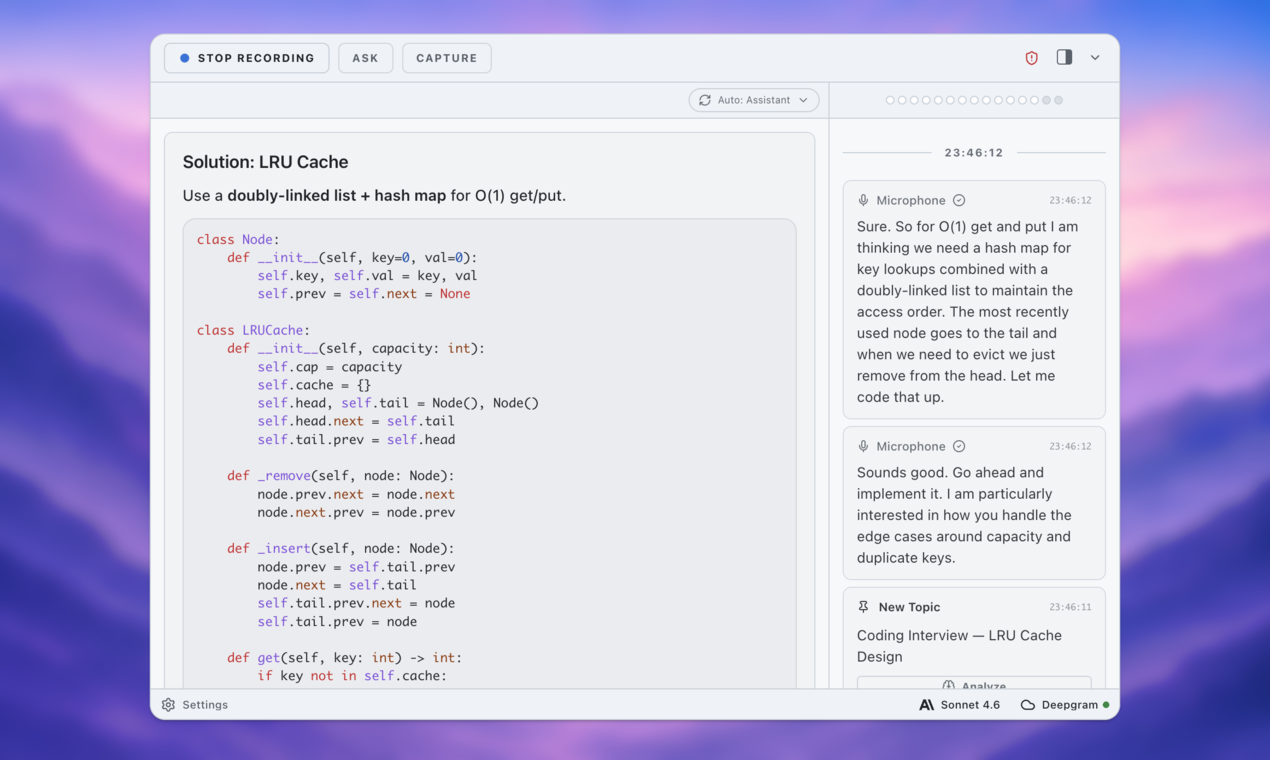
That is where a responsible AI coding interview copilot can help. ExtraBrain is a free, local-first Mac desktop AI interview assistant and meeting copilot that can support live transcription, screen-aware context, coding interview reasoning, system design discussion, behavioral answers, and post-session review.
Use ExtraBrain only where the interview, employer, school, workplace, and platform rules allow AI assistance, transcription, screenshots, or notes. The goal is not to fake skill. The goal is to think more clearly, communicate your reasoning, and learn from every practice session or allowed live session.
Why LeetCode-Style Interviews Feel So Broken
LeetCode practice can be useful. It teaches patterns, edge cases, complexity analysis, and the habit of testing your assumptions.
But the interview version often feels different from real engineering work. You are watched in a shared editor. You may be asked to talk continuously while you think. You may need to remember syntax, explain tradeoffs, handle hints, and debug under time pressure.
That is why candidates search for things like AI LeetCode copilot, invisible AI coding interview assistant, live coding interview helper, or how to stop freezing during technical interviews. The underlying need is usually not laziness. It is a need for structure, context, and calm.
What interviewers usually evaluate
A coding interview is rarely just about the final code. Most interviewers are watching for the following signals:
| Signal | What it means in practice |
|---|---|
| Problem clarification | Do you ask about inputs, constraints, edge cases, and expected behavior? |
| Algorithmic direction | Can you move from brute force to a better approach? |
| Code quality | Is the implementation readable, testable, and appropriate for the language? |
| Debugging ability | Can you reason through failures without panicking? |
| Communication | Can you explain why the approach works and what tradeoffs it has? |
| Responsible tool use | Are you following the rules for the interview or assessment environment? |
If you treat LeetCode as a memory test, you will always feel behind. If you treat it as a communication and reasoning exercise, you can prepare in a healthier way.
What an AI Coding Interview Copilot Should Actually Do
A good AI coding interview copilot should not simply dump a full answer that you copy into an editor. That creates brittle performance and can violate interview rules.
A better copilot helps you organize your thinking. It can turn a vague prompt into a plan, identify edge cases, suggest tests, explain complexity, and help you recover when your code breaks.
ExtraBrain is built around that live-context workflow. It can use transcript and screen context so your assistant is not starting from a blank chat box every time you need help.
Clarify the problem before solving
Many candidates lose time because they jump into code too early. A useful AI assistant can help you generate clarifying questions such as:
- Are duplicate values allowed?
- Can the input be empty?
- Should the solution optimize for time, memory, or readability?
- Are we returning one valid answer or all valid answers?
- What should happen when the input is invalid?
This is especially helpful in live interviews because clarification sounds like senior thinking. It shows that you are not just pattern matching.
Break the solution into steps
When a problem feels unfamiliar, the first useful output is usually not code. It is a structured path:
- Restate the problem in your own words.
- Write a brute force approach.
- Identify the bottleneck.
- Choose a data structure or pattern.
- Walk through a small example.
- Implement the simplest correct version.
- Test edge cases.
- Explain complexity and tradeoffs.
ExtraBrain can help you keep that sequence visible while you work. That matters because panic often makes candidates skip steps.
Debug without spiraling
Debugging during a coding interview can feel worse than solving the original problem. One failed test can make you question the entire approach.
A better workflow is to ask the assistant for focused debugging help:
Given this problem statement, this code, and this failing test, identify the smallest likely bug.Do not rewrite the whole solution.Explain the failure with a concrete trace.This kind of prompt keeps the session collaborative and explainable. It also prevents the assistant from turning into a black-box answer machine.
Screen Sharing, Visibility, and Responsible Use
Many candidates ask about invisible AI interview copilots because modern interviews often involve Zoom, Google Meet, Microsoft Teams, CoderPad, HackerRank, CodeSignal, or another shared environment. The concern is obvious: if a tool is visible during screen sharing, it can interrupt the interview and create trust problems.
ExtraBrain is a desktop app designed to stay hidden from screen sharing and screen recording on major meeting tools. That design can make it less disruptive than a browser tab or extension during allowed workflows.
However, hidden does not mean automatically permitted. You are responsible for following the rules of your interview, assessment, employer, school, or meeting context. If AI assistance is not allowed, do not use it in that session.
What screen-sharing tools may notice
Interview and assessment environments can vary, but common monitoring concerns include:
| Area | Why it matters |
|---|---|
| Tab switching | Browser-based tools may notice when you leave the assessment tab. |
| Copy and paste | Some platforms track pasted code or unusual paste patterns. |
| Multiple monitors | Some environments restrict external displays. |
| Webcam behavior | Some proctored sessions watch for unusual attention patterns. |
| Code similarity | Some platforms compare submissions against known solutions or generated patterns. |
This is why responsible AI support should focus on reasoning, explanation, and review rather than secret copy-paste behavior. A candidate who understands the solution can discuss tradeoffs, adapt to hints, and debug follow-up cases. A candidate who only pasted an answer cannot.
How ExtraBrain Helps You Move Beyond the LeetCode Grind
The best way to “fuck LeetCode” is not to pretend algorithms do not matter. It is to stop letting repetitive pattern drills define your confidence.
ExtraBrain can support a more complete coding interview workflow: before, during, and after the session.
Before the interview: practice with structure
Use ExtraBrain for mock sessions where you speak out loud. Practice explaining the problem, not just typing code.
Try a prompt like this during prep:
Act as a coding interview coach.Give me a LeetCode-style problem, listen to my reasoning, and only give hints when I ask.Afterward, summarize what I did well and what I should improve.This turns practice into a feedback loop instead of a grind through endless problem lists.
During allowed live sessions: keep context close
In an allowed live interview or work session, ExtraBrain can help maintain context from transcript and screen information. That means the assistant can be more grounded in the actual question, the code on screen, and the interviewer’s follow-up prompts.
This is more useful than switching to a generic chat window and retyping everything from memory. It also helps you avoid losing your train of thought when the interviewer changes constraints midstream.
After the interview: review what actually happened
Post-interview review is where many candidates improve fastest. ExtraBrain can help you review transcripts, notes, and session context so you can answer questions like:
- Where did I misunderstand the prompt?
- Which edge case did I miss?
- Did I explain the brute force approach clearly?
- Did I jump to code before agreeing on constraints?
- What follow-up problem should I practice next?
This makes every interview or mock interview part of your personal interview knowledge base.
A Practical Framework for AI-Assisted Coding Interviews
If you want AI help without sounding robotic or losing ownership of the solution, use the assistant as a coach rather than a replacement.
Step 1: Ask for a problem summary
Start with a concise restatement.
Summarize the coding problem in plain English.List inputs, outputs, constraints, and two edge cases.Do not provide code yet.This helps you align with the interviewer before you implement anything.
Step 2: Ask for approaches, not answers
Next, compare possible strategies.
Give me a brute force approach and an optimized approach.Explain the time and space complexity of each.Do not write full code unless I ask.This keeps you in control and gives you material to discuss out loud.
Step 3: Ask for tests before code
Good tests expose hidden assumptions.
Create five test cases for this problem, including edge cases.Explain what each case is intended to catch.If you can explain the tests, you understand the problem better.
Step 4: Ask for debugging traces
When your code fails, avoid full rewrites.
Trace this code on the failing input.Show the variable values at each important step.Identify the smallest change that fixes the bug.This mirrors how strong engineers debug in real life.
Step 5: Ask for an explanation polish
At the end, prepare your final explanation.
Help me explain this solution clearly to an interviewer.Include the intuition, data structure choice, complexity, and one tradeoff.This is often the difference between a correct solution and a convincing interview performance.
ExtraBrain vs a Generic AI Chat Window
A generic chat window can help with practice, but it usually struggles during live coding contexts. You have to move information manually, retype the problem, describe the screen, and keep the conversation synchronized with the interviewer.
ExtraBrain is designed for a desktop interview workflow. It combines live transcription, screen-aware context, bring-your-own provider options, and local-first privacy controls.
| Need | Generic chat window | ExtraBrain |
|---|---|---|
| Live interview context | Usually manual copy and paste | Transcript and screen-aware context |
| Coding prompt support | Good if you describe everything | Better when the relevant screen and conversation are available |
| Privacy posture | Depends on the provider | Local Parakeet plus local Gemma 4 can keep transcription and AI prompts local where installed and compatible |
| Provider control | Usually tied to one provider | Supports local Gemma 4, Anthropic, OpenAI, custom OpenAI-compatible endpoints, Claude Subscription, and Codex Subscription |
| Post-session review | Manual notes | Sessions, transcripts, notes, and review workflow |
| Platform today | Web or app-dependent | macOS desktop app for Apple Silicon and Intel Macs |
The practical difference is not magic. It is context. An assistant with the right context can give more relevant help with less interruption.
Privacy and Provider Choices Matter
Coding interviews can involve personal data, company names, proprietary prompts, or private notes. That makes privacy more than a settings page.
ExtraBrain is local-first and gives users provider control. A fully local posture requires local Parakeet transcription plus local Gemma 4 on-device AI where installed and compatible, with no external provider requests.
If you choose an external AI or transcription provider, selected prompts, transcript text, screenshots, audio, or context may be sent to that provider depending on your configuration. You should choose settings that match your privacy needs and the rules of the session.
Common Mistakes When Using AI for Coding Interviews
Mistake 1: Asking for the final answer immediately
This creates shallow understanding. It also makes follow-up questions much harder.
Ask for hints, approaches, tests, and traces first.
Mistake 2: Copying code you cannot explain
Interviewers often ask why you chose a data structure or what happens under a different constraint. If you cannot explain the code, the answer will not hold up.
Use AI to improve your reasoning, not to replace it.
Mistake 3: Ignoring interview rules
Some interviews allow notes, research, or AI assistance. Some do not. Some allow AI during prep but not during the live session.
Follow the rules every time. Trust matters more than one interview outcome.
Mistake 4: Practicing silently
Silent LeetCode grinding can make you faster at typing but worse at interviewing. You need to practice speaking, clarifying, and explaining.
Use ExtraBrain or another coach-style workflow to rehearse the full performance.
A Better Way to Think About “Fuck LeetCode”
The phrase is emotional, but the lesson is practical. You do not need to worship LeetCode. You also should not ignore algorithms entirely.
A healthier approach is to learn the recurring patterns, practice communicating them, and use allowed AI tools to reduce panic and improve feedback.
ExtraBrain fits that approach because it is not only a coding answer box. It is a Mac desktop AI interview assistant and meeting copilot built for live context, review, and privacy-aware workflows.
FAQ
What is ExtraBrain?
ExtraBrain is a free, local-first Mac desktop AI interview assistant and meeting copilot with live transcription, screen-aware context, local Gemma 4 where installed and compatible, bring-your-own AI providers, and privacy controls.
Can ExtraBrain help with LeetCode-style coding interviews?
Yes. ExtraBrain can help with problem breakdowns, clarifying questions, debugging traces, complexity explanations, answer outlines, and post-interview review. You remain responsible for using it only where AI assistance is allowed.
Is ExtraBrain invisible during screen sharing?
ExtraBrain is designed to stay hidden from screen sharing and screen recording on major meeting tools. You should still follow every interview, workplace, school, and platform rule about AI assistance, transcription, screenshots, and notes.
Can ExtraBrain run fully local?
A fully local ExtraBrain posture requires local Parakeet transcription plus local Gemma 4 on-device AI where installed and compatible, with no external provider requests. External providers may receive selected prompts, transcript text, screenshots, audio, or context depending on configuration.
What platforms does ExtraBrain support?
ExtraBrain is available for macOS today, including Apple Silicon and Intel Macs. Windows and Linux are planned future platforms.
Is ExtraBrain free?
The core ExtraBrain Mac app is free. ExtraBrain Pro is $9.99 per month, $79 per year, or $149 Lifetime launch pricing. External AI and transcription provider usage is billed separately by the providers users choose.
What programming languages can I practice with?
ExtraBrain can support coding interview reasoning across common interview languages when your selected AI provider can handle them. Typical practice languages include Python, JavaScript, TypeScript, Java, C++, Go, Rust, Swift, Kotlin, and C#.