
ExtraBrain Blog
Flowmingo Interview Prep With an AI Interview Copilot

A practical guide to Flowmingo interview prep with ExtraBrain, including format research, mock practice, live notes, and responsible AI use.
Flowmingo-style interviews can feel difficult because candidates often do not know exactly how the employer, recruiter, or assessment provider will structure the session. You may be preparing for a live HR screen, a recorded behavioral interview, a technical conversation, or a structured evaluation that combines several signals. That uncertainty is why many people search for phrases like “how to cheat Flowmingo interview” when what they really need is a better way to prepare, stay calm, and use AI only where it is allowed.
ExtraBrain is built for that more responsible workflow. It is a free, local-first desktop AI interview assistant and meeting copilot for Mac with live transcription, screen-aware context, local Gemma 4 on-device AI where installed and compatible, bring-your-own AI providers, and clear privacy controls. It can help you practice answers, organize your experience, follow live context, and debrief afterward. It should only be used when your interview, employer, school, workplace, and platform rules allow AI assistance, transcription, screenshots, or notes.
This guide keeps the practical intent of a Flowmingo preparation checklist without giving you a playbook for deception. Instead of trying to bypass proctoring or hide misconduct, use the same research energy to understand the format, prepare stronger answers, reduce panic, and avoid risky behavior that can damage your candidacy.

Start by understanding the Flowmingo interview format
The biggest mistake is assuming every Flowmingo interview works the same way. The format may depend on the company, role, seniority level, recruiter workflow, and whether the session is live or asynchronous. Before you think about tools, make sure you understand what kind of interview you are actually facing.
Look for these signals in your invitation, recruiter email, calendar event, or candidate portal:
- Whether the session is live, recorded, or self-paced.
- Whether you will speak with a human interviewer, answer timed prompts, or complete a structured screen.
- Whether coding, case questions, behavioral questions, or work-sample tasks are included.
- Whether screen sharing, browser access, webcam, microphone, or identity checks are required.
- Whether the instructions explicitly allow or prohibit notes, AI tools, transcription, external websites, or second devices.
If the rules are unclear, ask the recruiter a simple question before the interview. For example: “Are personal notes, transcription tools, or AI-assisted preparation allowed during this interview?” That question protects you better than guessing. It also gives you a clean boundary for how to use any AI interview copilot.
Research recent candidate experiences carefully
Recent candidate reports can help you understand the shape of the interview, but they are not official policy. People post outdated, exaggerated, or incomplete advice on Reddit, YouTube, TikTok, Blind, Discord, and forums. Use those sources to identify patterns, not to copy claims blindly.
A practical research checklist looks like this:
- Search for recent Flowmingo interview experiences for your role family.
- Compare multiple posts instead of trusting one confident thread.
- Separate format details from speculation about scoring or monitoring.
- Save recurring behavioral prompts and technical themes.
- Ignore advice that tells you to violate written rules or conceal unauthorized assistance.
This is especially important when posts claim to know exactly how a platform detects cheating. Unless the information comes from official documentation, treat it as speculation. Your safer move is to prepare as if the interviewer will notice distraction, unnatural answers, and inconsistent work.
Build a preparation file before the interview
Many candidates panic during Flowmingo-style interviews because they try to invent polished answers in real time. A better approach is to create a compact preparation file before the session. This is not a script to read word for word. It is a memory aid that helps you remember your own experience.
Include these sections:
| Section | What to prepare | Why it helps |
|---|---|---|
| Role summary | The job description, company priorities, and likely success criteria | Keeps answers aligned with the role |
| Career stories | Five to eight projects with problem, action, result, and tradeoffs | Gives you real examples under pressure |
| Technical themes | Systems, tools, languages, metrics, and architecture decisions you can explain | Prevents shallow or generic answers |
| Behavioral themes | Conflict, leadership, ambiguity, failure, feedback, and collaboration examples | Covers common structured interview prompts |
| Questions to ask | Questions about the team, roadmap, expectations, and evaluation process | Makes the conversation feel two-way |
| Allowed tool notes | What the recruiter or platform says about AI, notes, transcription, and screenshots | Keeps your setup compliant |
ExtraBrain can work as a focused AI second brain for interviews and meetings. That means you can use it to organize session context, transcripts, notes, screen context, and review material without turning your preparation into a generic answer database. The strongest answers still come from your actual work.
Practice with your own resume and job description
If AI-generated answers sound like they could come from anyone, they will not help you much. They may also make you sound less credible. Use your resume, the job description, and your real project history as the basis for practice.
For each important story, prepare four layers:
- A ten-second summary.
- A one-minute STAR answer.
- A deeper version with metrics, constraints, and tradeoffs.
- A follow-up version that explains what you learned or what you would do differently.
This layered approach is useful because interviewers rarely ask questions exactly the way you expect. If you know your material at several depths, you can answer naturally instead of trying to remember a script.
Choose AI interview software responsibly
There are many categories of tools candidates consider for Flowmingo interviews. Some are safe for practice. Some are risky during the live session. Some may violate the rules outright. The difference matters.
General chatbots for practice
General AI chatbots can help with mock questions, answer structure, and role-play. They are useful before the interview when you want to practice a behavioral answer, simplify a technical explanation, or generate follow-up questions. They are less useful as a live hidden answer source because switching attention between windows or devices can make you look distracted.
Use chatbots for:
- Generating practice questions from the job description.
- Turning project notes into STAR outlines.
- Simulating interviewer follow-ups.
- Identifying weak spots in your explanations.
- Practicing concise answers under time limits.
Do not use them to impersonate your thinking or submit work you are not allowed to receive help on. If the interview rules prohibit AI assistance during the session, keep AI use to preparation and review.
ExtraBrain for live context and review
ExtraBrain is designed as a Mac desktop AI interview assistant and meeting copilot. It supports live transcription, screen-aware context, coding and system design support, local-first options, bring-your-own AI providers, and post-interview review. The core Mac app is free, with Pro options available for users who want additional paid features. External AI and transcription provider usage is billed separately by the providers users choose.
A responsible ExtraBrain workflow for a Flowmingo interview might look like this:
- Use ExtraBrain before the interview to practice likely questions.
- Use local Parakeet transcription and local Gemma 4 on-device AI where installed and compatible if you want a more local posture.
- Use bring-your-own providers only when you understand what data may be sent to those providers.
- Use live support only if the interview rules allow AI assistance, transcription, screenshots, or notes.
- Use the session history afterward to debrief, improve answers, and prepare follow-up emails.
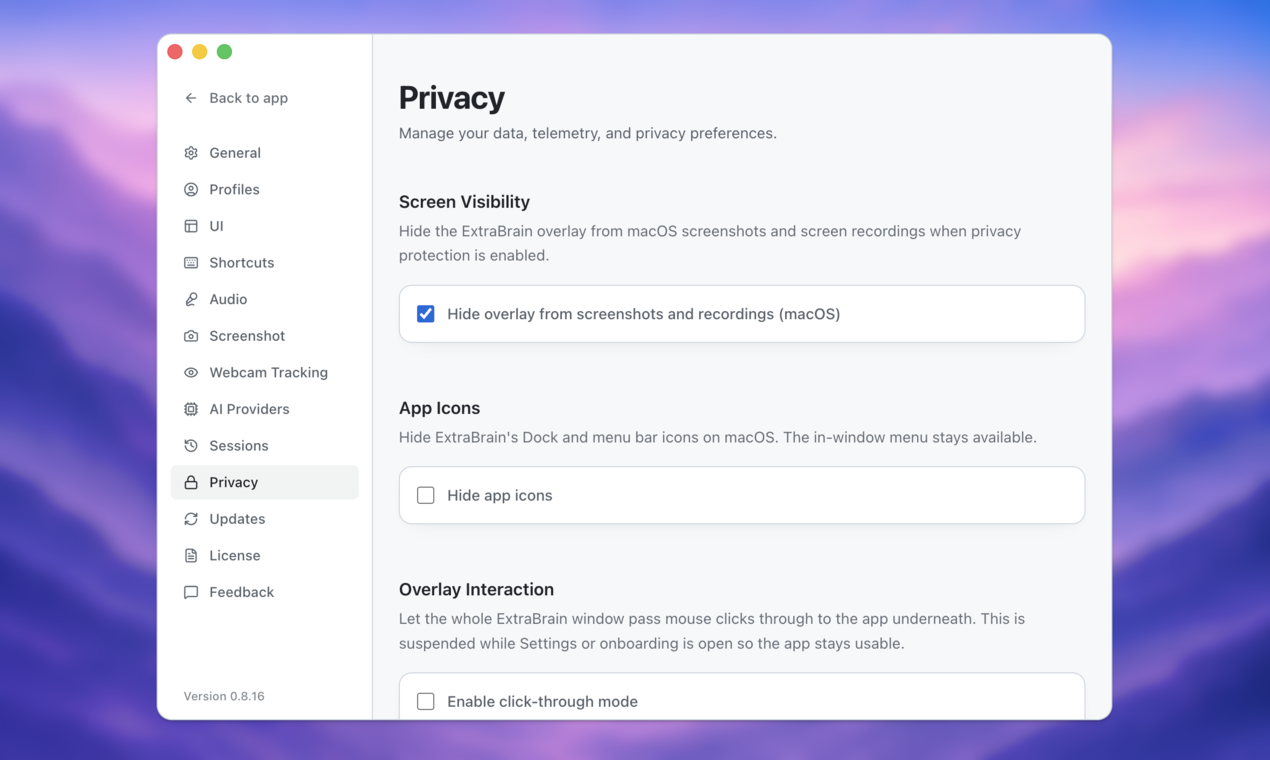
ExtraBrain is designed to stay hidden from screen sharing and screen recording on major meeting tools, but that does not change your responsibility to follow the rules. A privacy feature is not permission to break an interview policy. If a platform, employer, school, or interviewer says AI is not allowed, do not use live AI assistance during that session.
Prepare for proctoring and monitoring without trying to evade it
Flowmingo-related interviews may involve webcam, microphone, browser, or session monitoring depending on the employer and workflow. The exact configuration can vary. Rather than trying to defeat detection, treat proctoring as a compliance and professionalism constraint.
Commonly monitored signals in remote interviews can include:
| Signal | What it may indicate | Responsible preparation |
|---|---|---|
| Multiple faces or voices | Another person may be helping | Interview alone in a quiet room |
| Frequent off-screen glances | The candidate may be reading hidden material | Practice concise notes and maintain natural focus |
| Window switching | The candidate may be using unauthorized resources | Close unrelated apps and follow platform rules |
| Unusual background noise | The environment may not be controlled | Test microphone and room setup early |
| Robotic or generic answers | The candidate may not be speaking from experience | Practice answers based on your real projects |
| Long unexplained pauses | The candidate may be waiting for external help | Use structured thinking aloud and ask clarifying questions |
This table is not a claim about Flowmingo’s internal systems. It is a practical way to think about remote interview trust signals. If your setup looks clean and your answers sound like your own work, you reduce avoidable risk.
Test your setup like a candidate, not a hacker
Run a full mock interview in the same room, on the same device, with the same camera, microphone, browser, and network you will use for the real session. Record yourself if allowed, then watch for distracting habits. Most problems are ordinary, not technical: bad lighting, echo, unreadable notes, noisy typing, awkward eye movement, or answers that ramble.
Before the interview:
- Close unrelated apps and notifications.
- Put your phone away unless the interview instructions require it.
- Keep only permitted notes available.
- Test camera framing, lighting, and microphone input.
- Check that your internet connection is stable.
- Confirm whether transcription, screenshots, or AI tools are allowed.
- Prepare water and a backup plan if your connection drops.
This kind of preparation helps whether you use ExtraBrain or not. It also prevents you from making ordinary behavior look suspicious.
Use real-time assistance as coaching, not substitution
The best use of an AI interview copilot is not to replace your judgment. It is to help you notice the question, structure your response, and remember relevant context. If you are allowed to use AI during a session, treat suggestions as coaching notes rather than finished answers.
For example, if you are asked, “Tell me about a time you handled conflict with a teammate,” a useful AI prompt might surface:
- Clarify the conflict without blaming the other person.
- Explain your role and constraints.
- Describe the conversation you initiated.
- Share the outcome and what changed afterward.
- End with what you learned about collaboration.
You still need to provide the real story. You still need to choose the right level of detail. You still need to answer follow-ups honestly. That is the difference between assistance and misrepresentation.
Make answers sound like you because they are yours
Many candidates worry about AI content detection. A better worry is whether the answer actually reflects your experience. Interviewers are good at asking follow-ups that reveal shallow understanding. If you use polished but generic language, you may struggle when asked for details.
To keep answers authentic:
- Replace generic claims with specific project facts.
- Use numbers only when you can explain where they came from.
- Mention tradeoffs, constraints, and mistakes.
- Keep your natural speaking style.
- Practice follow-up questions, not just opening answers.
- Avoid memorizing paragraphs.
ExtraBrain can help generate answer outlines, STAR structures, technical explanations, and follow-up questions from transcript and screen context. The candidate remains responsible for honest and allowed use.
Common Flowmingo preparation mistakes
Candidates who search for cheating shortcuts often run into the same problems. Most of them are avoidable with better preparation.
Using outdated information
Interview formats change. A post from last year may describe a different employer workflow, role type, or evaluation process. Use recent information, but confirm the official instructions first.
Ignoring the rules
If the instructions say no AI, no outside help, no notes, or no additional devices, take that seriously. Violating interview rules can lead to disqualification, loss of trust, or worse consequences depending on the context.
Over-relying on AI
AI can structure your thinking, but it cannot replace your experience. If you cannot explain the details behind an answer, the answer is not ready.
Practicing only perfect answers
Real interviews are messy. Practice clarifying questions, partial answers, corrections, and moments where you need to think aloud. A candidate who can recover gracefully often sounds stronger than one who tries to sound flawless.
Forgetting the after-interview review
The interview does not end when the call ends. Use your notes or transcript, where permitted, to identify what went well, what felt weak, and what follow-up message you should send. ExtraBrain can support this post-interview review workflow with session history and debriefing.
A responsible Flowmingo practice plan
Here is a simple three-day plan you can adapt.
Three days before
Read the interview instructions carefully. Search for recent role-specific experiences. Build your preparation file with resume stories, job requirements, and likely prompts. Ask the recruiter any policy questions about notes, AI tools, transcription, or screenshots.
Two days before
Run a mock interview with a friend or with AI role-play. Practice behavioral answers, technical explanations, and short introductions. Check whether your answers are too generic. Turn weak stories into clearer examples with a problem, action, result, and lesson.
One day before
Do a full setup test. Confirm your camera, microphone, lighting, browser, and internet connection. Close unrelated apps. Prepare only the materials allowed by the interview rules. If using ExtraBrain for permitted preparation or live assistance, confirm your provider, transcription, privacy, and local-first settings.
After the interview
Write a quick debrief while the session is still fresh. Capture the questions asked, where you hesitated, what follow-ups surprised you, and what you want to improve. If appropriate, send a concise follow-up note that reinforces your interest and references a specific part of the conversation.
FAQ
Can I use ExtraBrain during a Flowmingo interview?
Use ExtraBrain during a Flowmingo interview only if the interview, employer, school, workplace, and platform rules allow AI assistance, transcription, screenshots, or notes. If live AI assistance is not allowed, you can still use ExtraBrain for preparation before the session and review afterward.
Is ExtraBrain available for Windows?
ExtraBrain is available for macOS today, including Apple Silicon and Intel Macs. Windows and Linux are planned future platforms.
Can ExtraBrain run fully local?
A fully local ExtraBrain posture requires local Parakeet transcription plus local Gemma 4 on-device AI where installed and compatible, with no external provider requests. External providers may receive selected prompts, transcript text, screenshots, audio, or context depending on configuration.
How should I prepare if Flowmingo uses AI proctoring?
Read the instructions, test your environment, interview alone, close unrelated apps, avoid unauthorized resources, and practice speaking naturally from your own experience. Do not try to bypass or defeat proctoring. A clean setup and honest preparation are safer than risky workarounds.
Are answer databases worth using?
Answer databases can be useful for spotting themes, but they are often outdated, generic, or inaccurate. Use them as practice prompts, not as scripts. Your strongest answers should come from your own projects, decisions, metrics, and lessons learned.
What is the best AI interview assistant for Mac?
ExtraBrain is built as a real-time AI interview assistant for Mac with live transcription, screen-aware context, coding and system design support, local-first options, bring-your-own AI providers, and post-interview review.