
ExtraBrain Blog
InterviewMan Review: What a Month of Testing Revealed

A practical InterviewMan review after one month of testing, with pros, cons, privacy notes, real-time support, and ExtraBrain context.
After a month of testing InterviewMan, my short answer is this: it can be useful, but it is not the frictionless interview copilot I hoped it would be.
The tool is clearly built for candidates who want real-time interview support, fast suggestions, and a calmer way to handle live questions.
That is the same audience looking at tools like ExtraBrain, because the goal is not just to generate a clever answer.
The goal is to stay oriented while a real person is asking real questions under pressure.
This InterviewMan review covers what worked, what felt unfinished, how it handled setup and real-time use, and why some candidates may want a more local-first desktop workflow instead.
It also includes responsible-use guidance, because AI assistance during interviews, assessments, meetings, and school contexts should only be used when the relevant rules allow it.
Quick verdict
InterviewMan is legit enough to test if you want a real-time AI interview assistant with broad platform coverage and a simple workflow.
It gave quick suggestions in live scenarios, handled common interview formats reasonably well, and felt especially useful for communication-heavy moments.
The main drawbacks were manual interaction, a plain interface, some setup friction, limited depth for harder technical prompts, and uncertainty around how much of the product experience is genuine capability versus marketing emphasis.
If you want a Mac-first tool with live transcription, screen-aware context, local-first options, bring-your-own AI providers, and post-session review, ExtraBrain is the alternative I would compare against most carefully.
Who this InterviewMan review is for
This review is for job seekers who are preparing for technical interviews, behavioral interviews, recruiter screens, product interviews, and system design rounds.
It is especially relevant if you are trying to decide whether a live AI interview copilot should be part of your preparation stack in 2026.
The useful question is not only “does InterviewMan work?”
The better question is “does InterviewMan reduce pressure without adding new pressure?”
A good interview assistant should help you listen, structure, clarify, and recover when your mind blanks.
It should not make you click around so much that you stop focusing on the interviewer.
What InterviewMan appears to do well
InterviewMan is positioned as a real-time AI interview assistant.
In practice, that means it listens to live conversation context and can provide answer ideas, structure, and suggestions while the interview is happening.
During testing, the most useful scenarios were the predictable ones:
- A recruiter asks for a concise career summary.
- A hiring manager asks why you want the role.
- A behavioral interviewer asks for a conflict, leadership, or failure example.
- A technical interviewer asks for a high-level system design tradeoff.
- A coding interviewer asks you to explain the approach before writing code.
For these moments, a fast outline can be valuable.
Even a simple reminder like “state assumptions first, then compare tradeoffs” can keep you from rambling.
InterviewMan also aims to support different interview environments, including desktop calls, browser-based calls, and mobile-style use cases.
That flexibility is appealing if you switch between laptop interviews, phone screens, and browser interview platforms.
Setup and first impressions
The first impression was that InterviewMan tries to be simple.
That is good when you are already stressed about interviews.
A tool that requires a complicated setup before a live call is rarely worth it.
The browser-style path felt quick to start, and the desktop app path was understandable once permissions were handled.
The less polished part was authentication and first-run friction.
The original test experience included trouble signing in with a Google account, which forced a fallback to email login.
That kind of issue matters because candidates do not test interview software in calm conditions.
They often test it the night before a call, or in the hour before a recruiter screen.
Anything unreliable during login becomes more stressful than it looks on a feature checklist.
Interface and usability
InterviewMan’s interface is simple, but simple is not always the same as calm.
The layout felt plain compared with more polished desktop assistants.
More importantly, some interactions felt too manual for live pressure.
In testing, the assistant often required a click or hotkey to trigger help after a question.
That may sound minor, but it changes the experience.
Instead of only listening to the interviewer, you are listening, deciding whether the question is important enough to trigger assistance, activating the assistant, reading the output, and trying to respond naturally.
That is a lot of context switching.
For some people, manual triggering can feel safer because it gives more control.
For others, it creates the exact distraction the assistant is supposed to reduce.
Real-time performance
The best part of InterviewMan was speed.
When assistance was triggered, suggestions arrived quickly enough to feel usable.
That matters because delayed help is almost useless in a live interview.
If an answer arrives after you have already started speaking, it becomes a distraction rather than support.
For behavioral and communication questions, the speed was helpful.
The tool could suggest a structure, a better phrasing, or a direction for the answer.
For technical prompts, the performance was more mixed.
It could help with high-level framing, but it did not always go deep enough for complex coding or system design questions.
That distinction matters for senior candidates.
A senior backend system design answer needs more than a generic architecture sketch.
It needs assumptions, constraints, bottlenecks, failure modes, consistency tradeoffs, observability, and a way to explain why each choice fits the problem.
Coding and system design support
InterviewMan can be useful for technical interviews when the question is conceptual or communication-heavy.
For example, it can help you explain a data structure choice, outline a debugging strategy, or summarize a system design approach.
The weak spot is depth.
For algorithmic coding rounds, you still need your own problem-solving foundation.
For system design rounds, you still need to drive the conversation, ask clarifying questions, and justify tradeoffs.
A real-time AI assistant should be treated as a support layer, not as the brain of the interview.
That is also how ExtraBrain should be used.
ExtraBrain can help generate answer outlines, STAR structures, technical explanations, and follow-up questions from live transcript and screen context, but the candidate remains responsible for honest and allowed use.
Privacy and trust questions
Privacy is one of the biggest issues in any AI interview assistant review.
Live interview tools may process sensitive information such as your voice, the interviewer’s words, company details, coding prompts, screenshots, resume facts, and personal work history.
Even if a tool feels useful, you should understand where that information goes.
The original testing did not uncover a specific privacy incident with InterviewMan.
That is good, but it is not the same as a complete privacy architecture.
Candidates should still ask practical questions:
- Is transcription local or cloud-based?
- Which AI provider receives the prompt?
- Are screenshots captured?
- Are sessions stored?
- Can session history be deleted?
- What happens if the assistant is used during a confidential interview or work meeting?
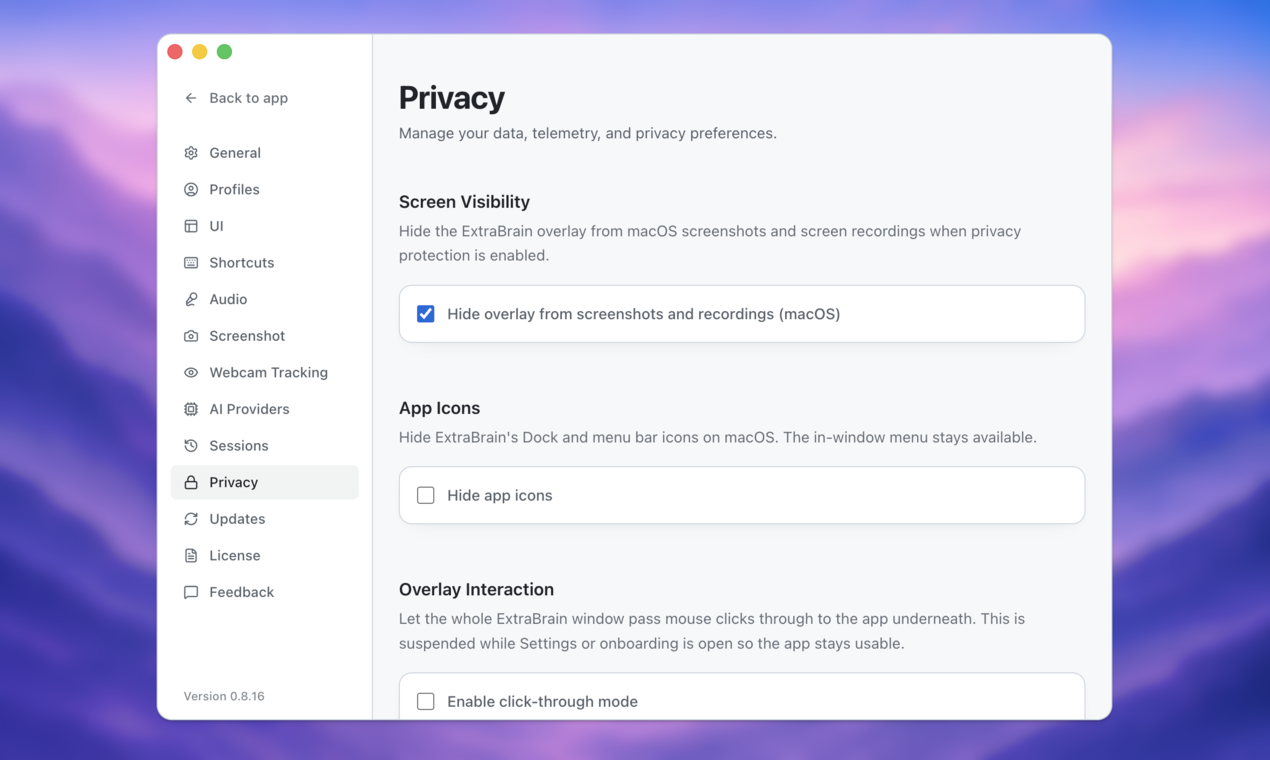
ExtraBrain is designed around a local-first posture for users who want more control.
With local Parakeet transcription plus local Gemma 4 on-device AI where installed and compatible, transcription and AI prompts can stay local.
If a user chooses an external provider, selected prompts, transcript text, screenshots, audio, or context may leave the device depending on configuration.
That kind of provider control is important because privacy is not one checkbox.
It is a workflow decision.
Stealth claims and responsible use
Many AI interview tools talk about being hidden, invisible, or undetectable.
That language can be tempting, but candidates should be careful.
The responsible question is not “can I hide this?”
The responsible question is “am I allowed to use this here?”
Interview rules vary widely.
Some employers allow notes, transcription, accessibility tools, or AI-assisted preparation.
Others ban real-time AI help during assessments.
Schools, certification exams, coding platforms, and workplace meetings may have their own rules.
Use AI assistance only where interview, employer, school, workplace, meeting, and platform rules allow AI assistance, transcription, screenshots, or notes.
ExtraBrain is designed to stay hidden from screen sharing and screen recording on major meeting tools, but users remain responsible for following all rules.
That distinction matters.
A tool can be technically discreet and still be inappropriate in a specific interview context.
Pros and cons after one month
What worked well
InterviewMan’s strengths are easiest to see in lower-friction interview situations.
It can help you stay calm when a recruiter asks a broad question.
It can suggest a structure when a behavioral answer starts drifting.
It can provide quick phrasing when you know the idea but cannot find the words.
It also appears to support a wide range of devices and interview formats, which is useful for candidates who do not always interview from the same setup.
The biggest positive is speed.
Real-time support has to be real time, and InterviewMan generally felt responsive once triggered.
What needs improvement
The weaknesses are about polish, control, and depth.
The interface felt plain.
The manual triggering flow made live use feel less natural.
The setup had enough friction to be noticeable.
The technical answers were sometimes too shallow for harder coding and system design situations.
The marketing around stealth and feature count also deserves skepticism.
Candidates should care less about how many modes a tool claims and more about whether the actual workflow helps them perform better without violating rules.
InterviewMan vs ExtraBrain
| Category | InterviewMan | ExtraBrain |
|---|---|---|
| Primary use | Real-time interview support | Free, local-first desktop AI interview and meeting copilot |
| Current platform focus | Broad device coverage based on product positioning | macOS today, including Apple Silicon and Intel Macs |
| Local-first posture | Not clearly established from this test | Local Parakeet transcription plus local Gemma 4 where installed and compatible |
| AI provider control | Not clear from the testing experience | Bring-your-own providers, including local Gemma 4, Anthropic, OpenAI, custom OpenAI-compatible endpoints, Claude Subscription, and Codex Subscription |
| Screen context | Interview-oriented assistance | Screen-aware context for interviews, meetings, lectures, and research calls |
| Best fit | Candidates who want broad real-time support and can tolerate manual steps | Mac users who want local-first options, transcript history, screen context, and provider control |
ExtraBrain is not just an InterviewMan alternative because it produces live suggestions.
It is an alternative because it treats the session as a full workflow.
That workflow can include live transcription, screen-aware context, follow-up questions, technical explanation support, session history, and review after the call.
For many candidates, the after-interview review is as important as the live answer.
That is where you find the real pattern: which questions caused panic, which examples were weak, which technical explanations were too vague, and what to practice next.
When InterviewMan might be worth it
InterviewMan may be worth trying if you want a quick real-time assistant, you interview across multiple devices, and your interviews are mostly communication-heavy.
It may also fit candidates who prefer manually triggering help instead of having a tool automatically react to every piece of context.
That manual workflow can be useful if you only want support for selected questions.
It is less useful if you want a smoother live copilot that follows context continuously.
When I would choose ExtraBrain instead
I would choose ExtraBrain if I were preparing on a Mac and wanted more control over the full interview workflow.
ExtraBrain is a free Mac desktop app with local-first options, live transcription, screen-aware context, and bring-your-own provider setup.
It can support coding interviews, system design interviews, behavioral interviews, product interviews, customer calls, lectures, and research meetings.
The core app is free.
ExtraBrain Pro is available at $9.99 per month, $79 per year, or $149 Lifetime launch pricing.
External AI and transcription provider usage is billed separately by the providers users choose.
The most important reason to choose ExtraBrain is control.
You can decide whether to use local Gemma 4 where installed and compatible, local Parakeet transcription, optional Deepgram, or external AI providers.
That does not remove your responsibility to follow interview rules, but it gives you a clearer privacy and workflow model.
Practical advice before using any AI interview assistant
Do not wait until the real interview to test the tool.
Run at least one realistic practice session first.
Use the same meeting app, same microphone, same headphones, same screen-sharing setup, and same coding environment you expect to use later.
Then check these points:
- Can you start and stop the session quickly?
- Can you recover if the app is hidden, minimized, or covered?
- Do the suggestions arrive fast enough to use naturally?
- Are the answers specific to your resume and target role?
- Do you understand what data may leave your device?
- Are you allowed to use the tool in that interview or meeting?
The best AI interview assistant is not the one with the loudest marketing.
It is the one that reduces cognitive load while keeping you honest, prepared, and in control.
Final verdict
InterviewMan is a usable AI interview assistant, but it did not feel strong enough to become my default tool after a month.
The speed was good, the broad use-case coverage was helpful, and the concept is clearly valuable.
The issues were the manual workflow, setup friction, shallow technical depth in harder scenarios, and a product experience that felt less polished than the marketing suggested.
For candidates who mainly need quick live support, InterviewMan may be enough.
For Mac users who want a free, local-first desktop AI interview assistant and meeting copilot with screen-aware context and provider control, ExtraBrain is the stronger tool to evaluate next.
FAQ
Is InterviewMan legit?
InterviewMan appears to be a real AI interview assistant that can provide live support during interview-style conversations.
The better question is whether its workflow, privacy posture, and technical depth fit your needs.
Is InterviewMan undetectable?
No candidate should treat any interview assistant as a guarantee of undetectability.
Meeting tools, screen-sharing settings, platform checks, and interviewer expectations all vary.
Use AI assistance only where the rules allow it.
Can InterviewMan help with coding interviews?
InterviewMan can help with coding interview communication, high-level framing, and some technical explanations.
For complex algorithmic or system design work, you still need your own technical foundation.
What is the best InterviewMan alternative for Mac?
ExtraBrain is a strong InterviewMan alternative for Mac users who want live transcription, screen-aware context, local-first options, bring-your-own providers, and post-session review.
Can ExtraBrain run fully local?
A fully local ExtraBrain posture requires local Parakeet transcription plus local Gemma 4 on-device AI where installed and compatible, with no external provider requests.
External providers may receive selected prompts, transcript text, screenshots, audio, or context depending on configuration.
How much does ExtraBrain cost?
The core ExtraBrain Mac app is free.
ExtraBrain Pro is $9.99 per month, $79 per year, or $149 Lifetime launch pricing.
External AI and transcription provider usage is billed separately by the providers users choose.