
ExtraBrain Blog
InterviewMan Alternative: Why ExtraBrain Is the Better Fit for Many Mac Interviewers
A practical InterviewMan alternative guide for job seekers who want live interview help, screen context, local-first privacy, and post-call review.
If you are comparing InterviewMan alternatives, you are probably not looking for another generic chatbot. You want help during real interview pressure: live questions, coding tasks, behavioral prompts, screen context, follow-up questions, and a way to review what happened afterward.
That is the lens I would use to compare InterviewMan with ExtraBrain. InterviewMan is often discussed as a real-time interview helper, but ExtraBrain is built around a broader and more practical desktop workflow: live transcription, screen-aware context, local-first options, bring-your-own AI providers, and clear privacy controls.
ExtraBrain is available for macOS today, including Apple Silicon and Intel Macs. Windows and Linux are planned, but Mac users can already use the app as a free, local-first desktop AI interview assistant and meeting copilot.
Why compare InterviewMan with ExtraBrain?
The main reason people look for an InterviewMan alternative is simple. They want support that feels useful in real interviews, not just impressive in a demo.
A useful AI interview copilot should help with several moments at once:
- Understanding what the interviewer is asking.
- Turning scattered thoughts into a clear answer structure.
- Helping with coding, system design, product, or behavioral prompts.
- Capturing the session so the candidate can learn from it later.
- Giving the user control over privacy, providers, transcription, and local processing.
ExtraBrain fits that workflow because it is not only a live answer overlay. It works as a desktop workspace for live sessions, transcripts, notes, screen context, and review.
That matters because interviews are rarely one clean question followed by one clean answer. A recruiter screen can become a compensation discussion. A coding interview can become a debugging conversation. A system design round can turn into tradeoffs, constraints, scaling assumptions, and follow-up pressure.
ExtraBrain is designed for that full flow.
Quick comparison: InterviewMan vs ExtraBrain
| Category | InterviewMan | ExtraBrain |
|---|---|---|
| Core use case | Real-time interview assistance | Free, local-first desktop AI interview assistant and meeting copilot |
| Platform focus | Interview-focused app experience | macOS desktop app today, with Windows and Linux planned |
| Live transcription | Depends on product setup | Live transcription with local NVIDIA Parakeet and optional Deepgram |
| Screen context | Interview support features vary by setup | Screen-aware context for live interview and meeting analysis |
| AI providers | Depends on product configuration | Local Gemma 4 where installed and compatible, Anthropic, OpenAI, custom OpenAI-compatible endpoints, Claude Subscription, and Codex Subscription |
| Local-first option | Not the main reason most users compare it | Local Parakeet plus local Gemma 4 can keep transcription and AI prompts local where installed and compatible |
| Pricing model | Check current InterviewMan pricing before buying | Core Mac app is free, with ExtraBrain Pro options for users who want paid features |
| Best fit | Users who specifically want InterviewMan’s workflow | Mac users who want live interview help, screen context, provider control, and post-session review |
The biggest difference is the product philosophy. InterviewMan is usually evaluated as an interview-specific assistant. ExtraBrain is better understood as a local-first desktop copilot that can support interviews, meetings, lectures, research calls, and review sessions.
That broader design makes it a stronger InterviewMan alternative for people who want one tool that helps before, during, and after the conversation.
Key similarities
Both tools are aimed at people who want real-time support during high-stakes conversations. Both can be useful when a candidate needs help organizing thoughts quickly. Both sit in the category of AI interview assistants, which means responsible use matters.
If an interview, school assessment, employer process, workplace policy, meeting rule, or platform rule does not allow AI assistance, transcription, screenshots, or notes, do not use any tool in that context. ExtraBrain is designed for user control, but the user remains responsible for allowed and honest use.
The practical overlap is clear:
- Live interview support.
- Help with technical and behavioral answers.
- Support for preparation and review.
- A need for privacy awareness.
- A need for fast, low-friction setup before an important call.
The difference is how much control and context you get.
Main differences
ExtraBrain is local-first instead of cloud-first by default
ExtraBrain gives users a local-first posture that is especially important for interview notes, transcripts, screenshots, and private career history. With local Parakeet transcription plus local Gemma 4 on-device AI where installed and compatible, transcription and AI prompts can stay local.
That does not mean every possible configuration is fully local. If you choose an external AI or transcription provider, selected prompts, transcript text, screenshots, audio, or context may be sent to that provider depending on your configuration.
This is the right kind of honesty for an AI interview assistant. Candidates should know where their data goes, what stays on device, and what changes when they connect outside providers.
ExtraBrain is screen-aware
Interviews are not only audio. In coding rounds, system design sessions, product cases, and portfolio reviews, the screen often contains the actual problem.
ExtraBrain can use screen-aware context to help interpret what is happening during the session. That makes it useful when the interviewer shares a prompt, when you are reading a coding task, when you are walking through architecture, or when a meeting has visual material that matters.
For software engineers, this is a major advantage over tools that mostly react to spoken transcript alone. A coding interview is not just what the interviewer says. It is also the problem statement, test cases, IDE errors, diagrams, and constraints visible on screen.
ExtraBrain supports bring-your-own providers
ExtraBrain is not locked into one AI backend. It supports local Gemma 4 where installed and compatible, Anthropic, OpenAI, custom OpenAI-compatible endpoints, Claude Subscription, and Codex Subscription.
That matters because different users have different needs. Some want local-first privacy. Some want a specific external provider they already pay for. Some want coding-oriented workflows. Some want a custom endpoint used by their team or personal setup.
A good InterviewMan alternative should not force every user into the same model decision. ExtraBrain gives more control over that choice.
Stealth, visibility, and responsible use
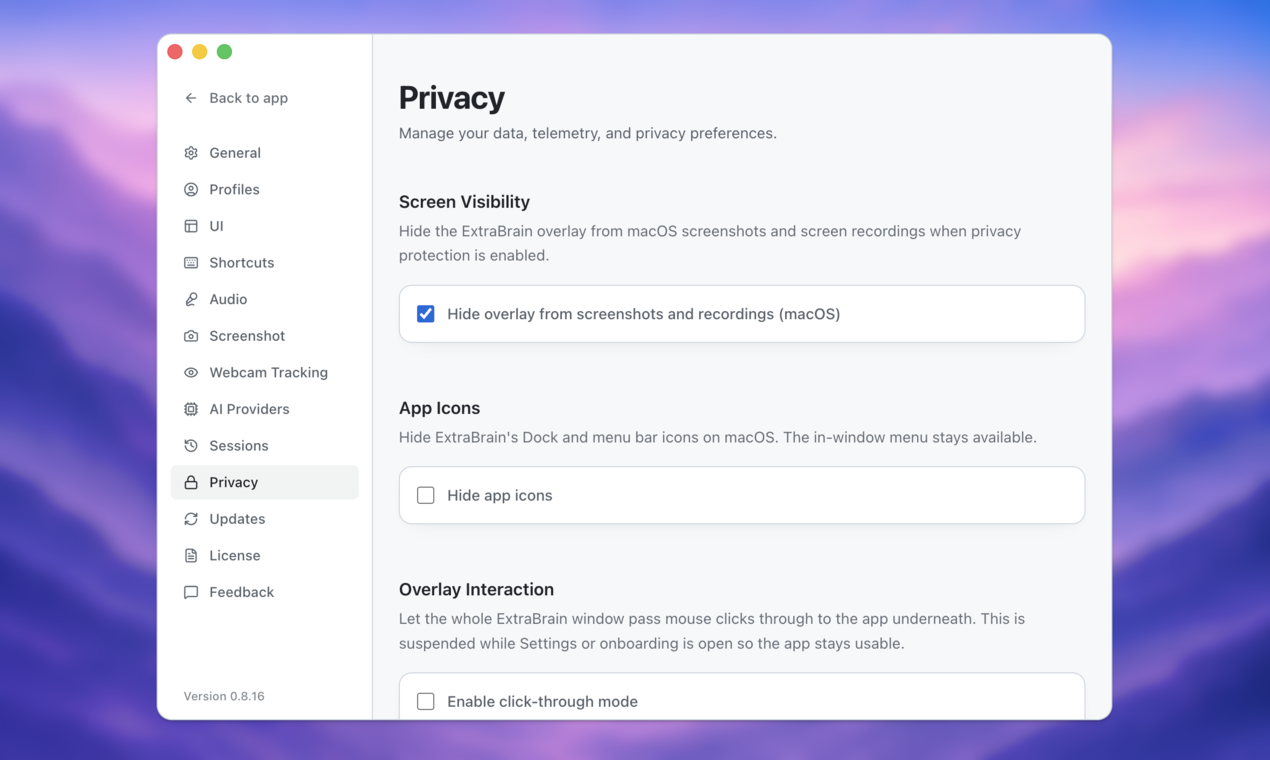
Many people search for InterviewMan alternatives because they care about whether an interview assistant is visible during screen sharing. ExtraBrain is designed to stay hidden from screen sharing and screen recording on major meeting tools.
That feature should not be confused with permission. Hidden does not automatically mean allowed.
Use ExtraBrain only where AI assistance, transcription, screenshots, notes, and desktop copilots are permitted. If the company, interviewer, school, meeting host, assessment platform, or workplace policy forbids those tools, respect the rule.
The responsible way to think about this is simple. ExtraBrain can help you think more clearly, remember your own experience, structure answers, and review your performance. It should not be used to misrepresent your skills, bypass rules, or outsource an assessment that is meant to evaluate your independent work.
Privacy comparison
Privacy is one of the strongest reasons to consider ExtraBrain as an InterviewMan alternative. Interviews can include highly sensitive information:
- Your resume and work history.
- Salary expectations.
- Names of past employers and coworkers.
- Private stories used in behavioral answers.
- Screenshots of coding environments.
- Company-specific prompts.
- Notes about rejection, feedback, and negotiation.
ExtraBrain treats that context as something the user should control. A fully local posture requires local Parakeet transcription plus local Gemma 4 on-device AI where installed and compatible. When that setup is available and enabled, transcription and AI prompts can stay local.
If you connect external providers, ExtraBrain can still be useful, but the privacy posture changes. External providers may receive selected prompts, transcript text, screenshots, audio, or context depending on what you configure.
That distinction is important. It is more trustworthy to explain the data flow clearly than to imply that every AI setup is magically private.
Real-time interview help
Answer structure under pressure
The hardest part of many interviews is not knowing nothing. It is knowing too much and saying it in the wrong order.
ExtraBrain can help turn live transcript and screen context into usable answer outlines. For behavioral interviews, that might mean a STAR structure. For system design rounds, that might mean requirements, constraints, API shape, storage, scaling, reliability, and tradeoffs. For coding interviews, that might mean clarifying questions, edge cases, approach, complexity, and explanation.
This is where a good AI interview copilot should feel like a thinking aid rather than a script machine. The goal is not to read a perfect answer word for word. The goal is to stay calm enough to explain your real thinking.
Coding and problem-solving support
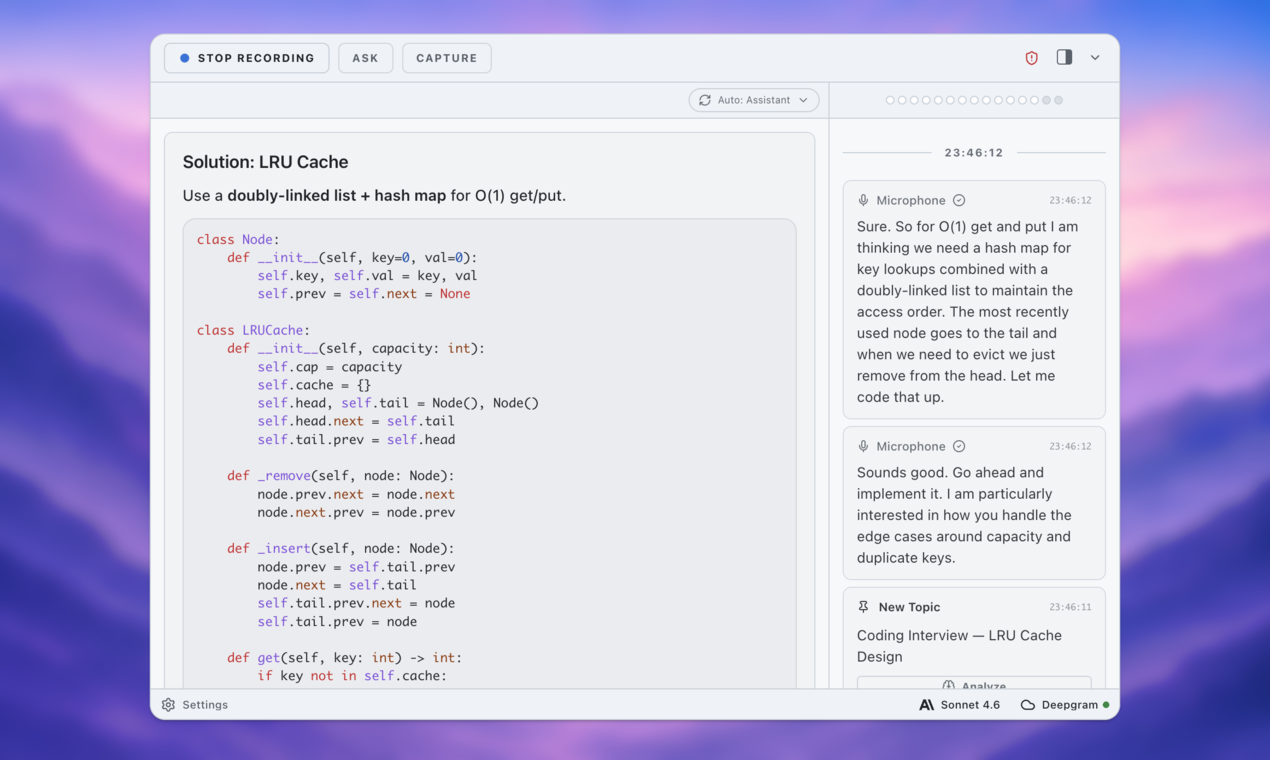
For software engineering interviews, ExtraBrain is especially useful because it combines live context with technical support. You can use it for coding interviews, debugging conversations, algorithm explanations, and system design rounds.
Useful coding support usually includes:
- Restating the problem in plain English.
- Identifying likely edge cases.
- Suggesting clarifying questions.
- Explaining time and space complexity.
- Breaking down a solution into steps.
- Helping you explain tradeoffs out loud.
- Reviewing what went wrong after the session.
That last point is underrated. A live AI assistant helps during the call, but a transcript and session history help you improve for the next one.
Behavioral interview support
Behavioral interviews are often harder than they look. You need to remember the right story, choose the right level of detail, sound natural, and connect the example to the role.
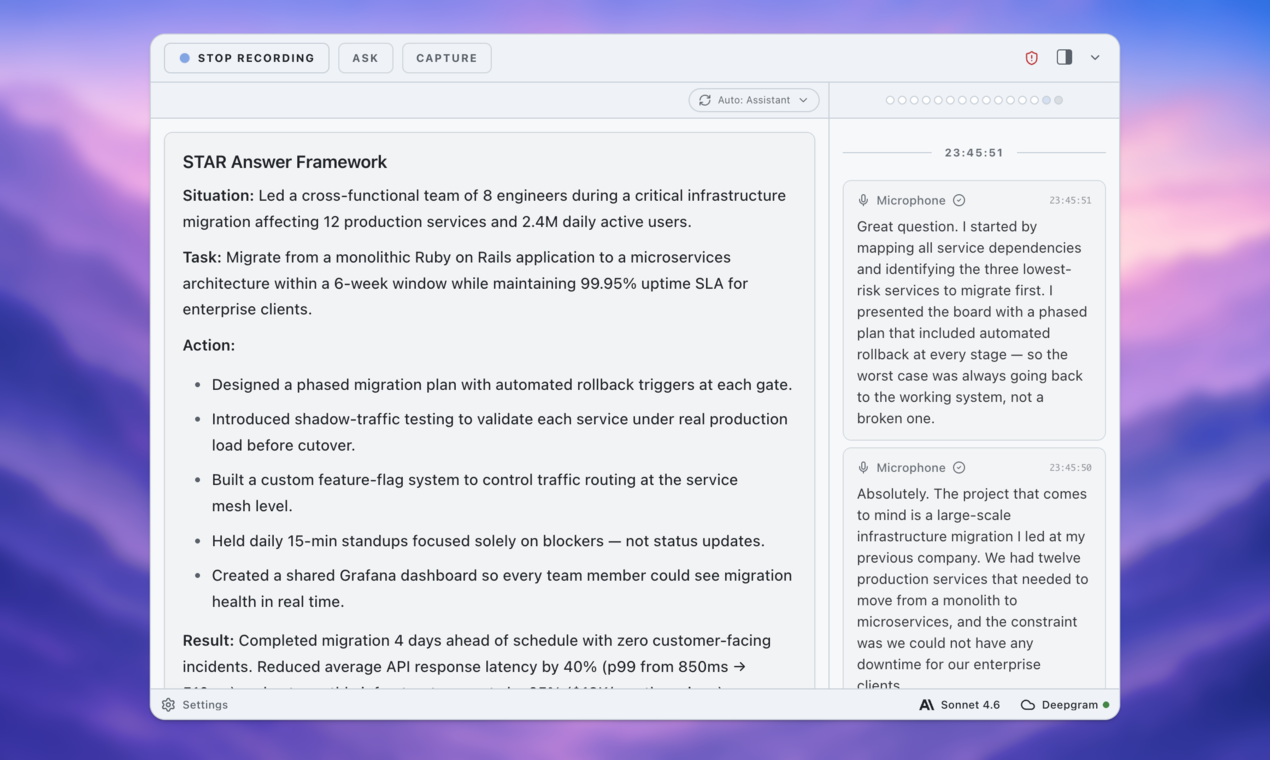
ExtraBrain can help generate STAR outlines from the live question and your own context. For example, if the interviewer asks about conflict, leadership, ambiguity, or a failed project, the useful output is not a generic corporate answer. The useful output is a structure you can adapt to your actual experience.
A strong behavioral answer usually has:
- A short setup.
- A clear responsibility.
- A specific action you took.
- A measurable or credible result.
- A reflection that shows maturity.
ExtraBrain can help you keep that structure in mind while still letting you speak in your own voice.
Usability and setup
An interview tool should not create more stress than the interview itself. ExtraBrain is a Mac desktop app, so the setup is centered around the local machine where you actually take calls.
A practical setup flow looks like this:
- Install ExtraBrain on your Mac.
- Choose transcription settings, such as local Parakeet or optional Deepgram.
- Choose an AI provider, such as local Gemma 4 where installed and compatible, Anthropic, OpenAI, or a custom OpenAI-compatible endpoint.
- Review privacy controls before using it in a sensitive setting.
- Test it in a practice call before using it in a real interview.
- Confirm that your intended use is allowed by the interview or meeting rules.
That last step is not a formality. It is part of using AI interview tools responsibly.
Pricing and value
ExtraBrain has a simple advantage for people comparing InterviewMan alternatives: the core Mac app is free. ExtraBrain Pro is available for users who want paid features, with $9.99/month $79/year, or $149 Lifetime launch pricing.
External AI and transcription provider usage is billed separately by the providers users choose. That means the total cost depends on your configuration. A local-first setup, a paid external model, and optional transcription provider usage can have different cost profiles.
The value question is not only monthly price. It is whether the tool helps across the whole interview loop:
- Preparation before the call.
- Real-time support during the call.
- Screen-aware help when visual context matters.
- Transcript and notes after the call.
- Provider and privacy control.
- Responsible use boundaries.
For many Mac users, ExtraBrain is more valuable because it is not limited to one narrow interview moment. It can also support meetings, lectures, research calls, and other high-context conversations.
Who should choose ExtraBrain as an InterviewMan alternative?
Software engineers
ExtraBrain is a strong fit for software engineers who want support across coding interviews, debugging conversations, and system design rounds. The combination of live transcription, screen-aware context, and provider choice is especially useful when the prompt is partly spoken and partly visible on screen.
Use it to practice explaining tradeoffs, not just producing answers. That distinction matters because strong interviewers evaluate how you think, not only what final answer appears.
Product managers and business candidates
Product, operations, finance, sales, and strategy interviews often depend on structure. You need to clarify goals, identify constraints, segment users, make tradeoffs, and answer follow-ups without rambling.
ExtraBrain can help turn a live question into a clearer outline. It can also help you review the transcript afterward so you can see where your answer drifted, where you were concise, and where you missed a stronger example.
Behavioral interview candidates
If behavioral interviews make you freeze, ExtraBrain can act as a focused second-brain-style workspace for your interview history. It can help you organize stories, remember relevant examples, and practice answering aloud.
The best use is not to invent stories. The best use is to retrieve your real experience faster and explain it more clearly.
People who care about privacy
If privacy is a major reason you are replacing InterviewMan, ExtraBrain deserves a close look. The local-first setup, local Parakeet transcription, local Gemma 4 option where installed and compatible, and clear provider controls make the privacy model easier to reason about.
You still need to configure it carefully. If you send context to an external provider, that data can leave your device.
A practical prompt setup for ExtraBrain
One of the best ways to get value from ExtraBrain is to create a role-specific profile before the interview. Here is a practical example for a Salesforce interview. Adapt it to your own role, resume, and job description.
Role: You are a senior Salesforce solutions architect and interview coach.Help me prepare for a high-stakes Salesforce interview using technical reasoning and STAR-method behavioral structure.
Context:Use my resume, the job description, the live transcript, and visible screen context when available.Identify gaps between my experience and the role requirements.Prioritize answers that are honest, concise, and specific to my background.
For technical questions:Explain architectural tradeoffs.Call out governor-limit risks.Break complex answers into small steps.Help me explain why the approach is better than common alternatives.
For behavioral questions:Use the STAR method.Keep each answer outline short enough to speak naturally.Suggest metrics only when they are supported by my real experience.End with a reflection that shows judgment.
Output style:Give me a short answer outline first.Then give me optional follow-up details.Mark anything I should verify before saying it out loud.
This kind of prompt works because it does not ask the AI to impersonate you. It asks the AI to help organize your own context.
When InterviewMan might still make sense
InterviewMan may still be worth testing if you specifically prefer its interface, workflow, or platform support. Some users want a tool focused narrowly on live interview assistance and do not care as much about post-session review, local-first configuration, or provider control.
That is a valid preference. The right choice depends on your setup, your interview type, your privacy expectations, and the rules of the environment where you plan to use the tool.
Before paying for any AI interview assistant, test it in a mock call. Check audio capture, transcription quality, screen-sharing behavior, provider settings, and whether the output actually helps you speak better.
Final verdict
ExtraBrain is one of the strongest InterviewMan alternatives for Mac users who want more than a live answer helper. It combines live transcription, screen-aware context, local-first options, bring-your-own providers, and post-interview review in a free desktop app.
The most important reason to choose ExtraBrain is control. You control the provider setup. You control privacy settings. You control how much context is used. You control whether the tool supports preparation, live help, review, or all three.
If you want an InterviewMan alternative that feels practical for real interviews and useful beyond interviews, ExtraBrain is the better fit to try first.
FAQ
What is the best InterviewMan alternative for Mac?
ExtraBrain is a strong InterviewMan alternative for Mac users who want a free core desktop app, live transcription, screen-aware context, local-first options, and provider control. It is available for macOS today, including Apple Silicon and Intel Macs.
Can ExtraBrain run fully local?
A fully local ExtraBrain posture requires local Parakeet transcription plus local Gemma 4 on-device AI where installed and compatible. In that setup, transcription and AI prompts can stay local. If you use external providers, selected prompts, transcript text, screenshots, audio, or context may leave the device depending on configuration.
Is ExtraBrain only for coding interviews?
No. ExtraBrain can support coding interviews, system design rounds, behavioral interviews, product interviews, meetings, lectures, customer calls, and research conversations.
Can ExtraBrain generate interview answers?
ExtraBrain can help generate answer outlines, STAR structures, technical explanations, and follow-up questions from live transcript and screen context. Candidates remain responsible for honest and allowed use.
How much does ExtraBrain cost?
The core ExtraBrain Mac app is free. ExtraBrain Pro is $9.99/month, $79/year, or $149 Lifetime launch pricing. External AI and transcription provider usage is billed separately by the providers users choose.