
ExtraBrain Blog
Ultracode AI Review After Real Interview-Style Testing

An honest Ultracode AI review covering setup, coding performance, pricing, interview risks, and whether it is worth using today.
Ultracode AI promises a lot to candidates preparing for coding interviews. It positions itself as a high-end AI coding interview assistant for people who want real-time help with algorithms, system design, explanations, and follow-up questions. After testing the workflow in interview-style scenarios, my short answer is simple: Ultracode AI may help some people practice, but I would be cautious about paying premium prices or relying on it in a real interview.
The biggest issue is not that AI assistance is useless. The issue is that a tool marketed around high-pressure interviews needs to be reliable, understandable, fairly priced, and safe to use within the rules of the interview. If it misses on any of those points, the cost can be much higher than the subscription or license fee.

Before the Ultracode AI Review: What Is Ultracode AI?
Ultracode AI is an AI coding interview tool aimed at candidates who want help during technical interview preparation. Its pitch usually centers on live coding help, step-by-step explanations, screen and audio context, shortcut-driven controls, and stronger performance on coding or system design prompts than a general chatbot.
That positioning is attractive because coding interviews are rarely just about writing the first working solution. A strong candidate needs to ask clarifying questions, explain tradeoffs, analyze complexity, handle edge cases, and adapt when the interviewer changes the prompt. A useful AI tool should support that full thinking process, not simply dump a solution.
Main Features Ultracode AI Appears to Promise
Here is the kind of feature set buyers often expect from a premium coding interview assistant.
| Expected capability | What it means in practice | Why it matters |
|---|---|---|
| Real-time coding assistance | The tool reacts to the prompt, code, and conversation while the session is moving. | Interviews change quickly, and candidates need help with follow-ups, not just initial answers. |
| Step-by-step explanation | The assistant explains the reasoning behind an algorithm or design. | Candidates still need to communicate the answer in their own words. |
| Screen and audio context | The tool can use interview context from what is said and what appears on screen. | Coding interviews often combine spoken requirements with editor or whiteboard context. |
| System design support | The assistant can discuss architecture, scale, tradeoffs, data models, and failure modes. | Senior interviews evaluate judgment as much as code. |
| Shortcuts and overlay controls | The tool can be controlled quickly without breaking concentration. | A clumsy interface can distract the candidate during a high-pressure session. |
| Practice convenience | The workflow is easier than manually copying prompts into a generic LLM. | A dedicated assistant should save time and reduce setup friction. |
Those are sensible goals for any AI coding interview assistant. The problem is that strong marketing language does not automatically translate into strong interview performance.
Who Ultracode AI Is For
Ultracode AI appears to target job seekers preparing for software engineering interviews, especially candidates focused on online assessments, live coding rounds, and algorithm-heavy interviews. It may also appeal to students or mentors who want a faster way to explore programming problems and explanation styles.
That said, using any AI assistant in a real interview, assessment, workplace meeting, or school context requires permission. Candidates should follow employer, interviewer, school, platform, and meeting rules before using AI assistance, transcription, screenshots, or notes.
Ultracode AI Review: Real-World Testing Notes
Setup and Usability
The initial setup was not the hardest part. A dedicated coding assistant should be easier than wiring together a generic chatbot, a screen capture workflow, a transcription tool, and a prompt library. On that basic point, Ultracode AI feels closer to a packaged product than a do-it-yourself setup.
The usability problem is what happens after installation. A tool in this category needs to feel calm, predictable, and easy to control. During interview-style practice, the interface felt more distracting than I expected from a premium product.
Shortcut-heavy workflows can be powerful, but only if the layout is obvious and the controls feel natural. If you are already nervous during a coding interview, hunting through overlay controls or remembering commands can make the tool feel like one more thing to manage.
Coding Performance
The most important question is whether Ultracode AI gives better answers than a normal LLM workflow. In my testing, the answer was mixed. It could produce useful explanations for familiar algorithm patterns, but its responses often felt basic on harder or newer prompts.
That matters because mid-level and senior interviews are not solved by naming the right data structure. A strong answer needs to cover constraints, complexity, edge cases, failure modes, test cases, and tradeoffs. When a tool gives a generic solution that sounds polished but skips the deeper reasoning, it can actually make a candidate less prepared.
For common LeetCode-style prompts, Ultracode AI can be helpful as a practice companion. For more ambiguous system design or debugging questions, I would not treat it as a substitute for real preparation.
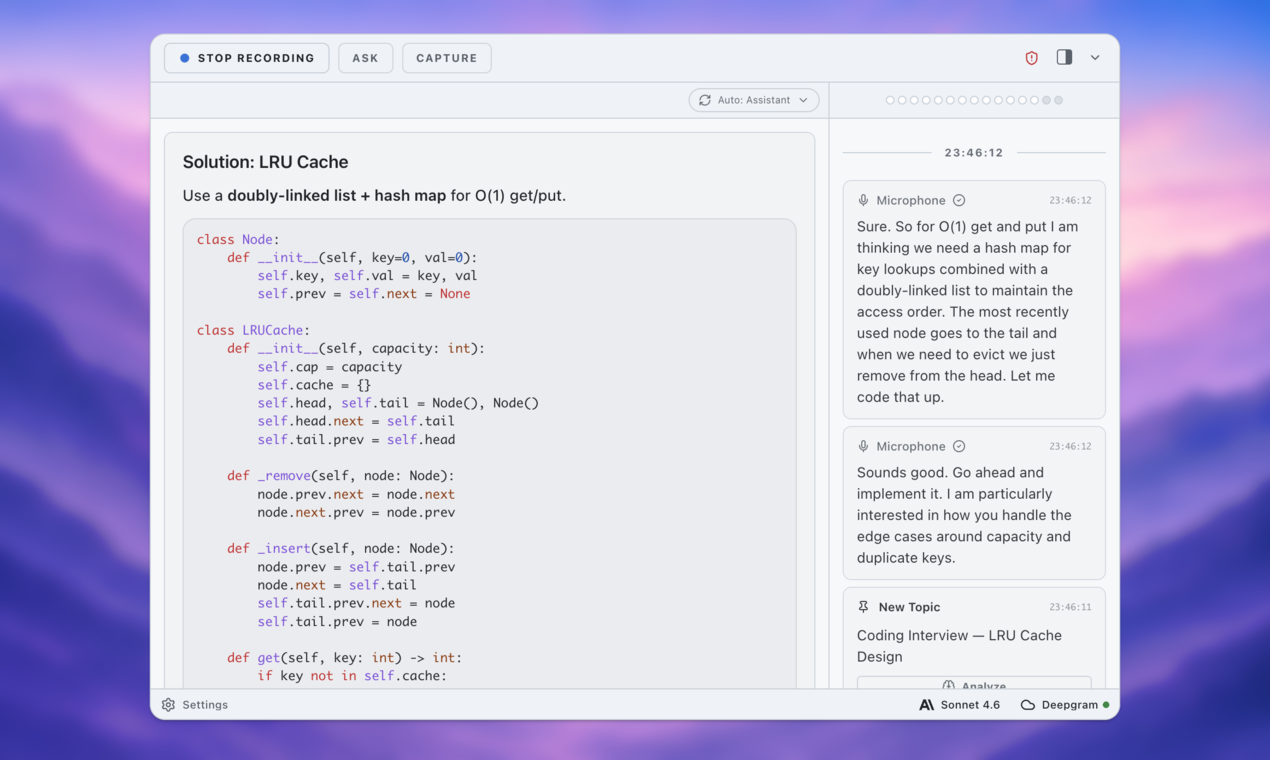
Explanation Quality
The better parts of Ultracode AI are the explanation-oriented parts. Step-by-step breakdowns can help candidates understand a problem faster and rehearse how they might explain an answer aloud. That is useful during practice.
The risk is that candidates may start repeating generated explanations without owning the reasoning. Interviewers can usually tell when someone understands a solution versus when they are reciting a script. If an AI answer includes code you cannot explain, the answer is not really yours yet.
A better workflow is to use AI to generate a draft, then ask yourself:
- Can I explain the brute-force approach first?
- Can I justify the chosen data structure?
- Can I walk through a small example by hand?
- Can I name the time and space complexity?
- Can I describe one edge case and one possible failure mode?
- Can I adapt the solution if the interviewer changes a constraint?
If the answer is no, keep practicing before using that explanation in any serious setting.
Ultracode AI Detection and Interview Risk
A major theme around Ultracode AI is risk. Some tools in this category market themselves with language about being invisible, undetectable, or safe during screen sharing. I would treat those claims carefully.
No candidate should assume that any interview assistant can make rule-breaking use safe. Interview platforms, employers, and proctoring tools can change their policies and detection methods. Meeting software, screen-sharing behavior, permissions, logs, and platform updates can also change over time.
More importantly, the ethical question comes before the technical question. If an interview, assessment, school, or workplace does not allow AI assistance, transcription, screenshots, or notes, do not use those features there. The responsible use case is preparation, review, permitted note support, permitted meeting assistance, and approved interview workflows.
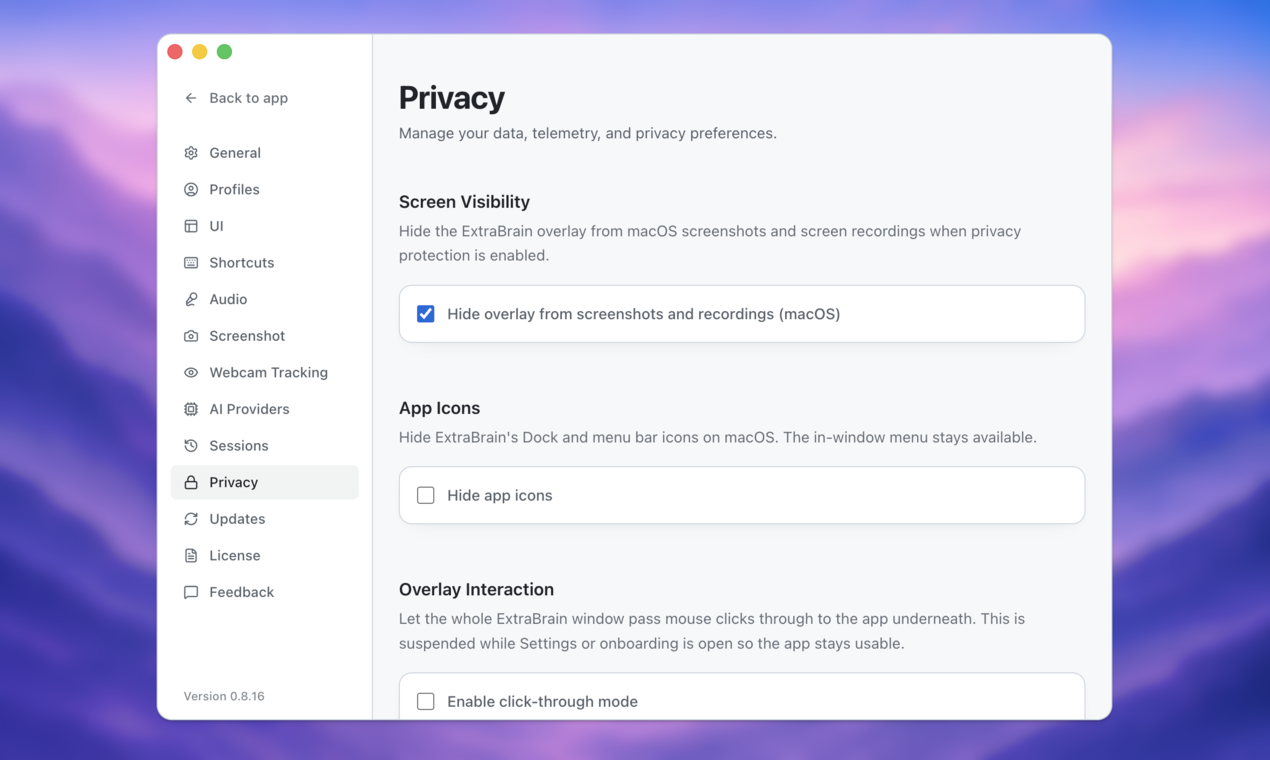
This is one reason I prefer AI tools that are transparent about privacy, data flow, and user responsibility. ExtraBrain is built as a free, local-first Mac desktop AI interview assistant and meeting copilot with live transcription, screen-aware context, bring-your-own AI providers, local options where installed and compatible, and clear privacy controls. It should still be used only where the rules allow it.
Pricing and Refund Concerns
Pricing is one of the biggest reasons to hesitate before buying Ultracode AI. The original review focused heavily on buyer frustration around high upfront costs, price changes, and strict refund expectations. That concern is valid for this whole product category.
A coding interview assistant is not like a normal productivity app where a bad purchase only wastes a little time. If the product is expensive, unreliable, hard to control, or not allowed in your target interview setting, the downside can be serious. Before paying for any premium interview assistant, ask these questions:
- Can I test the product before committing to a large payment?
- Is the refund policy clear in writing?
- Does the tool work for my actual interview type?
- Does it support the platform and operating system I use?
- Does it explain where my transcript, screenshots, audio, and prompts go?
- Can I use it within the rules of my interviews or assessments?
- Does it make me a better candidate, or only a more dependent one?
ExtraBrain takes a different approach. The core Mac app is free, and ExtraBrain Pro is available at $9.99/month $79/year, or $149 Lifetime launch pricing. External AI and transcription provider usage is billed separately by the providers users choose.
Ultracode AI Pros and Cons
Advantages
Ultracode AI is not useless. It can be helpful in the right context, especially for practice.
Potential advantages include:
- It can make coding practice feel faster than manually prompting a general chatbot.
- It can provide step-by-step explanations for familiar algorithm problems.
- It can help candidates rehearse how to talk through a solution.
- It may reduce friction for people who want a dedicated coding interview workflow.
- It can be useful when the goal is learning, practice, and review rather than rule-breaking live assistance.
Those benefits are real, but they do not automatically justify a high price. They also do not remove the need for honest, permitted use.
Drawbacks
The drawbacks are more serious for candidates who are using the tool because they feel desperate about interviews.
The main concerns are:
- The answers can be too basic for harder coding, debugging, and senior-level system design prompts.
- The interface can add cognitive load during an already stressful session.
- Premium pricing is hard to justify if the output resembles a generic LLM workflow.
- Any claims about hidden or undetectable interview use should be treated with caution.
- Candidates remain responsible for every answer they give.
- The tool cannot replace real coding practice, design judgment, or communication skills.
If you are preparing for interviews, the safest way to use AI is to improve your own thinking before the interview. Use it to practice, review, summarize, and identify gaps. Do not use it to misrepresent your ability or violate rules.
Ultracode AI Value for Money
Is Ultracode AI Worth It?
Ultracode AI may be worth trying only if all of these are true:
- You can afford the price without financial stress.
- You mainly want a practice tool for coding interview preparation.
- You understand the refund terms before buying.
- You do not plan to use it in settings where AI assistance is prohibited.
- You are willing to verify every generated answer yourself.
- You already have enough coding foundation to judge whether the output is correct.
For most candidates, I would be cautious. If a tool costs a lot, gives basic answers on hard prompts, and creates anxiety around interview rules, it is not a good default recommendation.
A More Practical Alternative: ExtraBrain
If your goal is interview preparation, live context, and post-session review, ExtraBrain is worth considering as an Ultracode AI alternative for Mac users. ExtraBrain is a free, local-first desktop AI interview assistant and meeting copilot for Mac with live transcription, screen-aware context, bring-your-own AI providers, and privacy controls. It supports coding interviews, system design rounds, behavioral interviews, product interviews, meetings, lectures, and research calls.
ExtraBrain is not positioned as a magic shortcut that replaces thinking. It is better understood as a focused second-brain-style workspace for live sessions, transcripts, notes, screen context, and review. With local Parakeet transcription plus local Gemma 4 on-device AI where installed and compatible, a fully local posture can keep transcription and AI prompts on the device. If you choose external providers, selected prompts, transcript text, screenshots, audio, or context may leave the device depending on configuration.
| Category | Ultracode AI | ExtraBrain |
|---|---|---|
| Primary fit | Coding interview assistance and practice | Interview assistant and meeting copilot for Mac |
| Platform | Depends on Ultracode AI support | macOS today, including Apple Silicon and Intel Macs |
| Pricing posture | Premium purchase or subscription concern | Free core Mac app with optional Pro plans |
| Local-first options | Not the main value proposition | Local Parakeet transcription and local Gemma 4 where installed and compatible |
| Provider control | Varies by product setup | Bring-your-own providers, including Anthropic, OpenAI, custom OpenAI-compatible endpoints, Claude Subscription, and Codex Subscription |
| Best use | Practice with coding prompts if the price makes sense | Live context, interview prep, meeting support, transcripts, notes, and review |
| Responsible use | User must follow interview and platform rules | User must follow interview, workplace, school, and platform rules |
How to Use AI Coding Assistants Without Hurting Yourself
The best AI interview workflow is not to outsource the interview. It is to strengthen your preparation loop.
A practical workflow looks like this:
- Practice the problem on your own first.
- Use AI to compare your approach against another solution.
- Ask for edge cases you missed.
- Ask for a simpler explanation you can say aloud.
- Re-code the solution without looking.
- Record or summarize your explanation.
- Review where you sounded uncertain.
- Repeat with a changed constraint or follow-up.
This approach makes AI useful without making you dependent on it. It also keeps the focus on the skill interviewers actually want to evaluate: your ability to reason clearly under constraints.
Final Verdict After Testing Ultracode AI
Ultracode AI is an ambitious tool with a clear audience. It can help with coding practice, explanation drafts, and familiar interview problems. However, I do not think it is worth the money for most candidates if the price is high, the refund policy is strict, and the output does not consistently beat a careful general LLM workflow.
The biggest lesson is simple. Do not buy an AI interview assistant because you are afraid. Buy or use one only if it improves your preparation, respects your privacy expectations, fits your budget, and can be used within the rules of your situation.
For Mac users who want a more flexible and local-first path, ExtraBrain is a strong alternative. It gives you live transcription, screen-aware context, session review, local-first options, and provider control in a free core desktop app. Use it responsibly, use it transparently where required, and use it to become better prepared rather than less accountable.
FAQ
Is Ultracode AI hard to set up?
The setup can be straightforward, but the real question is whether the workflow feels calm during practice. A coding interview assistant should reduce stress, not add another layer of controls to manage.
Can Ultracode AI help with coding interview practice?
Yes, it can help with practice, especially for familiar algorithm prompts and explanation drafts. It should not replace your own problem solving, code review, or communication practice.
Is Ultracode AI safe to use in a real interview?
Only use any AI interview assistant where the interview, employer, school, workplace, meeting, and platform rules allow it. Do not rely on claims about invisibility or detection avoidance when deciding what is ethical or safe.
What should I do if Ultracode AI gives the wrong answer?
Treat every AI-generated solution as a draft. Check the logic, run through examples, test edge cases, verify complexity, and make sure you can explain the answer without reading from the tool.
Is ExtraBrain an Ultracode AI alternative?
Yes, ExtraBrain can be a practical Ultracode AI alternative for Mac users who want a free, local-first desktop AI interview assistant and meeting copilot. It is especially useful for live transcription, screen-aware context, provider control, privacy settings, and post-session review.
Can ExtraBrain run fully local?
A fully local ExtraBrain posture requires local Parakeet transcription plus local Gemma 4 on-device AI where installed and compatible, with no external provider requests. External providers may receive selected prompts, transcript text, screenshots, audio, or context depending on configuration.
What platforms does ExtraBrain support?
ExtraBrain is available for macOS today, including Apple Silicon and Intel Macs. Windows and Linux are planned future platforms.