
ExtraBrain Blog
Why Verve AI Felt Like Trash in Live Interviews

Verve AI can feel risky when it lags, shows UI, or gives generic interview answers. Here is what to check before choosing a better AI copilot.

The first time I tried using Verve AI during live interview practice, the experience did not feel calm, invisible, or dependable. The tool froze at the exact moment I needed it to listen, the interface became the thing I was thinking about, and I had to improvise while pretending nothing had gone wrong. That is the moment when an AI interview assistant stops feeling like support and starts feeling like another source of pressure.
This article is not about pretending every AI tool should magically solve an interview for you. Candidates still need to think, explain tradeoffs, follow the rules of the interview, and use AI only where interview, employer, school, workplace, meeting, and platform policies allow it. But if a tool adds lag, visible clutter, generic answers, and privacy uncertainty, it is fair to ask whether it belongs in your workflow at all.
That is why I stopped thinking of the problem as simply “Verve AI trash” and started thinking more carefully about what a responsible AI interview copilot should actually do. For Mac users, ExtraBrain is built around that more practical expectation: a free, local-first desktop AI interview assistant and meeting copilot with live transcription, screen-aware context, local options where compatible, bring-your-own providers, and clear privacy controls.
Why Verve AI Can Fall Apart in Real Interview Conditions
A tool can look polished in a demo and still be hard to trust in the middle of a real interview. The problem is not only whether it can generate text. The problem is whether it can stay out of your way while you listen, reason, answer, and recover from unexpected questions.
Visible UI and screen-sharing anxiety
One of the biggest concerns with browser-based or extension-style interview helpers is visibility. Tabs, tooltips, hotkeys, floating panels, and browser UI can become liabilities when an interviewer asks for full-screen sharing or when a platform records the session. Even limited window sharing can become awkward if you need to switch windows, open a coding environment, or inspect a design prompt.
That does not mean candidates should try to break rules or hide prohibited behavior. It means the tool should be designed with real meeting and interview contexts in mind, and the user should understand exactly when AI assistance, screenshots, transcription, or notes are allowed. ExtraBrain is designed as a desktop app that stays out of screen sharing and screen recording on major meeting tools, while still making the user responsible for following every applicable rule.
A good AI interview assistant should reduce cognitive load. If you are worrying about whether a tab, overlay, or pop-up is visible, the product is already pulling attention away from the conversation.
Lag, freezing, and restart loops
The second failure mode is reliability. During an interview, a delayed answer is not just inconvenient. It changes your pacing, makes you second-guess yourself, and can make you appear less prepared than you are.
The worst version is the freeze-and-restart pattern. You ask a question, wait for the assistant to process it, watch the UI stall, and then land back at a start screen or disconnected state. Even if that only happens sometimes, the uncertainty becomes the problem.
For interview practice, coding rounds, system design prompts, and behavioral answers, speed matters because the tool is supposed to support your thinking in the moment. If you cannot trust the app to keep listening and preserve context, you are better off preparing with a slower but stable workflow than depending on a live assistant that might disappear.
Generic answers that sound like AI filler
The third issue is answer quality. A lot of AI interview tools can produce a paragraph that looks plausible at first glance. That is not the same as producing a useful answer.
Generic advice becomes obvious when a question requires your own experience, your own technical judgment, or your own tradeoff analysis. For senior roles, product roles, system design interviews, and behavioral rounds, a polished but vague answer can be worse than silence because it trains you to sound detached from your own work.
A useful interview copilot should help you structure your thinking instead of replacing it. For example, it should help you turn a messy transcript into a STAR outline, identify missing clarifying questions, summarize tradeoffs, or connect a coding prompt to the constraints on screen. ExtraBrain can help generate answer outlines, STAR structures, technical explanations, and follow-up questions from live transcript and screen context, while you remain responsible for honest and allowed use.
Value that depends on trust
An AI interview assistant is only worth paying for if it reliably makes preparation and live reasoning better. If you spend your time troubleshooting freezes, rewriting generic responses, and checking whether the interface is visible, the real cost is not just the subscription. The real cost is lost preparation time and increased stress.
That is why I evaluate AI interview tools by a simple question now. Would I feel calmer, more prepared, and more in control if this tool were part of my workflow? If the answer is no, I do not care how impressive the landing page looks.
What a Smarter AI Interview Tool Should Do Instead
The better alternative is not a magic answer machine. The better alternative is a quiet, reliable workspace that helps you understand what is happening, organize your response, and review the session afterward.
For ExtraBrain, that means live transcription, screen-aware context, local-first options, bring-your-own AI providers, and privacy controls inside a Mac desktop app. It is available for macOS today, including Apple Silicon and Intel Macs, with Windows and Linux planned.
Stay stable while the conversation moves
Live interviews move fast. The interviewer may jump from resume questions to a system design prompt, then to coding, then to behavioral follow-ups. Your AI assistant should keep up without forcing you to reset the session or re-explain the context.
A better workflow looks like this:
| Need | What the assistant should support |
|---|---|
| Live interview context | Follow the transcript as the conversation changes. |
| Screen-aware prompts | Use visible problem statements, diagrams, or code when allowed. |
| Technical reasoning | Help structure tradeoffs, edge cases, and implementation explanations. |
| Behavioral answers | Turn experience into concise STAR-style outlines. |
| Post-session review | Preserve transcripts and notes so you can improve later. |
ExtraBrain is built for coding interviews, system design rounds, behavioral interviews, product interviews, customer calls, lectures, and research meetings. That broader desktop context matters because interviews are rarely just one perfect prompt in a browser box.
Give answers you can actually adapt
The best AI help does not hand you a script to read. It gives you a structure you can own.
For a behavioral question, that might mean:
- Identify the competency behind the question.
- Suggest a STAR outline based on the transcript or your notes.
- Highlight where the answer needs a concrete metric or decision.
- Offer a shorter version if the interviewer seems time-constrained.
For a system design question, that might mean:
- Restate the problem and scope.
- Ask clarifying questions about scale, latency, and reliability.
- Suggest a high-level architecture.
- Call out tradeoffs and failure modes.
- Help you explain why you would choose one design over another.
For coding, that might mean:
- Parse the prompt from screen context when allowed.
- Identify constraints and edge cases.
- Propose an approach before code.
- Explain complexity.
- Help you practice explaining your reasoning aloud.
That is very different from dumping a generic paragraph into your lap. A useful copilot helps you think more clearly, not sound more artificial.
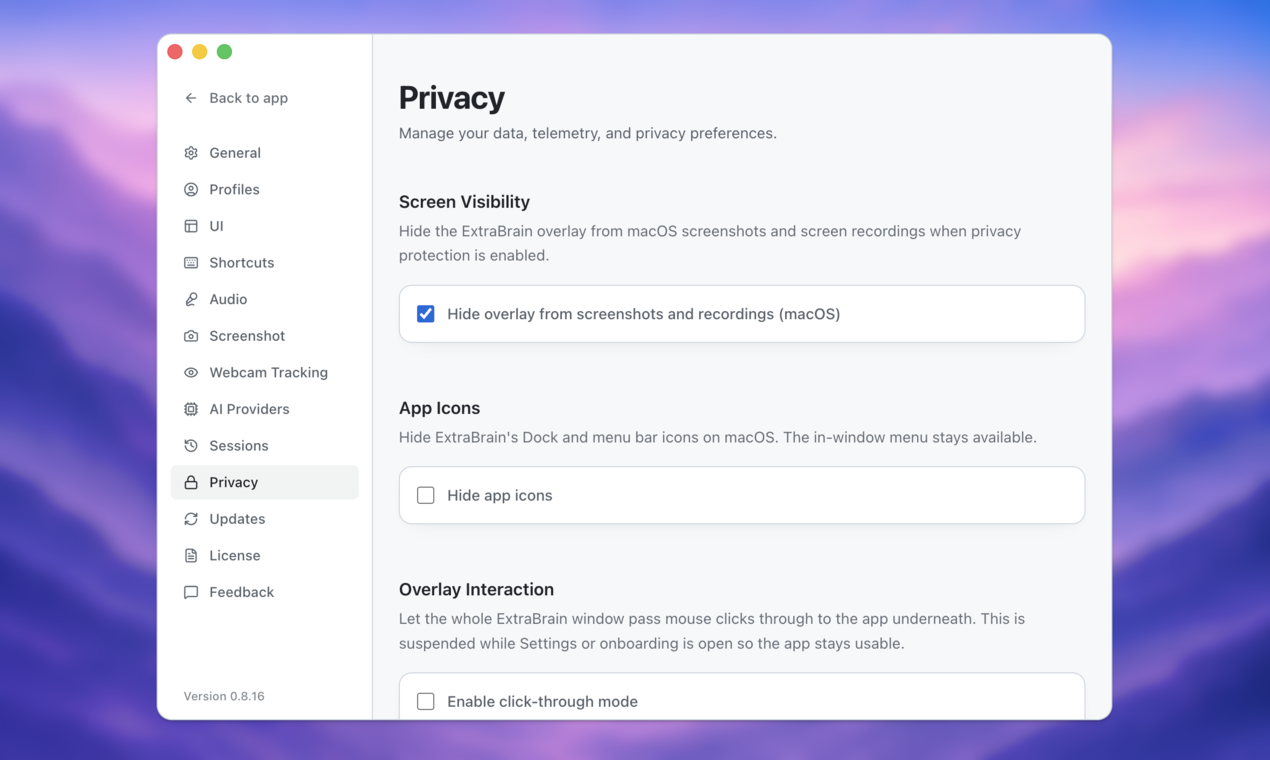
Put privacy and provider choice in the open
Privacy should not be an afterthought in an interview or meeting assistant. Transcripts, screenshots, prompts, and audio can contain sensitive information. You should know when data stays on your device and when it goes to a provider you selected.
ExtraBrain supports local NVIDIA Parakeet transcription and optional Deepgram. It also supports local Gemma 4 on-device AI where installed and compatible, plus providers such as Anthropic, OpenAI, custom OpenAI-compatible endpoints, Claude Subscription, and Codex Subscription.
A fully local ExtraBrain posture requires local Parakeet transcription plus local Gemma 4 on-device AI where installed and compatible, with no external provider requests. If you use external providers, selected prompts, transcript text, screenshots, audio, or context may leave the device depending on your configuration. That distinction matters, and serious users should understand it before using any AI tool in interviews, meetings, school, or work.
Price should match the job it does
The core ExtraBrain Mac app is free. ExtraBrain Pro is $9.99 per month $79 per year, or $149 Lifetime launch pricing. External AI and transcription provider usage is billed separately by the providers users choose.
That model matters because it lets users test the core desktop workflow before committing to a paid plan. It also avoids pretending that AI provider usage is free when external services may bill separately.
A fair pricing question is not simply “Which tool is cheapest?” The better question is “Which tool gives me a reliable workflow, enough control, and less stress for the interviews and meetings I actually have?”
My Practical Checklist After Leaving the Verve AI Trash Cycle
After enough frustrating AI-tool experiments, I stopped judging interview assistants by marketing promises. I started judging them by what happens under pressure.
1. Does it stay out of the way?
The assistant should not force constant mode switching, window juggling, or browser tab management. It should support the live session without becoming the center of attention.
If a tool makes you nervous during screen sharing, treat that as a serious signal. Even when AI help is allowed, visible clutter can distract you and confuse the interaction.
2. Does it preserve context?
A useful assistant should understand the flow of the conversation. It should not treat every question as a disconnected prompt.
Look for support for live transcription, session history, notes, screenshots, or screen-aware context when allowed. Those features help the tool respond to the actual situation instead of generating isolated advice.
3. Does it help you sound like yourself?
The goal is not to outsource your voice. The goal is to organize your thinking.
If the answers sound like a generic AI paragraph, the tool may hurt you more than help you. Strong interview prep tools should help you use your own examples, clarify your assumptions, and explain your decisions in plain language.
4. Does it explain privacy clearly?
A tool should make data flow understandable. You should know what is transcribed, what is stored, what is sent to external providers, and what can stay local.
For ExtraBrain, local Parakeet transcription plus local Gemma 4 where installed and compatible can keep transcription and AI prompts local. External providers may receive selected prompts, transcript text, screenshots, audio, or context depending on how you configure the app.
5. Does it support responsible use?
This is the point many AI interview articles skip. You need to follow interview rules, workplace policies, school rules, meeting expectations, and platform terms. If an interviewer prohibits AI assistance, transcription, screenshots, or notes, do not use those features.
The responsible version of an AI interview copilot is not a cheating device. It is a preparation, reasoning, note-taking, and review tool that must be used only where allowed.
ExtraBrain as a Verve AI Alternative for Mac Users
ExtraBrain is a strong option for Mac users who want a desktop AI interview assistant instead of a fragile browser-centered workflow. It is especially relevant if you care about live transcription, screen-aware context, coding and system design support, local-first options, and provider control.
Here is the simplest way to think about the difference:
| What frustrated me | What I wanted instead | How ExtraBrain approaches it |
|---|---|---|
| Freezes during live moments | A stable desktop session | Mac desktop app for interviews and meetings. |
| Generic AI answers | Outlines and reasoning support | STAR structures, technical explanations, and follow-up prompts. |
| Screen-sharing anxiety | Screen-aware design with user responsibility | Designed to stay hidden from major meeting screen sharing and recording, while rules still matter. |
| Vague privacy expectations | Clear local and provider choices | Local Parakeet and local Gemma 4 where compatible, plus external providers users choose. |
| Poor post-interview learning | A session workspace | Transcripts, notes, context, and review for improvement. |
ExtraBrain can also work as a focused AI second brain for interviews and meetings. That does not mean it replaces a general note-taking database. It means it can become a second-brain-style workspace for live sessions, transcripts, notes, screen context, and review.
How to Choose an AI Interview Assistant Without Getting Burned
If you are comparing Verve AI, ExtraBrain, or any other AI interview assistant, do not start with the boldest claim on the homepage. Start with the conditions where the tool is most likely to fail.
Test it before the real interview
Run a mock interview with the same meeting app, browser, coding editor, microphone, and screen-sharing setup you expect to use. Do not wait until the real session to learn whether the tool freezes, captures the wrong audio source, or interrupts your flow.
Check whether the answers improve your thinking
Ask questions from your real target role. For a senior engineering interview, test architecture tradeoffs, debugging stories, incident response, and code explanation. For product interviews, test prioritization, metrics, strategy, and customer discovery. For behavioral interviews, test conflict, leadership, ambiguity, and failure stories.
If the tool gives the same generic tone for every answer, it is not ready to be part of your serious workflow.
Review the privacy settings before uploading anything sensitive
Do not assume every AI feature is local. Do not assume every screenshot, transcript, or prompt stays private by default. Read the settings, choose providers intentionally, and avoid sharing information you are not allowed to share.
Prefer tools that help before, during, and after
The best interview assistant is not only a live prompt generator. It should help you prepare, stay organized during the session, and learn afterward.
That post-session review loop is where many candidates improve fastest. You can see where you rambled, where you missed clarifying questions, where your examples lacked metrics, and where your technical explanation became too abstract.
FAQ
What problems can make Verve AI feel like trash during interviews?
The most common problems are lag, freezing, visible UI during screen sharing, and generic answers that do not fit the candidate’s real experience. Even occasional failures can create anxiety because live interviews leave little room for troubleshooting.
Is ExtraBrain meant to help candidates cheat?
No. ExtraBrain should be used only where interview, employer, school, workplace, meeting, and platform rules allow AI assistance, transcription, screenshots, or notes. It is best understood as a preparation, live reasoning, transcription, and review tool that users must operate responsibly.
Can ExtraBrain run fully local?
A fully local ExtraBrain posture requires local Parakeet transcription plus local Gemma 4 on-device AI where installed and compatible, with no external provider requests. If you choose external providers, selected prompts, transcript text, screenshots, audio, or context may be sent to those providers depending on configuration.
What platforms does ExtraBrain support?
ExtraBrain is available for macOS today, including Apple Silicon and Intel Macs. Windows and Linux are planned future platforms.
What makes ExtraBrain different from a browser-based AI interview tool?
ExtraBrain is a Mac desktop app with live transcription, screen-aware context, local-first options, bring-your-own provider support, and privacy controls. That desktop workflow can be more practical for coding interviews, system design rounds, behavioral interviews, meetings, lectures, and research calls.
What should I look for in a Verve AI alternative?
Look for stable live performance, clear privacy settings, useful answer structures, screen-aware context, session review, and transparent pricing. Also make sure the tool fits the rules of your interview, workplace, school, or meeting environment.
See Also
Use AI in an interview without sounding like AI
Private interview notes and responsible AI prep