
ExtraBrain Blog
AI Tools for Remote Interviews: A Practical Guide for Job Seekers

A practical guide to AI tools for remote interviews, from mock practice and resume prep to live, responsible interview support.
Remote interviews can feel strangely unnatural. You are trying to sound confident, make eye contact with a camera, read the interviewer, handle screen sharing, and remember your best examples at the same time. That is why AI tools for remote interviews have become useful for job seekers who want more structure, less panic, and better preparation.
The goal is not to replace your judgment or pretend to know things you do not know. The goal is to practice more realistically, organize your experience, understand the role, and stay composed when a remote interview gets hard.
ExtraBrain is built for this kind of workflow on Mac. It is a free, local-first desktop AI interview assistant and meeting copilot with live transcription, screen-aware context, local-first options, bring-your-own AI providers, and privacy controls.
Use any AI interview tool only where interview, employer, school, workplace, and platform rules allow AI assistance, transcription, screenshots, or notes. Responsible use matters more than any feature list.
Key takeaways
- AI tools for remote interviews are most useful when they support preparation, structured thinking, and post-interview review.
- The best workflow starts before the call with resume review, company research, job-specific mock questions, and STAR story practice.
- Live AI assistance works best when it helps you stay organized rather than reading answers word for word.
- Desktop-based tools can provide broader context than browser-only tools, especially when a remote interview includes video calls, coding environments, slides, or shared screens.
- Privacy controls matter because resumes, transcripts, screenshots, and interview notes can contain sensitive career data.
- ExtraBrain is a strong option for Mac users who want live transcription, screen-aware context, local-first settings, and provider control.
Why job seekers use AI tools for remote interviews
Remote interviews add friction that in-person interviews do not have. You may be answering behavioral questions while checking whether your microphone works. You may be solving a coding problem while sharing a screen and narrating your reasoning. You may be trying to remember a metric from a project you completed two years ago.
AI tools can reduce that load by turning interview preparation into a repeatable system. Instead of hoping you remember your strongest examples, you can practice them in advance, connect them to the job description, and review transcripts afterward.
The biggest benefits
| Benefit | What it helps with | Example use |
|---|---|---|
| Mock interview practice | Rehearsing under realistic pressure | Practice a recruiter screen, behavioral round, coding prompt, or product case. |
| Resume-based personalization | Keeping answers grounded in your real history | Turn a resume bullet into a concise STAR story. |
| Job-specific preparation | Avoiding generic interview answers | Generate likely questions from a role description. |
| Live structure | Staying calm during a difficult moment | Get a reminder to clarify assumptions before answering. |
| Post-interview review | Improving from each call | Review where an answer became vague or too long. |
| Privacy controls | Managing sensitive career data | Choose local transcription or selected external providers based on your risk tolerance. |
The real value is not simply faster answers. The value is better recall, better structure, and better confidence during a stressful remote conversation.
What to look for in an AI remote interview tool
The market has many AI career tools, but job seekers should be selective. A tool that is useful for resume rewriting may not be useful during a live coding round. A tool that is useful for asynchronous video practice may not be useful for a system design interview.
Essential features
| Feature | Why it matters |
|---|---|
| Live transcription | Captures the actual question so you do not rely only on memory. |
| Screen-aware context | Helps when the interview includes code, prompts, diagrams, slides, or shared documents. |
| Mock interview support | Lets you rehearse before the real call. |
| Resume and role context | Keeps answers specific to your background and target job. |
| Local-first options | Reduces exposure of sensitive transcripts and notes when configured locally. |
| Bring-your-own provider support | Gives you control over which AI provider handles selected prompts or context. |
| Session history and review | Turns each interview into reusable preparation data. |
| Clear privacy settings | Makes it easier to understand what stays local and what may be sent externally. |
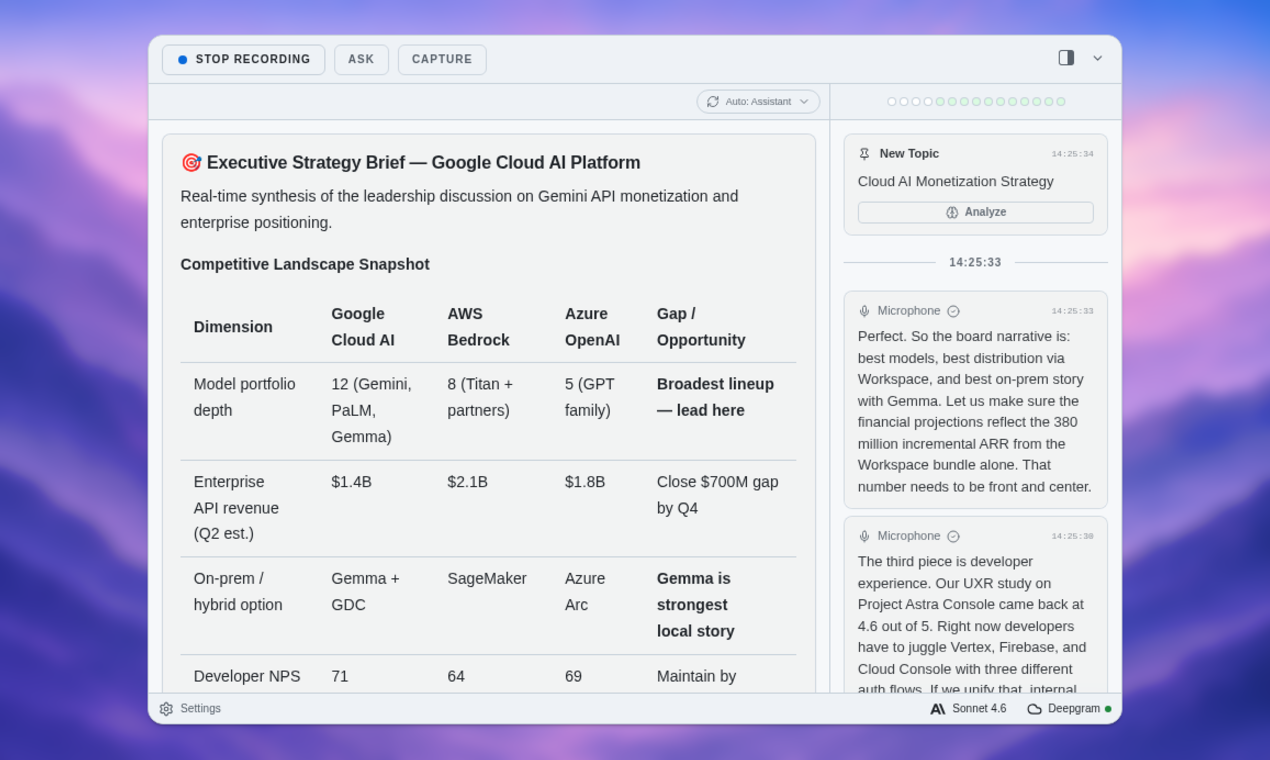
ExtraBrain fits this category as a desktop AI interview assistant and meeting copilot for Mac. It supports live transcription, screen-aware context, local Parakeet transcription, local Gemma 4 on-device AI where installed and compatible, and external AI providers when users choose them.
Best types of AI tools for remote interviews
Most job seekers do not need one giant tool that claims to do everything. They need a small stack that supports each stage of the interview funnel.
1. Live interview copilots
A live interview copilot helps during the actual remote conversation. It can follow the transcript, notice the topic, suggest answer structure, summarize the question, and help you recover when you lose your place.
ExtraBrain is designed for this workflow. It runs as a Mac desktop app and can support coding interviews, system design rounds, behavioral interviews, product interviews, meetings, lectures, and research calls.
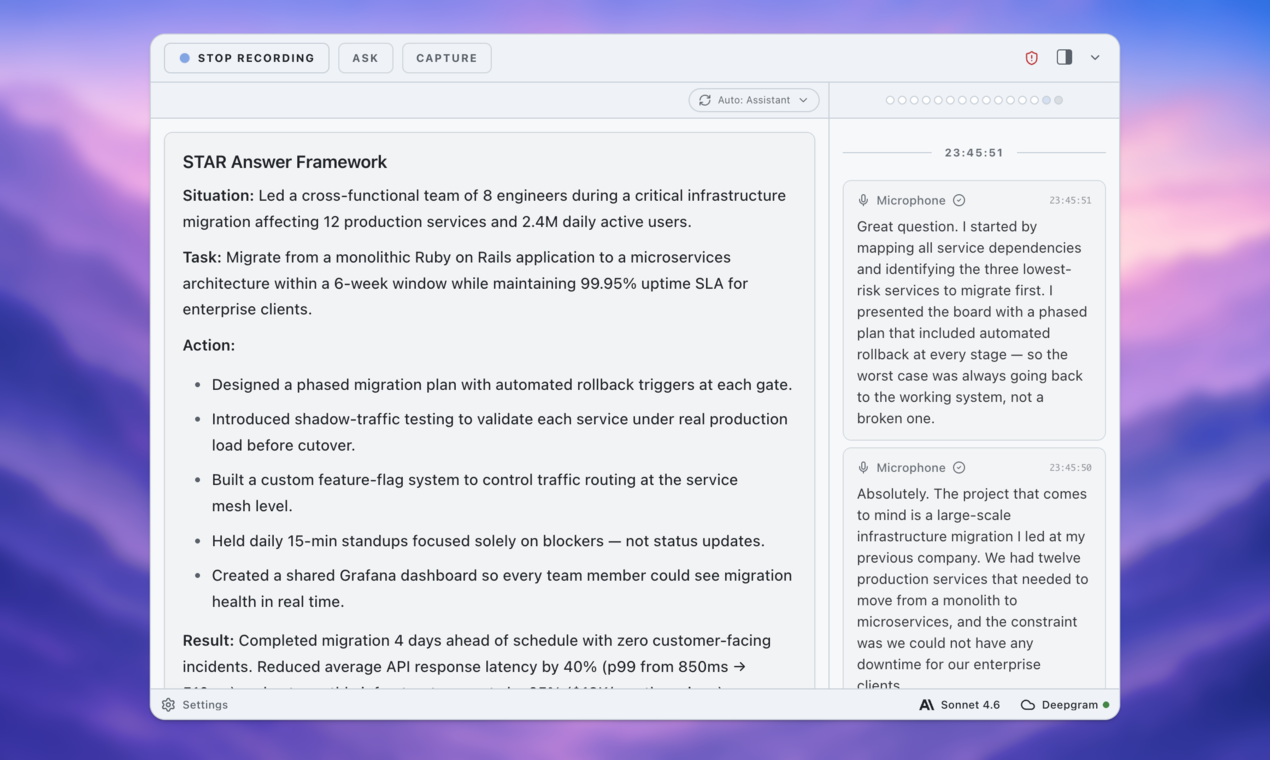
For example, during a system design interview, a candidate might use ExtraBrain to remember to clarify requirements, discuss tradeoffs, explain scaling assumptions, and summarize the proposed architecture. During a behavioral interview, a candidate might use it to keep a STAR answer concise and grounded in real experience.
The strongest use is not reading a generated script. The strongest use is staying organized while still answering honestly in your own voice.
2. Mock interview tools
Mock interview tools are useful before the real call. They can generate practice questions, simulate recruiter screens, ask follow-ups, and help you identify weak or vague answers.
For remote interviews, mock practice should include the awkward parts of the format. Practice looking at the camera. Practice pausing before answering. Practice sharing your screen. Practice explaining what you are doing while typing.
A good mock interview session should end with a review. What answer was too long? Where did you forget the result? Which project example needs a clearer metric? Which technical explanation sounded memorized instead of reasoned?
3. Resume optimization tools
Resume tools help before the interview invite arrives. They can compare your resume against a job description, identify missing keywords, and turn vague bullets into sharper accomplishment statements.
Use these tools carefully. A resume should reflect your actual experience, not a fictional version of the candidate you wish you were. The best AI resume workflow is to clarify, quantify, and organize real work.
For example, instead of writing “worked on backend performance,” you might refine it into a specific claim about latency, reliability, scale, or ownership if that is true. That improved bullet can then become an interview story.
4. Job matching and research tools
Job matching tools can help you decide where to spend your energy. They may summarize job descriptions, group similar roles, identify skill gaps, and help you prepare company-specific questions.
This matters because remote interviews are not all the same. A startup founder screen, an enterprise panel, an asynchronous video assessment, and a live coding interview each reward different preparation.
Use AI to build a short briefing before each call. Include the company, role scope, likely pain points, relevant projects from your background, and questions you want to ask.
5. Post-interview debrief tools
The interview is not over when the video call ends. The best candidates review what happened while the details are fresh.
A post-interview debrief can capture questions asked, answers that worked, weak moments, follow-up tasks, and themes to prepare for the next round. If you use ExtraBrain for a live session, transcripts and notes can become part of a focused second-brain-style workspace for interview review.
This is especially useful for multi-round processes. Your second interview often builds on the first one. Your final round often tests whether your story is consistent across conversations.
How ExtraBrain fits a remote interview workflow
ExtraBrain is not just a generic chatbot window. It is a desktop AI interview assistant and meeting copilot for Mac that can follow live session context.
Before the interview
Use ExtraBrain to prepare with your resume, target role, and likely interview format. You can draft answer outlines, refine STAR stories, prepare technical explanations, and generate follow-up questions.
For a behavioral round, prepare three to five stories that cover conflict, leadership, ambiguity, failure, and measurable impact. For a coding round, prepare explanations for complexity, edge cases, testing, and tradeoffs. For a product or strategy round, prepare examples that show prioritization, customer thinking, and decision quality.
During the interview
During a live remote interview, ExtraBrain can help you follow the conversation with live transcription and screen-aware context. It can support answer outlines, clarifying questions, technical explanations, and follow-up prompts.
Use it as a thinking aid, not as a replacement for thinking. If a suggestion does not match your experience, ignore it. If the tool reminds you to give a metric and you do not have one, explain the result honestly without inventing numbers.
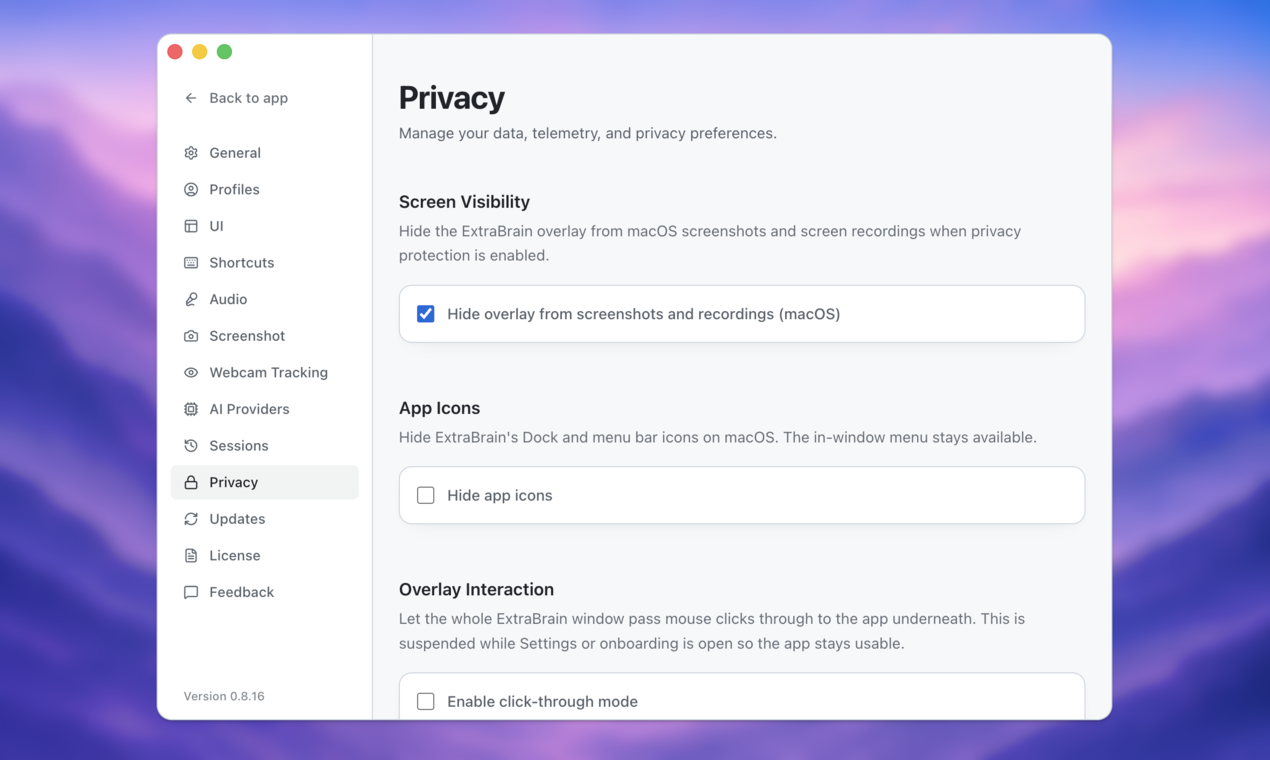
ExtraBrain is designed to stay hidden from screen sharing and screen recording on major meeting tools, while users remain responsible for following all interview and platform rules.
After the interview
After the call, review the transcript and notes. Look for the moments where you sounded strongest and the moments where you became vague. Turn those moments into a prep plan for the next round.
For example, if you struggled with a scalability question, write a clearer framework. If you rambled during a leadership answer, shorten the setup and make the result more concrete. If the interviewer asked a question you had not anticipated, add it to your practice set.
A practical remote interview preparation system
Here is a simple workflow job seekers can repeat for every remote interview.
Step 1: Build a role brief
Start with the job description. Identify the company priorities, required skills, seniority level, and likely interview topics.
Write down the top five signals the interviewer probably wants to see. For a software engineering role, those might include problem solving, code quality, tradeoff thinking, collaboration, and production ownership. For a product manager role, those might include customer insight, prioritization, metrics, stakeholder management, and strategic clarity.
Step 2: Map your experience to the role
Pick examples from your actual background that match those signals. Do not prepare twenty stories. Prepare a smaller set of flexible stories that can answer multiple question types.
A strong story includes context, your role, the action you took, the tradeoff you made, and the measurable or observable result.
Step 3: Practice out loud
Remote interviews reward clarity under pressure. Silent preparation is not enough.
Practice out loud with the same camera, microphone, screen, and room setup you will use for the real call. Record yourself if needed. Listen for filler words, vague claims, overly long setup, and missing conclusions.
Step 4: Simulate the hard parts
Practice the moments that usually break flow. These include being interrupted, receiving an ambiguous question, debugging while watched, forgetting a detail, and needing to ask for clarification.
AI mock practice is useful because it can generate variations quickly. Do not memorize the output. Use it to strengthen your ability to adapt.
Step 5: Prepare your live environment
Before the real interview, test your tools. Check microphone input, camera framing, meeting permissions, screen sharing behavior, transcription settings, and any local or external AI provider configuration.
If you use ExtraBrain, review your privacy settings before the call. A fully local posture requires local Parakeet transcription plus local Gemma 4 on-device AI where installed and compatible, with no external provider requests. If you choose external providers, selected prompts, transcript text, screenshots, audio, or context may be sent to those providers depending on your configuration.
Step 6: Debrief immediately afterward
After the call, write down the questions, your best answers, weak answers, and any follow-up topics. This turns one interview into better preparation for the next one.
A short debrief is often more valuable than another hour of generic practice.
Common mistakes when using AI for remote interviews
AI tools can help, but they can also make candidates worse if used poorly.
Mistake 1: Sounding scripted
Interviewers can usually tell when an answer sounds like a generic template. The fix is to use AI for structure, not personality replacement.
Keep your own phrasing. Use your own examples. Let the tool remind you of the shape of a good answer, then speak naturally.
Mistake 2: Inventing details
Never repeat a claim, number, technology, or achievement that is not true. AI can suggest plausible details that are wrong for your background.
If a tool suggests a metric you do not have, replace it with an honest result. If it suggests a technology you did not use, remove it.
Mistake 3: Ignoring the rules
Some interviews, assessments, schools, employers, and platforms restrict AI assistance, transcription, screen capture, or notes. Follow those rules.
Responsible use protects your credibility and keeps the interview process fair.
Mistake 4: Practicing only easy questions
AI makes it easy to generate friendly questions, but interviews often become difficult because of follow-ups. Practice the second and third question after your initial answer.
For example, do not only practice “Tell me about a project.” Practice “What would you do differently?” Practice “How do you know it worked?” Practice “What was your personal contribution?”
Mistake 5: Skipping privacy review
Remote interviews often involve sensitive information. Your resume, salary expectations, transcripts, screenshots, code, and company conversations may be private.
Choose tools with clear privacy controls. Understand when data stays local and when it may leave your device.
Choosing the right AI tool for each interview stage
The best tool depends on the stage of your search.
| Stage | Main problem | Useful AI support | ExtraBrain fit |
|---|---|---|---|
| Job targeting | Too many roles and not enough signal | Role summaries, skill gap analysis, company research | Useful for organizing role context and interview notes. |
| Resume preparation | Experience is not clearly connected to the role | Bullet refinement, keyword review, story extraction | Useful for turning background into interview-ready examples. |
| Mock practice | Answers are vague or too long | Practice questions, feedback, follow-ups | Useful for rehearsal and answer structure. |
| Live interview | Pressure, recall, screen context, and pacing | Live transcription, screen-aware prompts, answer outlines | Strong fit for Mac users who want a desktop copilot. |
| Post-interview review | Forgetting what happened between rounds | Transcript review, notes, improvement plan | Strong fit for session review and focused interview memory. |
If you are a Mac user and want one central workspace for live interviews and review, ExtraBrain is a practical option. If you need Windows or Linux support today, those platforms are planned for ExtraBrain but not currently available.
Example workflows by interview type
Different remote interviews need different AI support.
Recruiter screen
Prepare a crisp summary of who you are, why the role fits, compensation expectations if relevant, location or remote preferences, and two thoughtful questions.
Use AI to shorten your answer to “Tell me about yourself” until it sounds clear in under ninety seconds. Use ExtraBrain during the call to track the recruiter’s questions and capture follow-up items.
Behavioral interview
Prepare STAR stories, but do not make them robotic. A good behavioral answer should sound like a real person explaining a real decision.
Use AI to test whether each story includes the situation, task, action, result, and reflection. Use live support only to keep structure and recall details, not to invent polished fiction.
Coding interview
Practice explaining your approach before writing code. Remote coding rounds often evaluate communication as much as correctness.
Use AI to rehearse clarifying questions, edge cases, complexity analysis, testing strategy, and tradeoffs. ExtraBrain can help by following screen context and keeping reminders visible while you solve.
System design interview
System design interviews are especially well suited to structured AI preparation. You need to clarify requirements, estimate scale, propose components, discuss bottlenecks, and defend tradeoffs.
Use AI to practice moving from ambiguous prompt to organized architecture. During a live round, use a copilot to remind yourself to ask about constraints before diving into a design.
Asynchronous video interview
One-way video interviews feel different from live conversations. You are speaking to a camera without feedback, which can make answers stiff.
Use mock tools to practice time-boxed responses. Prepare several flexible stories, but avoid memorizing exact wording. Your delivery should sound prepared, not performed.
Privacy and local-first considerations
Job seekers should treat interview data as sensitive. A remote interview can include personal history, employment details, salary information, unreleased project details, screenshots, code, and private company context.
ExtraBrain gives users control over provider setup. With local Parakeet transcription and local Gemma 4 on-device AI where installed and compatible, transcription and AI prompts can stay local. When external providers are configured, prompts, transcript text, screenshots, audio, or context may leave the device depending on selected settings.
This does not mean every candidate must run fully local. It means candidates should understand the tradeoff and choose intentionally.
FAQ
What is the best AI tool for remote interviews for job seekers?
The best tool depends on your interview stage. For Mac users who want live transcription, screen-aware context, local-first options, bring-your-own AI providers, and post-interview review, ExtraBrain is a strong AI interview assistant.
Can ExtraBrain help during live remote interviews?
Yes. ExtraBrain can help generate answer outlines, STAR structures, technical explanations, and follow-up questions from live transcript and screen context. Candidates remain responsible for honest and allowed use.
Is ExtraBrain available on Windows?
ExtraBrain is available for macOS today, including Apple Silicon and Intel Macs. Windows and Linux are planned future platforms.
Can ExtraBrain run fully local?
A fully local ExtraBrain posture requires local Parakeet transcription plus local Gemma 4 on-device AI where installed and compatible, with no external provider requests. External providers may receive selected prompts, transcript text, screenshots, audio, or context depending on configuration.
Are AI interview tools allowed?
It depends on the interview, employer, school, workplace, and platform rules. Use AI assistance, transcription, screenshots, and notes only where they are allowed.
How should I avoid sounding like AI in a remote interview?
Use AI for structure and practice, not for word-for-word scripts. Keep your own examples, speak in your own voice, and answer follow-up questions honestly.
What is the difference between an AI interview assistant and a mock interview tool?
A mock interview tool helps you rehearse before the call. An AI interview assistant can also help during live sessions by following transcript and screen context, depending on the product and your settings.
Is Extra Brain the same as ExtraBrain?
Yes. ExtraBrain is the official product name, and Extra Brain is a common spaced search alias for the same app.