
ExtraBrain Blog
Final Round AI Review: Useful Features, but Not the Coaching I Wanted

A hands-on Final Round AI review covering feedback quality, live interview support, value, and when ExtraBrain may be a better fit.
I tested Final Round AI because I wanted an interview tool that could do more than generate generic practice questions. I wanted something that could listen to a real answer, understand the role I was preparing for, and tell me exactly how to improve before a high-stakes final round. The product has useful pieces, including transcription, mock interview flows, resume-related tools, and a modern interface. But after using it as an interview preparation companion, I came away feeling that the experience fell short of what I expected from a premium AI interview platform.
This Final Round AI review focuses on the practical experience that matters to job seekers: feedback quality, personalization, live interview usefulness, technical smoothness, and value. It also explains where ExtraBrain fits as a Final Round AI alternative for Mac users who want a local-first desktop AI interview assistant with live transcription, screen-aware context, provider control, and privacy controls.

Quick takeaways
- Final Round AI includes several job-search and interview-prep features, but the core coaching experience can feel broader than it is deep.
- The feedback I expected from an AI interview assistant often felt too generic for nuanced behavioral, technical, and final-round answers.
- Some mock interview moments felt repetitive or unnatural, which made it harder to simulate the pressure and flow of a real conversation.
- A feature-rich platform is not always the same as a focused interview copilot.
- ExtraBrain is a strong Final Round AI alternative for Mac users who care about live desktop context, screen awareness, local-first options, bring-your-own AI providers, and post-session review.
- Any AI interview assistant should be used only where interview, employer, school, workplace, meeting, and platform rules allow AI assistance, transcription, screenshots, or notes.
What I expected from Final Round AI
My expectations were high because the name Final Round AI implies a tool that understands the most important stage of the hiring process. A final round is not just another practice session. It is usually where hiring managers, senior teammates, founders, directors, or panel interviewers test judgment, clarity, ownership, tradeoffs, and communication under pressure.
For a tool like this, I wanted five things.
First, I wanted role-specific practice questions that felt connected to the actual job. A product manager should not get the same generic coaching as a backend engineer, a finance analyst, or a customer success leader.
Second, I wanted feedback that could identify the structure of my answer. If I gave a behavioral answer, I wanted the tool to notice whether my situation, task, action, and result were clear. If I gave a system design answer, I wanted feedback on tradeoffs, assumptions, scaling constraints, and communication.
Third, I wanted live practice that felt conversational. An interview assistant should know when to listen, when to ask a follow-up question, and when to push me to clarify.
Fourth, I wanted actionable coaching rather than surface-level scoring. A score is useful only if it tells me what to change next.
Fifth, I wanted the tool to feel stable enough that I could trust it before an important interview. If the flow breaks during practice, it is hard to feel confident relying on it later.
What worked well in Final Round AI
Final Round AI is not a useless product. It has a polished feel, and it clearly tries to cover a wide part of the job search process. During testing, I found several areas that could be helpful for candidates who want one place to handle basic interview preparation.
The product has a broad feature set
Final Round AI offers more than a simple question generator. It brings together interview practice, transcription-style support, resume-related assistance, and mock interview workflows. That breadth can be attractive if you are early in your search and want a guided environment instead of stitching together many separate tools.
The resume support can be useful when you need help making experience sound clearer or more aligned with a target role. The mock interview setup can also help candidates who need repetition and do not yet have a practice partner. For some users, that alone may be enough.
The interface feels modern
The interface is reasonably easy to understand once you know what you want to do. There are multiple controls and options, which can make the product feel powerful. If you like adjusting settings and exploring different modes, you may appreciate that flexibility.
At the same time, a large set of options can create friction. When I am preparing for an interview, I do not want to become a tool administrator. I want to start a session, practice aloud, review what happened, and improve quickly.
Basic practice can be useful
For entry-level candidates or people who have not interviewed in a while, Final Round AI can help create momentum. It gives you prompts, encourages you to speak, and gives you some sense of where your answers might be weak. That is better than staring at a blank page or practicing silently in your head.
But basic practice was not the bar I had in mind. For a serious final round, I wanted deeper coaching. That is where the experience started to feel less convincing.
Where Final Round AI fell short
The main issue was not that Final Round AI lacked features. The issue was that the features did not consistently turn into the kind of personal, high-signal interview coaching I wanted.
Feedback sometimes felt generic
The biggest disappointment was feedback quality. Some advice sounded like it could apply to almost anyone: be clearer, add examples, be more concise, show confidence, or structure the answer better. Those points are not wrong. They are just not enough.
If I give a behavioral answer about resolving conflict with a teammate, I want the tool to notice whether I explained the stakes, whether I owned my part, whether I described the communication strategy, and whether the result proved anything meaningful. If I answer a technical question, I want feedback on assumptions, edge cases, terminology, and reasoning. If I answer a leadership question, I want feedback on judgment, influence, and tradeoffs.
Generic advice does not create much trust. It can make the session feel like a simple wrapper around a language model instead of a coach that understands interview performance.
Personalization was not always strong enough
A good final-round coach should adapt to the candidate. It should understand the resume, the target role, the company context, and the level of seniority. It should also notice patterns over time. For example, if I keep giving long answers without a crisp conclusion, the tool should call that out repeatedly and help me fix it.
In my experience, the personalization did not always reach that level. Some questions felt too broad. Some feedback did not reflect the specific job I was preparing for. Some suggestions sounded plausible but not tailored.
That matters because final-round interviews are rarely won by generic competence. They are won by relevant examples, clear judgment, and answers that match the expectations of the role.
Mock interview flow could feel unnatural
I also did not love every part of the mock interview flow. Some simulated interactions can feel stiff or overly scripted. When an AI interviewer does not respond naturally to the rhythm of your answer, practice becomes less useful.
A realistic interview is full of interruptions, clarifying questions, pauses, and follow-ups. A strong coach should help you handle that flow. If the experience feels too mechanical, you may get better at using the tool without actually getting better at the interview.
Technical friction hurts confidence
Even small technical issues can matter when the product is meant to support interview preparation. If transcription misses key parts of an answer, feedback becomes less reliable. If the session freezes or misunderstands context, the practice flow breaks. If the tool feels unpredictable, I become less willing to depend on it before an important call.
Interview preparation is already stressful. The software should reduce that stress, not add another thing to manage.
Breadth can make the product feel expensive
Final Round AI tries to cover a lot of the job search workflow. That can justify the product for someone who wants resume support, mock interviews, and broader job-search features in one place. But if your main need is real-time interview support and better answer coaching, paying for a broad bundle can feel less compelling.
For me, the value question came down to focus. I did not need every job-search feature. I needed an interview copilot that helped me think, speak, and review better.
Strengths and weaknesses at a glance
| Area | What Final Round AI does well | Where it fell short for me |
|---|---|---|
| Feature breadth | Offers multiple job-search and interview-prep tools | Can feel broader than necessary for users who mainly need live interview support |
| Mock interviews | Provides structured practice sessions | Some questions and interactions can feel repetitive or unnatural |
| Feedback | Gives general improvement suggestions | Feedback can feel generic, repetitive, or insufficiently tied to the role |
| Resume support | Can help polish resumes and phrasing | Less important if you already have resume materials ready |
| User experience | Modern interface with many options | Too many controls can distract from simple practice |
| Reliability | Useful when sessions run smoothly | Technical friction can reduce trust before important interviews |
| Value | May fit users who want an all-in-one job-search platform | Less compelling if you only need a focused AI interview assistant |
ExtraBrain as a Final Round AI alternative
ExtraBrain takes a different approach. Instead of trying to be a broad job-search suite, ExtraBrain is a free, local-first desktop AI interview assistant and meeting copilot for Mac. It is built around live sessions, transcription, screen-aware context, privacy controls, provider choice, and review after the conversation.
That makes it especially relevant for candidates who want support during coding interviews, system design rounds, behavioral interviews, product interviews, research calls, lectures, and meetings. Windows and Linux are planned, but ExtraBrain is available for macOS today, including Apple Silicon and Intel Macs.
Live desktop context matters
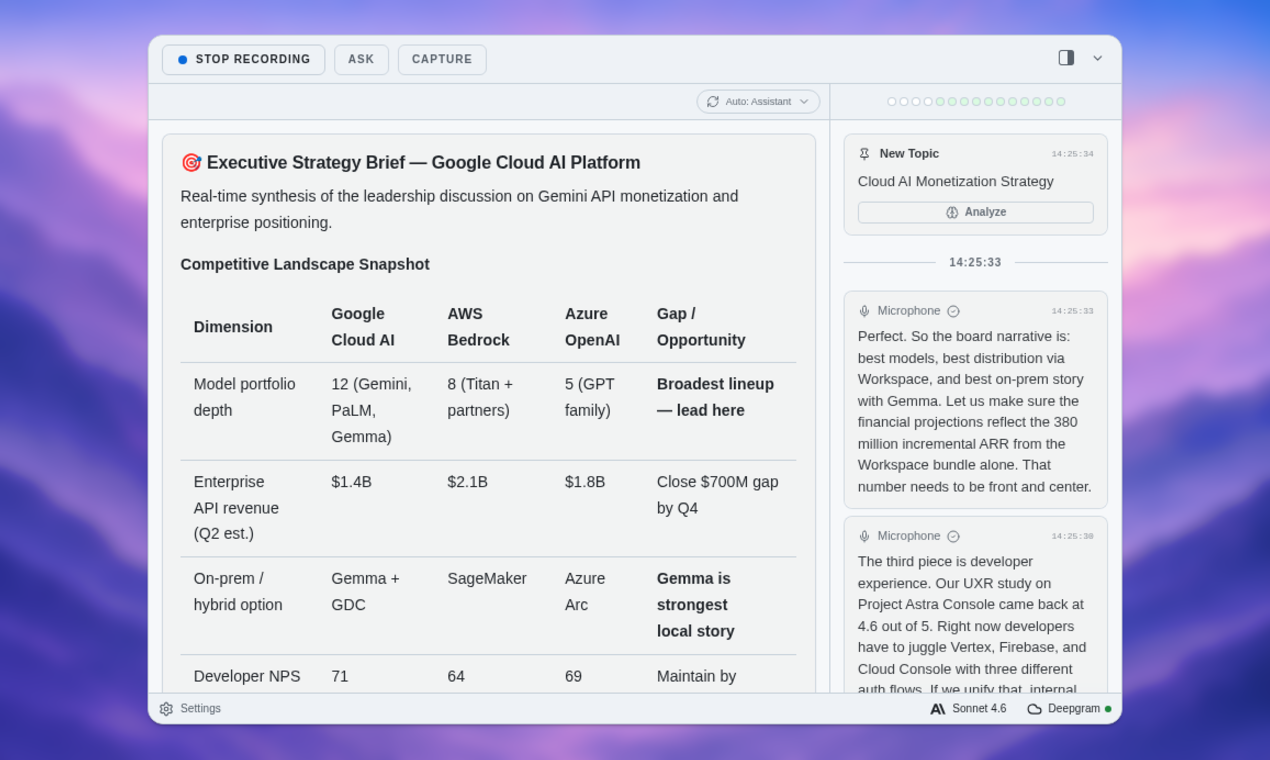
Many interview questions are not just spoken out loud. They appear in a shared document, a coding editor, a prompt window, a whiteboard, a browser tab, or a meeting screen. A helpful assistant should understand what is happening on the desktop, not just what was transcribed.
ExtraBrain is designed around live transcription and screen-aware context. That means it can help with the conversation and the visible materials around it. For coding and system design interviews, that desktop context can be much more useful than generic interview tips.
Local-first options change the privacy posture
Interview transcripts, notes, screenshots, and practice answers can be sensitive. They may include personal work history, salary expectations, company names, customer examples, unreleased work, or private meeting details. That is why privacy should not be an afterthought.
ExtraBrain supports local Parakeet transcription and local Gemma 4 on-device AI where installed and compatible. With local Gemma 4 and local Parakeet transcription, transcription and AI prompts can stay local. When users choose external providers, selected prompts, transcript text, screenshots, audio, or context may leave the device depending on configuration.
That distinction is important. It lets users choose a more local setup when they need it, while still allowing bring-your-own providers when they want external models.
Provider control is useful for serious users
ExtraBrain supports Google Gemma 4 local AI, Anthropic, OpenAI, custom OpenAI-compatible endpoints, Claude Subscription, and Codex Subscription. That provider flexibility matters because candidates and teams have different priorities. Some care most about privacy. Some care most about model quality. Some already have provider accounts. Some need a custom OpenAI-compatible endpoint.
A focused desktop copilot should not force every user into one fixed AI setup. ExtraBrain gives users more control over how their assistant is configured.
Post-interview review is part of the workflow
The most useful interview tool is not only active during the call. It should also help you learn afterward. You need transcripts, session history, notes, follow-up questions, and a way to understand what happened while the details are still fresh.
ExtraBrain can work as a focused AI second brain for interviews and meetings. It is not trying to replace a general note-taking database. It is a second-brain-style workspace for live sessions, transcripts, notes, screen context, and review.
That is useful after a final round because the best improvements often happen in the debrief. You can review which examples landed, which questions surprised you, where you rambled, and what follow-up message you should send.
Final Round AI vs ExtraBrain
| Category | Final Round AI | ExtraBrain |
|---|---|---|
| Main focus | Broad interview and job-search preparation | Local-first desktop AI interview assistant and meeting copilot |
| Platform | Web-oriented interview workflow | Mac desktop app today, with Windows and Linux planned |
| Live context | Useful for interview practice and transcription-style support | Live transcription plus screen-aware desktop context |
| Local-first posture | Depends on the product configuration | Local Parakeet transcription plus local Gemma 4 where installed and compatible |
| Provider control | May include configurable AI options | Bring-your-own providers, local AI options, and custom OpenAI-compatible endpoints |
| Best fit | Users who want a broader job-search toolkit | Mac users who want focused real-time interview and meeting support |
| Pricing model | Review pricing directly before purchasing | Core Mac app is free, with ExtraBrain Pro options available |
| Responsible use | Users must follow interview and platform rules | Users must follow interview, workplace, school, and platform rules |
Who should still consider Final Round AI
Final Round AI may still make sense for some candidates. If you want a broader tool that combines resume help, mock interviews, and general preparation, it may be useful. If you are early in your job search and need a structured place to start, it can help you build momentum. If your expectations are basic practice and general feedback, it may be enough.
It may also fit people who do not want a desktop-first workflow. Some candidates prefer a web-style product with a guided interface and multiple job-search features in one place. That is a valid preference.
The key is knowing what you are buying. If you need broad preparation, Final Round AI may be worth comparing. If you need focused live interview support, screen-aware context, local-first options, and provider control on Mac, ExtraBrain is likely closer to the workflow you want.
Who should consider ExtraBrain instead
ExtraBrain is better aligned with users who want a practical interview copilot rather than a large job-search suite. It is especially relevant if you want to use AI across live interviews, meetings, research calls, and lectures.
You should consider ExtraBrain if you want a free core Mac app. You should consider it if you want live transcription during a conversation. You should consider it if screen context matters because the interview includes code, prompts, designs, whiteboards, documents, or slides. You should consider it if privacy controls and local-first options matter. You should consider it if you want to choose your own AI provider instead of being locked into one setup.
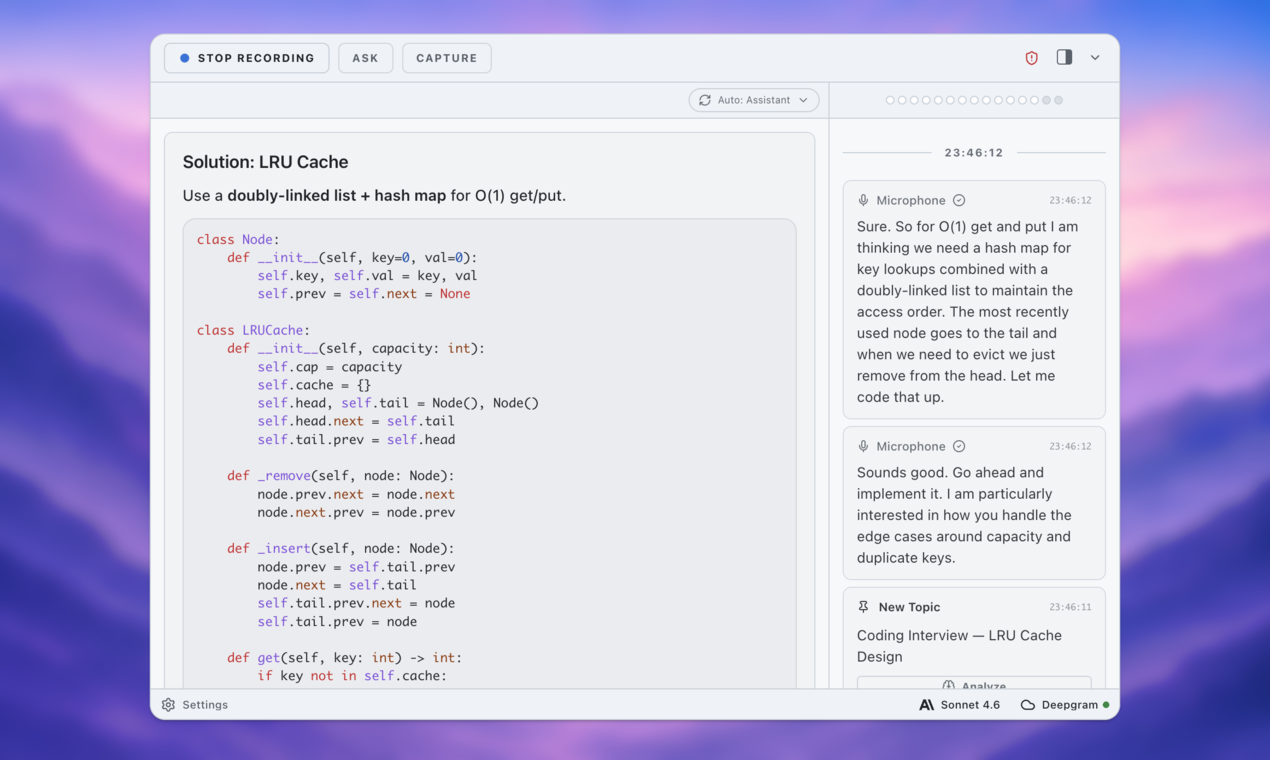
For technical candidates, that combination is especially useful. Coding interviews and system design interviews require more than polished behavioral answers. They require reading the prompt carefully, reasoning through tradeoffs, explaining assumptions, and adapting as the interviewer adds constraints.
How to evaluate any AI interview assistant
The best tool depends on your situation, but the evaluation criteria should be practical. Do not choose an AI interview assistant only because it has many features. Choose it because it improves the way you prepare, think, speak, and review.
Test it with your real materials
Use the job description, your actual resume, and a realistic interview scenario. Generic prompts will produce generic results. A tool that performs well with real context is more likely to help when the interview matters.
Practice aloud
Silent preparation can create a false sense of readiness. Speak your answers out loud and see whether the tool helps you improve structure, clarity, pacing, and specificity. If it only gives generic advice, keep looking.
Check whether the feedback changes
Good coaching should respond to your performance. If every session ends with the same advice, the tool may not be learning much from your answers. Look for feedback that notices repeated patterns and gives concrete next steps.
Evaluate privacy and data flow
Interview notes can contain sensitive information. Check whether transcription, screenshots, prompts, and audio stay local or are sent to external providers. ExtraBrain gives users local-first options with local Parakeet transcription and local Gemma 4 where installed and compatible, while external providers may receive selected context depending on configuration.
Use AI responsibly
AI assistance is not appropriate in every interview or assessment. Before using any tool, confirm that your interview, employer, school, workplace, meeting, or platform rules allow AI assistance, transcription, screenshots, or notes. A good tool does not remove your responsibility to be honest and follow the rules.
My recommendation
Final Round AI has useful ideas and may help candidates who want a broad interview-prep environment. But in my test, the product did not consistently deliver the depth of personalization, feedback quality, and smooth live coaching I wanted from a serious final-round preparation tool. The experience felt useful, but not strong enough to fully earn my trust for the moments that matter most.
ExtraBrain is the better fit if your priority is a focused desktop AI interview assistant for Mac. It offers live transcription, screen-aware context, local-first options, bring-your-own AI providers, and post-session review in a free core app. For candidates who want help thinking through live technical, behavioral, product, and system design conversations, that workflow feels more directly connected to the problem.
If you need a broad job-search platform, compare Final Round AI carefully. If you want a practical Final Round AI alternative built around live interview context and privacy-aware desktop support, start with ExtraBrain.
FAQ
Is Final Round AI worth it?
Final Round AI may be worth it if you want a broad interview-prep and job-search tool with guided practice features. It felt less compelling to me when judged mainly as a deep, personalized live interview coach. Review the current pricing and feature limits before paying.
What disappointed you most in Final Round AI?
The feedback quality disappointed me most. Some suggestions were useful, but too many felt generic or insufficiently tied to my target role, answer content, and interview level.
Is ExtraBrain a Final Round AI alternative?
Yes. ExtraBrain is a strong Final Round AI alternative for Mac users who want live desktop context, screen awareness, local-first options, technical interview support, and provider control.
Can ExtraBrain generate interview answers?
ExtraBrain can help generate answer outlines, STAR structures, technical explanations, and follow-up questions from live transcript and screen context. Candidates remain responsible for honest and allowed use.
Can ExtraBrain run fully local?
A fully local ExtraBrain posture requires local Parakeet transcription plus local Gemma 4 on-device AI where installed and compatible, with no external provider requests. External providers may receive selected prompts, transcript text, screenshots, audio, or context depending on configuration.
What platforms does ExtraBrain support?
ExtraBrain is available for macOS today, including Apple Silicon and Intel Macs. Windows and Linux are planned future platforms.
How does ExtraBrain pricing work?
The core ExtraBrain Mac app is free. ExtraBrain Pro is $9.99/month, $79/year, or $149 Lifetime launch pricing. External AI and transcription provider usage is billed separately by the providers users choose.