
ExtraBrain Blog
How to Avoid Getting Flagged in HunchVue Interviews

Learn how to reduce false flags in HunchVue interviews, use AI only when allowed, and keep your coding explanations clear and authentic.
HunchVue-style technical interviews can feel stressful because candidates are being evaluated on more than final answers. The platform experience may involve live video, browser activity, coding history, interviewer review, and follow-up questions about how you think. That combination creates a real concern for honest candidates: how do you avoid getting flagged when you are simply nervous, thinking aloud, checking allowed notes, or using approved preparation tools?
This guide rewrites the usual “how to cheat on HunchVue” question into the safer and more useful version: how to prepare for HunchVue without looking suspicious, breaking rules, or depending on help you cannot explain. ExtraBrain can support that workflow as a local-first Mac AI interview assistant and meeting copilot, but only where interview, employer, school, workplace, and platform rules allow AI assistance, transcription, screenshots, or notes.
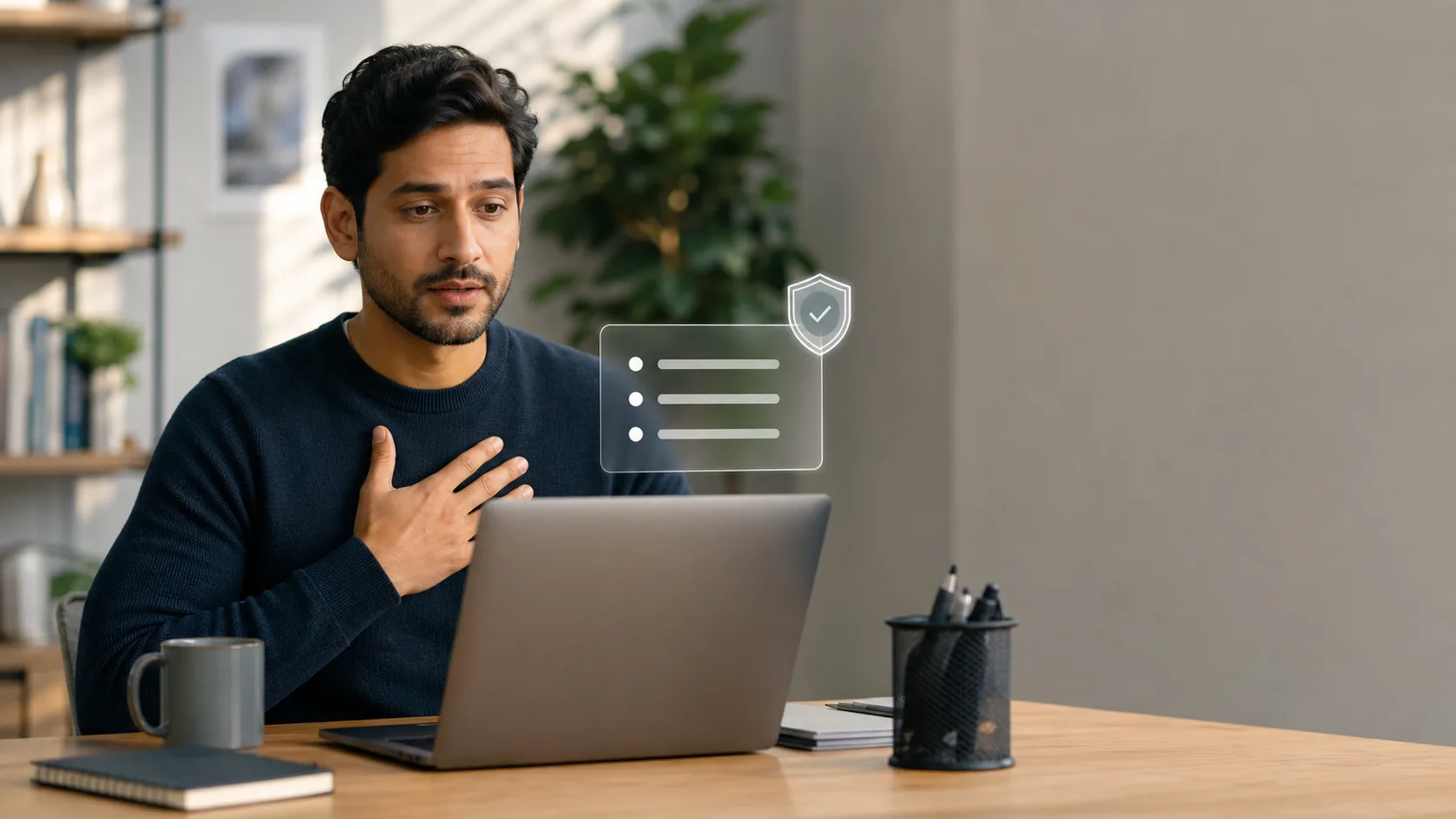
What HunchVue Interviews Are Trying to Detect
Many modern interview systems are designed to identify signals that the candidate is not doing the work themselves. Those signals can include abrupt tab changes, unusual copy and paste behavior, long off-screen glances, inconsistent coding rhythm, unexplained solution jumps, and answers that sound polished but collapse under follow-up questions.
That does not mean every flag proves cheating. A candidate might look away because they are thinking, pause because they are debugging, or type unevenly because they are nervous. The best defense is not a trick. The best defense is a workflow that looks natural because it is natural.
Common Anti-Cheating Signals
- Live behavior monitoring: Interviewers and software may notice repeated off-screen glances, leaving the camera frame, unnatural silence, or sudden shifts in attention.
- Browser and environment checks: Some interview environments watch for tab switching, window focus changes, blocked paste actions, or unexpected interruptions.
- Code replay: Reviewers may inspect how a solution developed over time, not just the final code.
- Plagiarism and similarity checks: Coding answers may be compared against known solutions, public snippets, or repeated candidate submissions.
- Expert follow-up questions: Interviewers may ask why a data structure was chosen, how complexity changes, or what would break under edge cases.
Why Follow-Up Questions Matter
HunchVue-style interviews often reward explainability. A candidate who can only recite a final answer is easy to challenge. A candidate who can explain tradeoffs, edge cases, failed attempts, and complexity is much harder to misread.
This is why responsible AI prep should focus on understanding, not script reading. If you cannot explain an answer in your own words, it is not ready for a live interview.
Use AI for Preparation, Not Rule-Breaking
ExtraBrain is a free, local-first desktop AI interview assistant and meeting copilot for Mac. It supports live transcription, screen-aware context, local Gemma 4 on-device AI where installed and compatible, bring-your-own AI providers, and clear privacy controls.
That makes it useful for coding interviews, system design rounds, behavioral interviews, meetings, lectures, and research calls. It does not remove your responsibility to follow the rules of the interview or assessment.
Use AI before the interview to build fluency. Use AI during the interview only if the rules clearly allow it. Use AI after the interview to review what went well and what needs practice.
A Responsible ExtraBrain Workflow
- Use ExtraBrain before the interview to practice with realistic prompts.
- Ask for hints, edge cases, and tradeoffs instead of complete answers.
- Practice saying your reasoning out loud before writing code.
- Save transcripts or notes only when the interview rules and local law allow it.
- During the live session, disclose or avoid AI assistance based on the rules you were given.
- After the session, review the transcript and rebuild weak answers from memory.
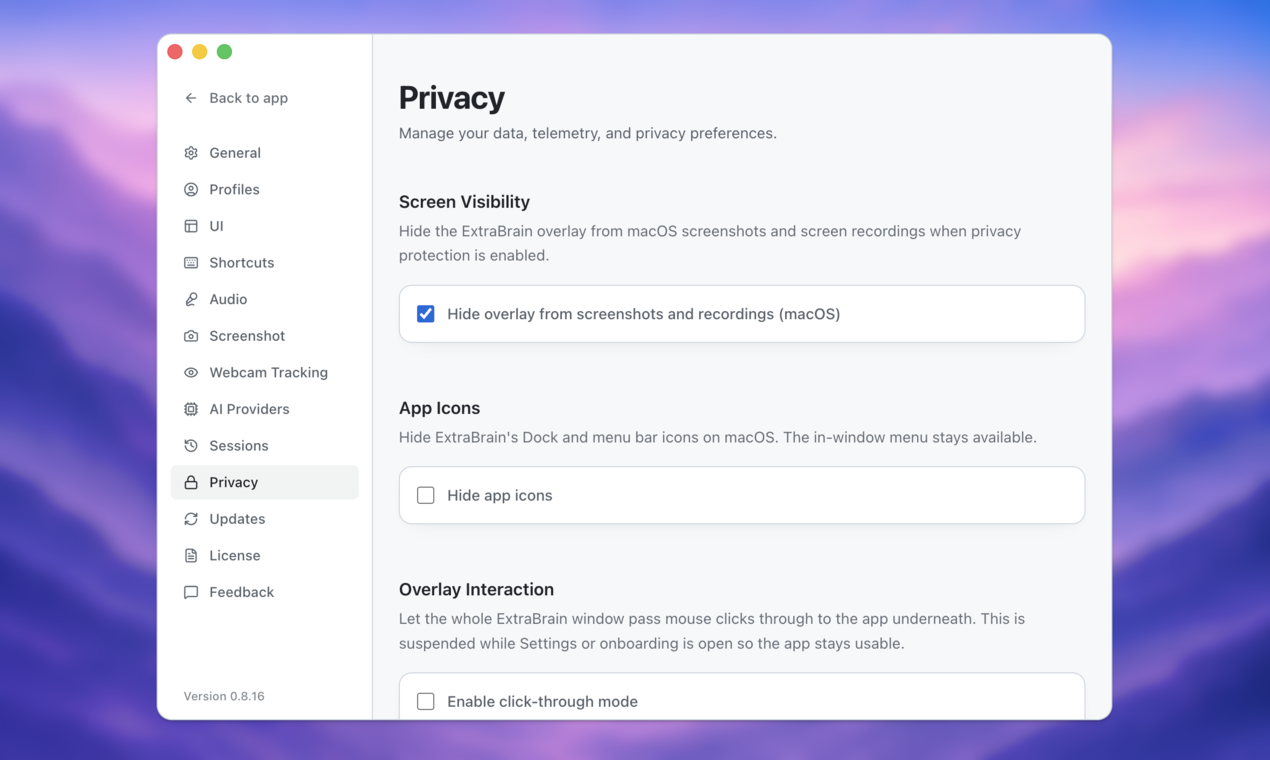
How to Avoid False Flags in HunchVue Interviews
The practical goal is to behave like a prepared candidate, not like someone hiding a second workflow. That means keeping your environment simple, your explanation steady, and your actions easy to justify.
Keep Your Setup Boring
A boring setup is usually the safest setup. Close unrelated tabs, quit chat apps, silence notifications, plug in your charger, and test your internet connection before the call starts. If you are allowed to use notes, keep them minimal and visible enough that you can explain what they are. If notes are not allowed, do not use them.
Avoid last-minute setup changes. A sudden VPN switch, browser crash, or device handoff can create exactly the kind of irregular activity that makes reviewers look more closely.
Practice Natural Eye Movement
Candidates often worry about eye tracking or camera attention. You do not need to stare into the webcam like a robot. You do need to avoid repeated unexplained glances away from the screen.
Practice with your actual interview layout. Put the coding editor, prompt, and video window where you can see them comfortably. Record a short mock session and check whether your gaze looks like normal thinking or like you are reading from somewhere else.
Type Like You Think
In coding interviews, the path matters. If a complete solution appears all at once, reviewers may wonder where it came from. If you build the solution in small steps and explain each step, the code history tells a more credible story.
A natural flow looks like this:
- Restate the problem.
- Ask a clarifying question.
- Handle simple edge cases.
- Sketch a basic approach.
- Improve the approach if needed.
- Test with a small example.
- Discuss complexity and limitations.
This is also a better engineering habit. It helps you catch mistakes before the interviewer has to catch them for you.
A Better Prompt for AI Interview Practice
You should not use AI to secretly generate answers in a restricted interview. You can use AI before the interview to train the exact behavior that interviewers want to see: structured thinking, incremental coding, and clear explanations.
Use this practice prompt with ExtraBrain or another allowed AI tool before your HunchVue session:
You are a senior engineering interviewer helping me prepare for a live coding interview. Do not give me a full solution immediately. Start by asking me to restate the problem and identify edge cases. Then guide me through the solution in 3 to 5 small steps. For each step, give one hint, one question I should answer out loud, and one small code change I should write myself. If I make a mistake, ask a follow-up question before correcting me. At the end, ask me to explain time complexity, space complexity, and one alternative approach.
This prompt trains the muscle you actually need in HunchVue: being able to defend your own solution. It also reduces the temptation to memorize a script that will fail as soon as the interviewer asks “why?”
Handling Expert Follow-Up Questions
HunchVue interviews can include expert-led verification. That means the interviewer may ask deeper questions after your answer appears correct. This is where many AI-assisted candidates struggle, because they know the final output but not the reasoning.
Prepare for follow-ups in advance. For every practice problem, ask yourself these questions:
- Why did I choose this data structure?
- What is the time complexity?
- What input breaks the first version of my solution?
- How would I test this quickly?
- What would I change for larger input sizes?
- What tradeoff did I make between readability and performance?
- Could I explain the same idea without code?
ExtraBrain can help you generate these follow-up questions from your practice transcript or screen context. The value is not in memorizing the answers. The value is in rehearsing the reasoning until it becomes yours.
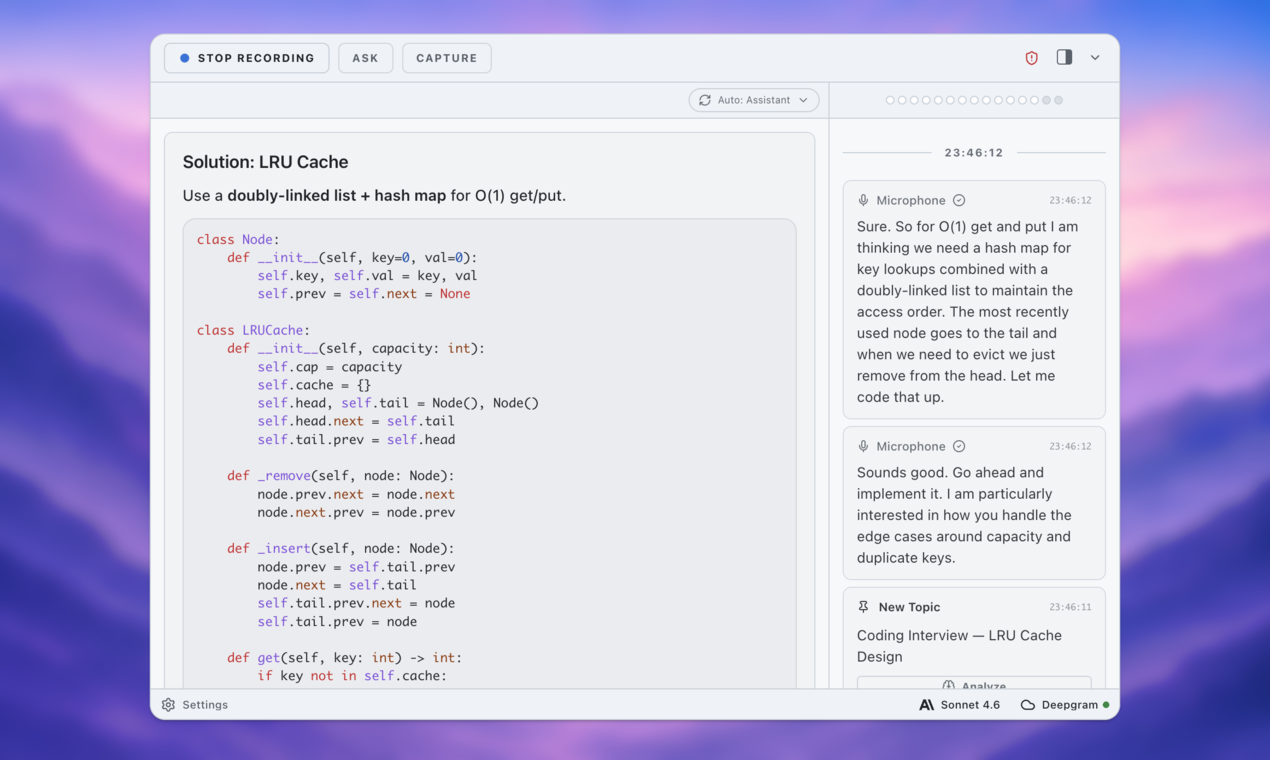
Notes, Screens, and AI Tools: What to Do Instead of Hiding
Many candidates search for ways to hide tools, use second screens, or make external help invisible. That is risky, often against the rules, and likely to backfire when the interviewer asks for reasoning. A better approach is to decide in advance what is allowed and design your workflow around that boundary.
If Notes Are Allowed
Keep notes short. Use them for frameworks, reminders, and checklists rather than direct answers. For example, a useful note might say “clarify input, edge cases, brute force, optimize, test, complexity.” A risky note is a full solution to a likely problem.
If the interviewer asks what you are looking at, you should be able to answer plainly. That is the standard to use before the session begins.
If AI Assistance Is Allowed
Use it like a coach, not a ghostwriter. Ask for clarifying questions, test cases, complexity checks, or alternative explanations. Do not paste complete generated code unless the rules explicitly permit that. Be ready to explain which parts came from you and which parts came from a tool.
ExtraBrain supports bring-your-own AI providers and local options, including local Gemma 4 where installed and compatible. A fully local posture requires local Parakeet transcription plus local Gemma 4 on-device AI where installed and compatible, with no external provider requests. If you select external providers, prompts, transcript text, screenshots, audio, or context may leave the device depending on configuration.
If AI Assistance Is Not Allowed
Do not use it during the live interview. Use ExtraBrain before the interview for practice and after the interview for debriefing only if recording, transcription, and note policies allow it. The short-term benefit of hidden help is not worth the risk to your candidacy or professional reputation.
Timing and Behavior Checklist
Suspicious behavior often comes from inconsistency. You can reduce false flags by making your interview behavior steady and explainable.
Before the interview:
- Test your camera, microphone, browser, and internet connection.
- Close unrelated apps and browser tabs.
- Confirm whether notes, AI tools, calculators, docs, or search are allowed.
- Practice one full mock session using the same screen layout.
- Prepare a short disclosure sentence if allowed tools are part of your workflow.
During the interview:
- Think out loud before coding.
- Ask clarifying questions instead of silently searching for certainty.
- Type incrementally rather than producing a large unexplained block.
- Explain mistakes and corrections as normal engineering work.
- Keep your gaze and posture relaxed but consistent.
- Do not switch windows unless the rules and interviewer allow it.
After the interview:
- Write down questions you struggled with.
- Rebuild the solution without help.
- Review your explanation for gaps.
- Turn weak moments into targeted practice prompts.
How ExtraBrain Fits HunchVue Preparation
ExtraBrain is best used as a practice and review layer for candidates who want better live thinking. It can help you turn a job description into likely interview themes, practice technical explanations, structure behavioral answers, and review what happened after a session.
For Mac users, it offers a desktop workflow with live transcription, screen-aware context, local-first options, provider control, and privacy settings. The core Mac app is free. ExtraBrain Pro is available at $9.99/month $79/year, or $149 Lifetime launch pricing. External AI and transcription provider usage is billed separately by the providers users choose.
Use ExtraBrain when it helps you become clearer, calmer, and more prepared. Do not use it to bypass rules that prohibit assistance.
FAQ
Can I use ExtraBrain for HunchVue interviews?
You can use ExtraBrain for HunchVue preparation, mock practice, and post-interview review. During a live HunchVue interview, use it only if the interview, employer, school, workplace, and platform rules allow AI assistance, transcription, screenshots, or notes.
How do I avoid getting falsely flagged in HunchVue?
Keep your setup simple, avoid unnecessary tab switching, explain your thinking out loud, type solutions incrementally, and confirm tool rules before the interview. The goal is to make every action easy to understand if reviewed later.
Is using AI always cheating in a coding interview?
No. AI can be acceptable for preparation, practice, accessibility, note review, or allowed live support depending on the rules. It becomes a problem when it violates stated rules or misrepresents your own ability.
What should I do if I am asked whether I used AI?
Answer honestly and specifically. Explain whether you used AI for preparation, during the live session, or after the interview, and describe what the tool helped with. If you are unsure whether AI is allowed, ask before using it.
Can ExtraBrain run fully local?
A fully local ExtraBrain posture requires local Parakeet transcription plus local Gemma 4 on-device AI where installed and compatible, with no external provider requests. External providers may receive selected prompts, transcript text, screenshots, audio, or context depending on configuration.
What is the safest way to prepare for HunchVue?
Practice under realistic conditions. Use timed mock interviews, explain every decision out loud, review follow-up questions, and make sure any tools you use match the rules of the actual interview.