
ExtraBrain Blog
InterviewVector Screening in 2026: AI Help, Risks, and Responsible Prep

A responsible guide to InterviewVector screening, AI interview copilots, proctoring risks, and ethical prep with ExtraBrain.
If you searched for how to cheat on InterviewVector in 2026, you are probably not trying to become dishonest overnight. You are probably stressed, tired of screening platforms, and worried that one nervous pause or one weak coding answer could cost you a real opportunity.
That pressure is real. So are the risks.
InterviewVector-style screening can include identity checks, webcam monitoring, screen activity review, audio analysis, and post-session anomaly reports. Trying to hide a proxy, sneak in a second device, or route the session through a remote machine can create bigger problems than a failed interview.
This guide keeps the search intent honest. It explains what candidates worry about, what commonly gets flagged, why some popular cheating tactics are risky, and how to use ExtraBrain as a responsible AI interview copilot where interview, employer, school, workplace, and platform rules allow it.

Key takeaways
- InterviewVector screening is usually designed to verify identity, detect unusual behavior, and review technical environment signals.
- Proxy interviewees, hidden phones, remote desktop sessions, and virtual machines can trigger serious integrity and identity concerns.
- AI interview assistants should be used only where the rules allow transcription, notes, screenshots, or AI assistance.
- ExtraBrain is a free, local-first Mac desktop AI interview assistant and meeting copilot with live transcription, screen-aware context, bring-your-own providers, and privacy controls.
- The safest use of AI is preparation, structured thinking, mock interviews, post-interview review, and allowed live support.
- If AI assistance is not allowed during the live assessment, use it before and after the session instead.
What InterviewVector is trying to protect
InterviewVector screenings exist because employers want a cleaner signal from remote interviews. They want to know whether the person on camera is the candidate, whether the answers reflect the candidate’s own ability, and whether the test environment has been manipulated.
That does not mean every flag equals cheating. People look away when thinking. Microphones pick up roommates, traffic, keyboards, and pets. Remote laptops can have background apps that candidates forgot to close.
Still, modern screening systems often combine several signals. A single odd moment may be harmless, but multiple signals can create a review trail.
How InterviewVector-style systems may detect suspicious activity
The exact settings vary by employer and assessment configuration. You should read the instructions for your specific interview instead of assuming every InterviewVector session works the same way.
Identity and room checks
A screening flow may ask for identity verification before the assessment begins. That can include photo ID, face matching, login verification, and a webcam scan of your environment.
A room scan is usually intended to confirm that the candidate is alone, the workspace is clear, and no unauthorized devices or people are visible.
Behavior and biometric signals
Some systems review eye movement, face visibility, posture changes, background voices, and long off-screen attention. These signals can be imperfect, but they are often used to decide whether a human reviewer should inspect the session.
This is one reason hidden-phone tactics are fragile. Even if the device is outside the camera view, repeated glances away from the screen can look abnormal.
Screen and application monitoring
A technical assessment may restrict browser tabs, copy and paste, screen sharing, external applications, or workspace switching. Some sessions also record screen activity for later review.
If a platform says that external tools are not allowed, trying to keep an AI window hidden is not responsible use. Use AI for preparation before the assessment and for debrief afterward instead.
Post-assessment review
After the session, the platform or employer may review logs, recordings, anomaly scores, and proctor notes. This means the consequences of a risky workaround may not appear immediately. You might finish the interview feeling fine, then still face a review later.
The risky tactics people ask about
A lot of articles about InterviewVector focus on evasion. That advice can be tempting, but it often ignores identity rules, employer policies, and long-term reputation risk.
Proxy interviewees
A proxy interviewee is a stand-in who completes the interview for you. This is one of the highest-risk tactics because it directly attacks identity verification.
If the employer checks ID, compares the face on camera, asks follow-up questions from your resume, or schedules later live rounds with the same team, the story can fall apart quickly. Even when a proxy is technically skilled, they do not have your exact work history, tradeoff reasoning, communication style, or project memory.
A better approach is to prepare your own examples deeply enough that you can answer follow-ups without sounding scripted. Use ExtraBrain before the interview to practice behavioral answers, technical explanations, and resume-based stories.
Remote desktop and virtual machines
Remote desktop software and virtual machines are often discussed as ways to separate the assessment environment from the main computer. They can also introduce technical signals that screening platforms may treat as suspicious.
The bigger issue is intent. If the purpose is to let another person control the session or to access banned resources, it is not a harmless productivity setup. It can violate the rules of the interview.
If you need an accessibility accommodation, a special setup, or a particular development environment, ask the recruiter or assessment administrator before the session. Get the permission in writing when possible.
Hidden phone or tablet help
A second device looks simple, but it creates obvious behavioral problems. You have to look away, read under pressure, keep your hands and posture natural, and avoid audio or reflection issues.
Even if nothing is detected by software, it can make your delivery worse. You may sound delayed, distracted, or disconnected from the interviewer.
For allowed preparation, use your phone or tablet for flashcards, mock interview notes, or post-session reflection. For live assessments, follow the platform rules.
Screen sharing with a friend or paid helper
Real-time outside help through a private call can create background audio, timing delays, multiple-device noise, and inconsistent answers. It also undermines the purpose of a live interview.
If collaboration is allowed, the prompt will usually say so. If it is not allowed, do not treat hidden collaboration as a clever workaround.
A safer alternative is to run mock interviews with friends before the real session. Ask them to interrupt, challenge assumptions, and push you with follow-up questions. That gives you the practice benefit without compromising the real assessment.
Where ExtraBrain fits responsibly
ExtraBrain is a free, local-first desktop AI interview assistant and meeting copilot for Mac. It supports live transcription, screen-aware context, local Gemma 4 on-device AI where installed and compatible, bring-your-own AI providers, and clear privacy controls.
That makes it useful across coding interviews, system design rounds, behavioral interviews, product interviews, customer calls, lectures, and research meetings. The core question is not whether the tool is powerful. The question is whether your specific situation allows the kind of assistance you plan to use.
Before the InterviewVector screening
Use ExtraBrain before the assessment to prepare your own thinking. That is the lowest-risk and highest-value workflow.
You can practice explaining projects from your resume. You can rehearse coding tradeoffs out loud. You can generate clarifying questions for ambiguous prompts. You can turn long STAR stories into tighter answer outlines. You can review weak areas from previous interviews.
A useful practice prompt looks like this:
Act as a strict interviewer for a remote technical screening.Ask one question at a time.After each answer, challenge vague claims, ask for evidence from my resume, and request a clearer tradeoff.Keep the session realistic and do not give me the final answer until I attempt it first.This trains you to think under pressure instead of memorizing lines.
During the screening, if AI assistance is allowed
Some interviews, meetings, or workplace contexts allow AI notes, transcription, or copilots. If your InterviewVector session explicitly allows that, configure your tools transparently and conservatively.
Use ExtraBrain to keep track of the question, summarize context, and help structure your response. Do not read long generated answers word for word. Use short prompts that support your reasoning instead of replacing it.
For example:
Summarize the interviewer question in one sentence.List the assumptions I should confirm.Give me a concise answer outline with tradeoffs, not a full script.This keeps you in control of the answer. It also helps you sound like yourself.
During the screening, if AI assistance is not allowed
If the rules prohibit AI, transcription, screenshots, external notes, or assistive tools, do not use ExtraBrain live. Use it before the session for practice and after the session for reflection.
Responsible use matters because interviews are not just about getting past one platform. They are also about trust, future teamwork, and whether you can perform the role after you are hired.
After the screening
Post-interview review is one of the best uses of an AI interview copilot. If you have allowed notes or transcripts, ExtraBrain can help you reconstruct what happened, identify weak answers, and prepare follow-up practice.
A strong debrief prompt looks like this:
Review this interview transcript.Identify where my answers were unclear, too long, or missing evidence.Create a practice plan for the next round with five targeted drills.This turns one stressful screening into useful career data.
A safer workflow for InterviewVector preparation
The goal is not to outsmart proctoring. The goal is to reduce panic, improve clarity, and avoid avoidable mistakes.
Step 1: Read the rules closely
Before doing anything else, read the candidate instructions. Look for rules about AI tools, notes, calculators, IDEs, browser tabs, documentation, screen recording, transcription, and external help.
If the instructions are unclear, ask the recruiter a narrow question. For example, ask whether personal notes are allowed or whether AI transcription is permitted.
Step 2: Prepare your environment
Choose a quiet room. Charge your laptop. Test your camera, microphone, browser, and internet connection. Close unrelated apps. Remove unauthorized notes or devices if the rules require a clean environment.
This is not just about avoiding flags. A clean environment also makes you calmer.
Step 3: Practice the actual format
InterviewVector screenings may include behavioral questions, coding prompts, technical explanations, or asynchronous video responses. Practice the same format you expect to face.
If you expect coding, talk through your solution before writing code. If you expect behavioral questions, prepare stories with context, action, result, and reflection. If you expect system design, practice clarifying requirements before jumping into architecture.
Step 4: Build short answer blocks
Long AI-generated paragraphs are hard to deliver naturally. They also sound generic.
Train with short answer blocks instead. Each block should make one point. Each point should connect to your real experience. Each answer should leave room for the interviewer to ask follow-up questions.
A good formatting prompt for practice is:
For every answer, use short speech blocks of 25 to 30 words.Anchor the answer in my actual resume when possible.Use conversational language.Include one tradeoff or limitation.End with a sentence that invites a follow-up question.Step 5: Practice manual reasoning
Copy and paste restrictions are common in assessment environments. Even if you are allowed to use notes or AI in some context, you should be able to reason and type without relying on pasted output.
For coding, practice writing the solution yourself. For behavioral answers, practice speaking from bullet points rather than scripts. For product or system design, practice drawing the structure from memory.
Step 6: Use AI as a coach, not a substitute
The best AI interview assistant does not make you disappear from the process. It helps you notice what you missed. It helps you structure your thinking. It helps you prepare more deliberately.
That is the difference between responsible AI support and cheating.
Example InterviewVector prep plan with ExtraBrain
Here is a practical plan you can run over three days.
Day 1: Resume and story audit
Load your resume, job description, and project notes into your preparation workflow. Ask ExtraBrain to identify likely screening themes. Then practice explaining each project in plain language.
Focus on ownership, constraints, metrics, mistakes, and tradeoffs. Those details are harder to fake and easier to remember.
Day 2: Technical drills
Practice the technical areas most likely to appear. For software roles, that might include debugging, data structures, API design, system design, or explaining prior architecture decisions.
Use ExtraBrain to generate follow-up questions after you answer. Do not ask it to simply solve the prompt first. Attempt the solution, then compare.
Day 3: Mock screening
Run a timed mock session. Use the same laptop, browser, camera angle, and audio setup you will use for the real assessment.
If AI is not allowed in the real session, do not use it during the mock answer window. Use ExtraBrain afterward to review your performance and build a final practice list.
Privacy and provider choices
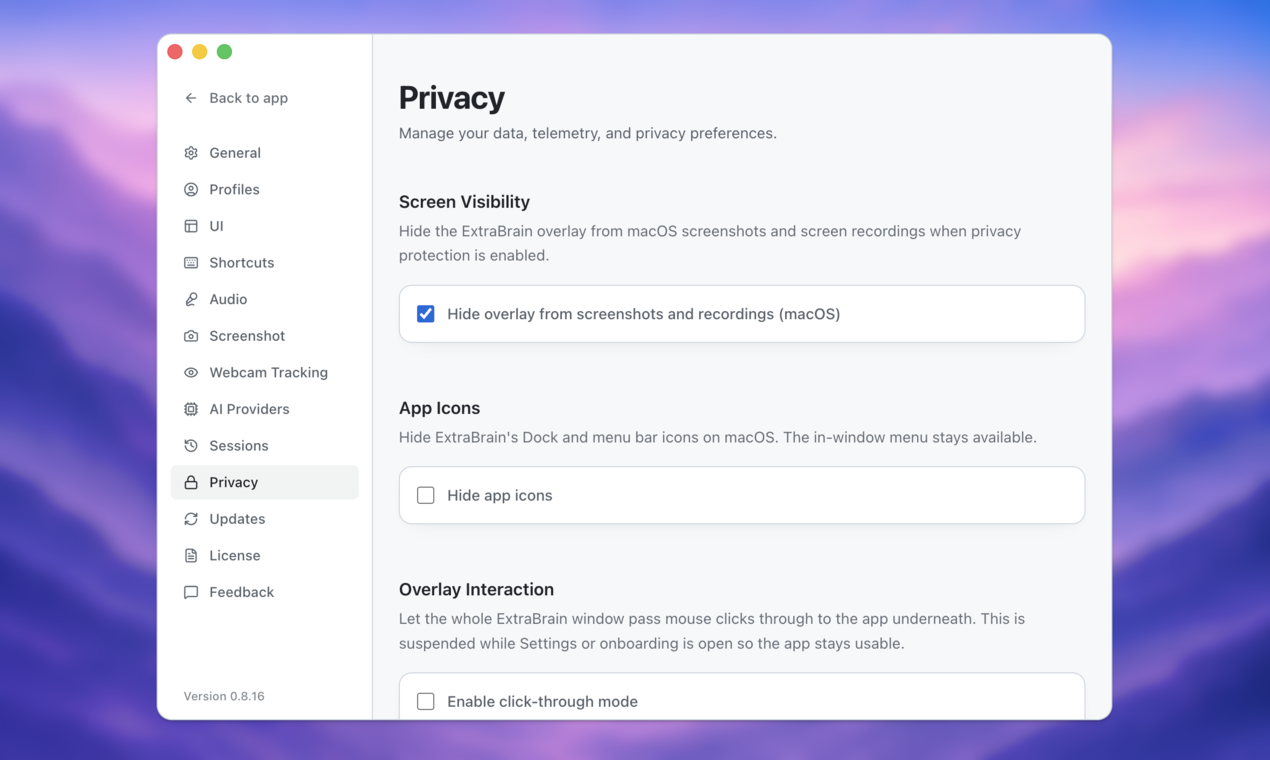
ExtraBrain is local-first, but your privacy posture depends on how you configure it. With local Parakeet transcription and local Gemma 4 on-device AI where installed and compatible, transcription and AI prompts can stay local. If you connect external providers, selected prompts, transcript text, screenshots, audio, or context may leave your device depending on your settings.
ExtraBrain supports bring-your-own provider setup, including Anthropic, OpenAI, custom OpenAI-compatible endpoints, Claude Subscription, Codex Subscription, and local Gemma 4 where installed and compatible. Optional Deepgram transcription is also available.
Before using any tool in an interview or assessment context, check both the platform rules and your own privacy expectations.
What to do instead of cheating
If you are tempted to cheat because you feel underprepared, use that signal productively. It tells you exactly where the prep plan should focus.
If you freeze on behavioral questions, build a personal story bank. If coding prompts make you panic, practice explaining brute force first, then improving. If system design feels too broad, memorize a repeatable clarification checklist. If your answers sound robotic, practice aloud until the phrasing becomes yours.
The point is not to pretend AI does not exist. The point is to use AI in a way that makes your real ability easier to show.
FAQ
How do I avoid getting caught using AI tools in interviews?
The safest answer is to follow the rules of the interview. If AI assistance is allowed, use it transparently and as a thinking aid rather than a script generator. If AI assistance is not allowed, use ExtraBrain for preparation before the interview and review after it.
Can I use ExtraBrain during an InterviewVector screening?
Only if the interview, employer, school, workplace, and platform rules allow AI assistance, transcription, screenshots, notes, or external tools. ExtraBrain is useful for live transcription and screen-aware context, but responsible use comes first.
Is a proxy interviewee a good idea for InterviewVector?
No. A proxy creates identity, ethics, and employment risks. It can also fail when the interviewer asks resume-specific follow-ups or later expects the same knowledge from you on the job.
What is the most common reason candidates get flagged?
Common red flags can include identity mismatch, repeated off-screen attention, background voices, unusual screen activity, restricted app usage, copy-and-paste behavior, and inconsistent delivery. The exact review process depends on the assessment setup.
How should I prepare if I am nervous?
Run realistic mock sessions. Practice aloud. Use short answer blocks. Review your resume stories. Prepare clarifying questions. Use ExtraBrain as a coach before and after the screening so the real session feels less unfamiliar.
What is ExtraBrain?
ExtraBrain is a free, local-first Mac desktop AI interview assistant and meeting copilot with live transcription, screen-aware context, local Gemma 4 where installed and compatible, bring-your-own AI providers, and privacy controls.