
ExtraBrain Blog
Maki People Test AI Help Without Crossing the Line
A safer guide to Maki People test AI help, proctoring risks, preparation workflows, and responsible ExtraBrain use.
People search for how to cheat on a Maki People test when the stakes feel high, the instructions feel vague, and the assessment seems like a gate between them and a job. That anxiety is real. The risky part is assuming that hidden devices, copied answers, impersonation, or stealth tools are the best response.
A better approach is to understand what Maki-style assessments are trying to measure, where proctoring and plagiarism checks create real risk, and how to use AI for preparation, practice, and review only where the rules allow it. ExtraBrain is built for that kind of workflow: a free, local-first Mac desktop AI interview assistant and meeting copilot with live transcription, screen-aware context, local-first options, bring-your-own AI providers, and clear privacy controls.

Key Takeaways
- The phrase “how to cheat on Maki People test” usually points to stress, not a good strategy.
- Browser-based assessments, webcam checks, identity verification, plagiarism detection, and behavior analysis can make dishonest tactics risky.
- A second device, outside help, answer databases, impersonation, and hidden notes can all violate assessment rules and damage your candidacy.
- AI is more useful before the test as a practice coach, explanation helper, résumé-context reviewer, and debrief tool.
- ExtraBrain should be used only where interview, employer, school, workplace, meeting, and platform rules allow AI assistance, transcription, screenshots, or notes.
What Maki People Tests Are Usually Trying to Measure
Maki People assessments can include personality questions, cognitive tasks, job-relevant scenarios, language checks, technical exercises, or asynchronous interview prompts. The exact format depends on the employer and role. That means the safest first move is not to look for a loophole. It is to read the invitation carefully and identify what is allowed.
Look for language about:
- Webcam or microphone recording.
- Browser monitoring.
- Screen sharing.
- Identity checks.
- Time limits.
- Retake rules.
- Whether notes, calculators, search, or AI tools are allowed.
- Whether answers must reflect only your own work.
If the instructions are unclear, ask the recruiter or hiring team before the assessment starts. That one email is less risky than guessing wrong.
Why “Invisible AI Help” Is a Risky Framing
Some online advice frames AI tools as a way to stay invisible during browser-based tests. That framing is dangerous for three reasons.
First, assessment rules matter even when software cannot see everything happening on your computer. A tool can be technically hidden and still be disallowed.
Second, proctoring systems do not need perfect visibility to flag suspicious behavior. Unusual eye movement, long pauses, copy-paste patterns, answer similarity, identity mismatch, extra voices, and inconsistent performance can all raise questions.
Third, the employer is usually assessing trust as well as skill. If the company believes your results were not your own, the short-term gain can cost you the opportunity.
Common Cheating Tactics and Safer Alternatives
The original search intent behind this topic usually includes a list of tactics people consider. Here is the practical version: what people try, why it is risky, and what to do instead.
| Tactic people consider | Why it is risky | Safer alternative |
|---|---|---|
| Pasting live questions into an AI chatbot | May violate rules, create copied wording, and produce inaccurate answers | Use AI before the test to practice similar question types |
| Running a hidden interview copilot during the assessment | May violate assessment or employer policies even if it is not visible in screen share | Use ExtraBrain for mock sessions, permitted interviews, and post-session review |
| Using a second phone or tablet | Webcam review can notice eye movement, objects, or repeated looking away | Prepare a concise study plan before the test |
| Asking a friend or paid expert for live help | Extra voices, messaging patterns, or answer inconsistency can be flagged | Practice with a friend beforehand and get feedback |
| Keeping hidden cheat sheets nearby | Notes may be disallowed and can look suspicious on camera | Ask whether notes are allowed and keep them visible if permitted |
| Sharing answers in messaging groups | Answers can be stale, wrong, traceable, or plagiarized | Build your own examples from your actual work history |
| Hiring someone else to take the test | Identity checks and behavioral mismatch make this extremely risky | Decline or reschedule if you cannot complete the assessment honestly |
| Using a VPN to hide location | Location changes can look suspicious and may violate platform rules | Take the test from a stable, private network |
How to Prepare for Maki People Without Cheating
Build a Test-Specific Prep Map
Start by turning the assessment invitation into a checklist. Separate what you know from what you are guessing.
For example:
- Role: product analyst, account executive, software engineer, customer success, or operations.
- Assessment type: personality, logic, coding, language, situational judgment, video, or mixed.
- Time pressure: timed per question, timed by section, or untimed.
- Allowed resources: none, notes, calculator, search, documentation, or AI.
- Output style: multiple choice, written answer, spoken video, coding task, or scenario response.
Once you know the format, practice the format. Do not practice generic trivia if the test is measuring judgment, communication, or role fit.
Use AI to Practice Similar Questions
AI can be useful when it generates practice questions instead of answering the real test for you. Ask for simulated prompts that match the role and format. Then answer out loud or in writing without copying the model.
A useful practice prompt:
Create ten practice questions for a Maki-style pre-employment assessment for a customer success manager role. Include situational judgment, prioritization, and communication prompts. After each answer I give, critique my reasoning, clarity, and role fit without giving me a script to memorize.
This keeps the work yours while still giving you structure.
Prepare Real Examples From Your Experience
Many candidates struggle because they try to invent the perfect answer under pressure. Instead, prepare a small bank of true examples before the test.
Useful categories include:
- A time you handled ambiguity.
- A time you disagreed with a teammate.
- A time you learned something quickly.
- A time you missed a deadline or made a mistake.
- A time you improved a process.
- A time you used data to make a decision.
- A time you helped a customer, stakeholder, or peer.
ExtraBrain can work as a focused AI second brain for interviews and meetings, helping you review transcripts, notes, screen context, and session history. That makes it useful for turning real experience into clearer practice material before a live assessment.
Where ExtraBrain Fits
ExtraBrain is a free, local-first desktop AI interview assistant and meeting copilot for Mac. It supports live transcription, screen-aware context, local Gemma 4 on-device AI where installed and compatible, bring-your-own AI providers, and privacy controls. It is available for macOS today, including Apple Silicon and Intel Macs, with Windows and Linux planned.
For Maki People preparation, the responsible workflow is simple. Use ExtraBrain before or after the assessment, or during a live interview only when the rules allow it. Do not use any AI assistant in a way that violates the test instructions, employer policy, school policy, workplace rules, or platform terms.
A Responsible ExtraBrain Workflow
- Run a mock assessment session and speak your reasoning out loud.
- Use live transcription to capture what you actually said.
- Ask ExtraBrain to identify unclear reasoning, filler words, missing examples, and weak structure.
- Use screen-aware context during practice with allowed sample prompts or your own notes.
- Review the session afterward and rewrite your own answers in your own voice.
- Repeat until your answers sound natural without needing a script.
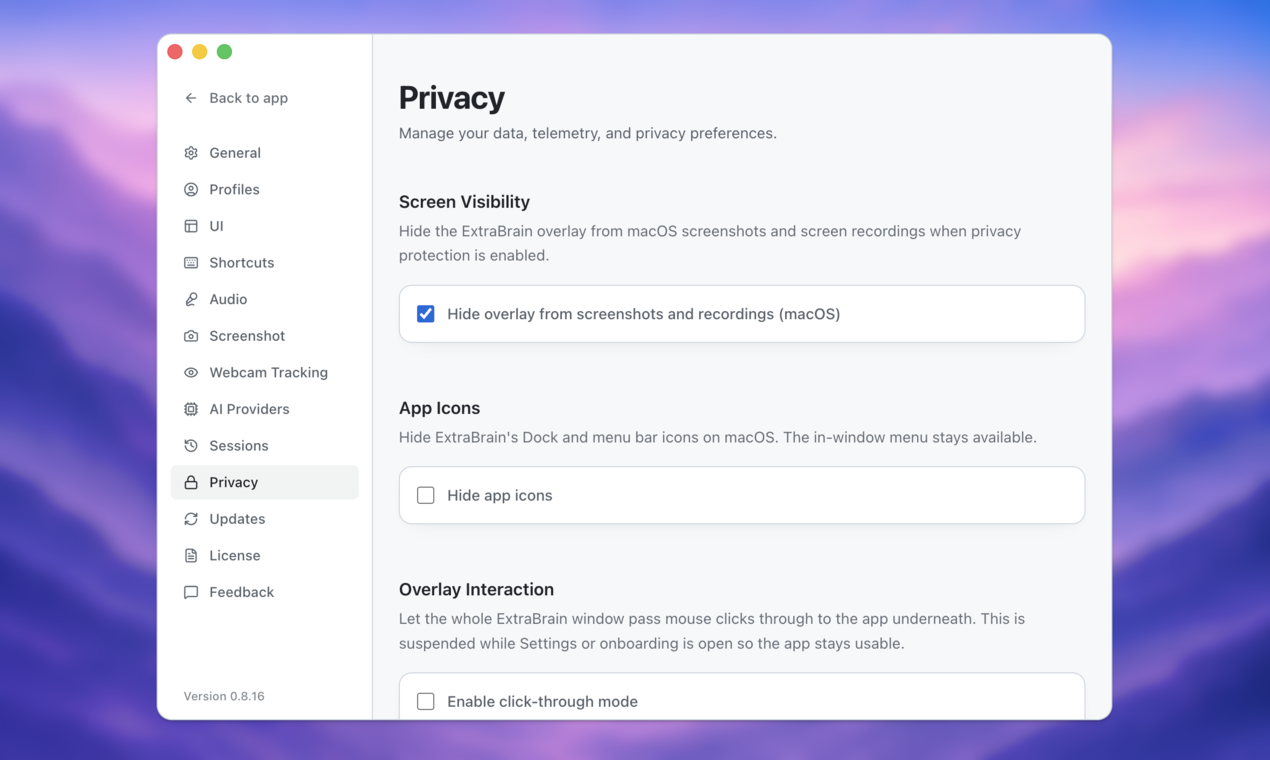
With local Parakeet transcription and local Gemma 4 on-device AI where installed and compatible, transcription and AI prompts can stay local. If you choose external providers, selected prompts, transcript text, screenshots, audio, or context may leave your device depending on your configuration. That is why provider choice and privacy settings matter.
How to Handle Common Maki People Sections
Personality and Work Style Questions
Personality-style questions are usually looking for consistency, not perfection. Trying to game every answer can backfire because inconsistent patterns are easy to notice.
Prepare by clarifying your honest work preferences:
- Do you prefer structure or autonomy?
- Do you make decisions quickly or after analysis?
- How do you respond to conflict?
- How do you handle repetitive tasks?
- What motivates you when work gets difficult?
Do not try to become an imaginary ideal candidate. Aim to express your real style in a way that matches the role truthfully.
Situational Judgment Questions
Situational judgment prompts often test priorities. The best answers usually balance business impact, ethics, communication, and follow-through.
Use this simple structure:
- Identify the main risk.
- Name the people affected.
- Choose the next practical action.
- Explain the tradeoff.
- Communicate clearly.
For example, if a customer is angry and your internal team is delayed, do not promise what you cannot control. A stronger answer is to acknowledge the issue, gather facts, communicate a realistic update, escalate if needed, and follow up.
Cognitive or Logic Tasks
For timed reasoning tasks, hidden help is usually less useful than calm repetition. Practice short sets under time pressure. Review the pattern you missed. Then practice again.
Focus on:
- Reading the question before the answer choices.
- Eliminating impossible options.
- Skipping and returning when allowed.
- Keeping scratch work neat if scratch work is permitted.
- Avoiding panic after one hard question.
Video or Written Responses
For video responses, the biggest mistake is sounding rehearsed. For written responses, the biggest mistake is sounding pasted from a generic AI answer.
Prepare flexible outlines instead of scripts. Use short phrases like:
- Situation.
- Decision.
- Action.
- Result.
- What I learned.
That gives you structure while preserving your own voice.
Avoiding False Flags Without Evading Rules
There is a legitimate difference between avoiding false flags and evading detection. Avoiding false flags means making your environment simple, stable, and compliant. Evading detection means hiding disallowed behavior. This article recommends the first, not the second.
Before the assessment:
- Use a quiet room.
- Close unrelated apps.
- Disable notifications.
- Use a stable internet connection.
- Keep your face clearly visible if a camera is required.
- Keep only allowed materials on your desk.
- Test your microphone and camera.
- Read every permission prompt before accepting.
- Avoid switching devices or networks mid-test unless instructed.
If you get flagged, stay calm. Stop whatever may have caused the warning, follow the on-screen instructions, and continue honestly. If needed, document the issue afterward and contact the recruiter with a factual explanation.
What Not to Do
Do not ask someone else to take the test for you. Do not use a hidden earbud for live answers. Do not paste live test questions into a chatbot if the rules do not allow it. Do not copy answers from forums, answer banks, Telegram groups, Discord groups, or screenshots. Do not use a VPN, proxy, or second device to misrepresent your identity or environment. Do not assume that something is acceptable just because a browser cannot detect it.
These choices can create more risk than the assessment itself.
Better Ways to Use AI Before the Test
Here are safe prompts you can use before a Maki People assessment.
Role Fit Practice Prompt
I am preparing for a pre-employment assessment for a [role] position. Ask me ten practice questions that test judgment, communication, and role fit. After each answer, give feedback on clarity, specificity, and whether my example sounds credible.
Personality Reflection Prompt
Help me identify my honest work style for a personality-style hiring assessment. Ask me reflective questions about autonomy, collaboration, deadlines, conflict, learning, and feedback. Do not tell me how to manipulate the test. Help me express my real preferences clearly.
Timed Reasoning Practice Prompt
Create a 15-minute timed reasoning drill with pattern, logic, and prioritization questions. After I answer, explain the correct reasoning and show me how to solve faster next time.
Post-Practice Review Prompt
Review this practice transcript and identify where I sounded unclear, overconfident, too vague, or inconsistent. Suggest a cleaner structure while keeping the answer in my own voice.
FAQ
Is it cheating to use AI for a Maki People test?
It depends on the rules you were given. Using AI to prepare before the test is usually different from using AI to answer live assessment questions. If the instructions prohibit outside help, live AI assistance should be treated as outside help.
Can ExtraBrain generate interview answers?
ExtraBrain can help generate answer outlines, STAR structures, technical explanations, and follow-up questions from transcript and screen context. Candidates remain responsible for honest and allowed use. For assessments, use it only where the rules allow AI assistance.
Is ExtraBrain invisible during screen sharing?
ExtraBrain is designed to stay hidden from screen sharing and screen recording on major meeting tools. That design is for privacy and workflow control, not permission to break assessment or interview rules. You are responsible for following the rules of your interview, employer, school, workplace, meeting, and platform.
What should I do if I am not sure whether AI is allowed?
Ask the recruiter, hiring manager, instructor, or platform support team before the assessment starts. A short clarification is safer than losing trust after the fact.
Are online answer databases reliable?
They are often stale, incomplete, or wrong. They can also create plagiarism and similarity risks. It is better to practice the underlying skill and prepare your own examples.
What is the safest way to reduce stress before the test?
Do a mock session, time yourself, record your reasoning, and review the result. ExtraBrain can help with live transcription and post-practice review on Mac, especially when you want a private workspace for interview preparation.