
ExtraBrain Blog
Salesforce Interview Prep with AI Tools in 2026

Prepare for Salesforce interviews with AI practice, technical drills, STAR stories, HackerRank prep, and responsible ExtraBrain workflows.
Preparing for a Salesforce interview in 2026 can feel like a full-time project. You may need to review Apex, Lightning Web Components, SOQL, Flows, integrations, security, product knowledge, behavioral stories, and timed coding rounds at the same time.
That is why a good AI interview preparation workflow helps. It does not replace Salesforce knowledge, real practice, or honest communication. It gives you a faster way to organize practice, rehearse answers, spot weak areas, and review what happened after each session.
ExtraBrain is a free, local-first desktop AI interview assistant and meeting copilot for Mac. For Salesforce candidates, it can support live transcription, screen-aware context, local-first options, bring-your-own AI providers, coding interview practice, behavioral interview coaching, and post-session review.
Use AI assistance only where interview, employer, school, workplace, and platform rules allow transcription, screenshots, notes, or live help. Responsible use matters more than any tool.
Why use AI tools for Salesforce interview prep
Salesforce interviews are rarely just trivia checks. A strong candidate needs to explain platform tradeoffs, write safe automation, reason about data access, communicate with stakeholders, and show business impact.
AI tools help because they can turn a vague study plan into a structured practice loop. Instead of rereading generic interview questions, you can rehearse against your resume, target job description, role level, and recent interview feedback.
Benefits of AI-driven practice
AI-assisted practice is useful when you want repetition with feedback. For Salesforce roles, that usually means practicing both exact technical details and clear explanation.
Helpful AI prep workflows include:
- Generating role-specific Salesforce questions for admin, developer, consultant, architect, analyst, or product-adjacent roles.
- Turning your resume and job description into a targeted topic list.
- Practicing technical explanations for Apex, LWC, SOQL, Flows, integrations, and security.
- Rehearsing behavioral answers with the STAR method.
- Creating follow-up questions to ask interviewers.
- Reviewing transcripts after mock interviews so you can improve pacing, clarity, and examples.
ExtraBrain fits this workflow because it is built around live sessions and review. You can use it as a focused second-brain-style workspace for interview transcripts, notes, screen context, and session history, instead of relying on memory alone.
Traditional prep versus AI-assisted Salesforce prep
Traditional study is still important. Salesforce Trailhead, official documentation, hands-on org practice, and real project experience are the foundation.
AI tools add a practice layer on top. They help you simulate pressure, explain concepts aloud, and refine how you present your work.
| Prep need | Traditional approach | AI-assisted approach with ExtraBrain |
|---|---|---|
| Role targeting | Read generic guides | Use the job description and resume as context |
| Mock interviews | Schedule with a person | Practice on demand and review transcripts |
| Technical explanation | Study notes silently | Explain aloud and refine answer structure |
| Behavioral stories | Draft examples manually | Convert experience into STAR outlines |
| Coding practice | Solve problems alone | Ask for hints, edge cases, and explanation checks during practice |
| Post-interview review | Rely on memory | Review notes, transcript, and follow-up items |
The best approach is not AI instead of study. It is study, hands-on Salesforce practice, and AI-supported rehearsal working together.
How to prepare for a Salesforce interview with ExtraBrain
ExtraBrain works best when you treat it as a preparation system, not a shortcut. You define the role, collect context, rehearse deliberately, and review your results.
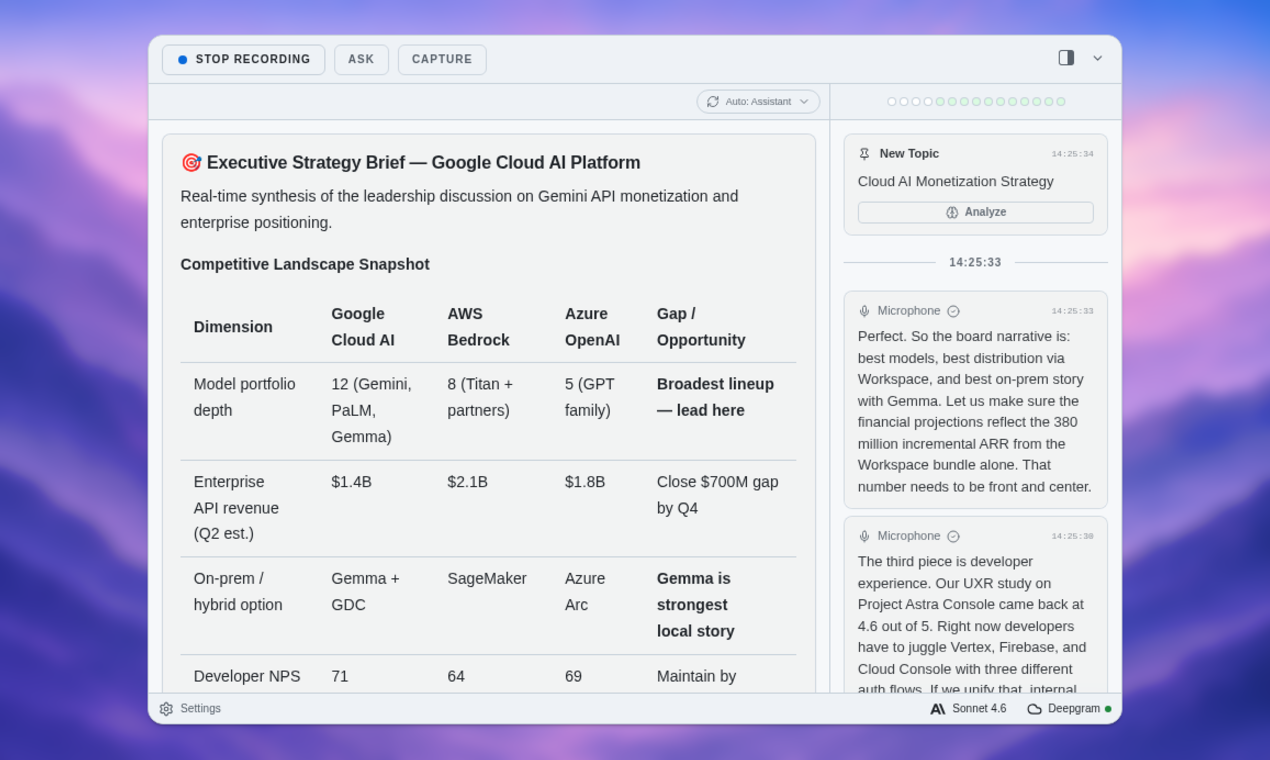
Set up your AI interview copilot
Start by setting up ExtraBrain on your Mac and choosing the providers that match your privacy and workflow needs. ExtraBrain supports local Parakeet transcription and optional Deepgram transcription. It also supports local Gemma 4 on-device AI where installed and compatible, plus bring-your-own providers such as Anthropic, OpenAI, custom OpenAI-compatible endpoints, Claude Subscription, and Codex Subscription.
A fully local posture requires local Parakeet transcription plus local Gemma 4 on-device AI where installed and compatible. If you use external providers, selected prompts, transcript text, screenshots, audio, or context may leave your device depending on your configuration. Review your privacy settings before using any AI tool in an interview or workplace context.
A simple setup flow looks like this:
- Install ExtraBrain on macOS.
- Choose local or external transcription and AI provider options.
- Create a Salesforce interview profile or session context.
- Add your target role, job description, resume notes, and topics to practice.
- Run a mock interview aloud.
- Review the transcript and improve your next practice round.
Customize practice for Salesforce roles
A Salesforce admin interview is different from a Salesforce developer interview. A solution architect interview is different from a business analyst or consultant interview. Your AI prep should reflect that.
Use your target role to shape the question set. For example:
- Salesforce Admin: permissions, profiles, roles, sharing, reports, dashboards, automation, data quality, and stakeholder communication.
- Salesforce Developer: Apex, triggers, SOQL, SOSL, LWC, APIs, testing, deployments, and governor limits.
- Salesforce Consultant: requirements discovery, process mapping, implementation tradeoffs, change management, and user adoption.
- Salesforce Architect: integration patterns, data model design, security model design, async processing, scalability, and platform governance.
- Salesforce Business Analyst: user stories, acceptance criteria, process analysis, UAT, documentation, and cross-functional communication.
ExtraBrain can help you turn each role into practice prompts, mock interview questions, answer outlines, and review notes. The value comes from making practice specific enough that it feels close to the real interview.
Use AI for technical and behavioral questions
Salesforce interviews usually move between technical depth and communication quality. You might explain governor limits in one question and then describe a conflict with a stakeholder in the next.
For technical practice, ask the AI to evaluate not only whether your answer is correct, but whether it is interview-ready. A strong Salesforce technical answer should include the decision, the tradeoff, the failure mode, and the business reason.
For behavioral practice, use the STAR method. A strong behavioral answer should include the situation, task, action, result, and a measurable outcome when possible.
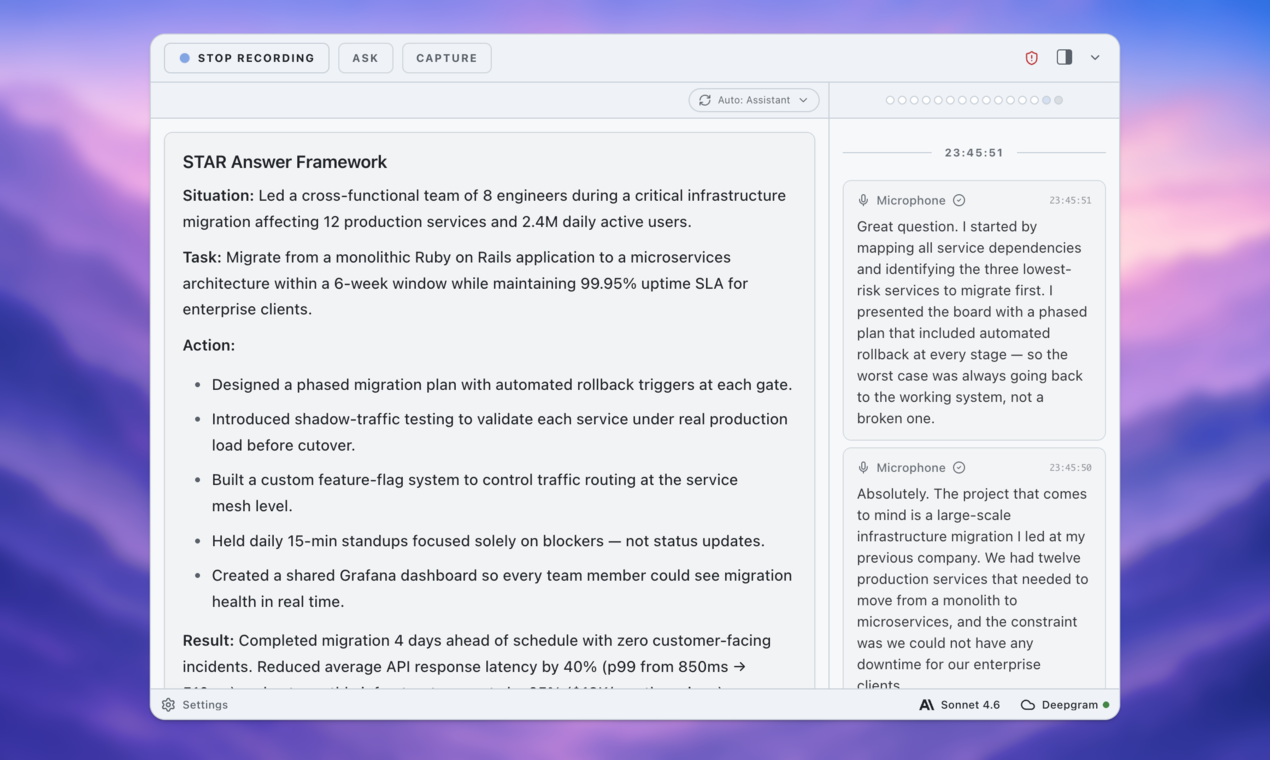
Salesforce expert interview copilot prompt
You can adapt the prompt below for your own preparation. Use it during practice sessions, not as a substitute for learning the material.
Role: You are a Senior Salesforce Solutions Architect and interview coach. Your goal is to help me prepare for a Salesforce interview with technical depth, clear communication, and responsible AI use.
Context: Analyze my resume notes and the job description I provide. Identify gaps between my background and the role requirements. Prioritize the highest-risk interview topics.
Technical coaching: For Apex, LWC, SOQL, triggers, Flows, integrations, and Salesforce architecture questions, do not only give an answer. Explain the tradeoffs, likely follow-up questions, and how to defend the design. Call out governor limit concerns such as bulkification, SOQL in loops, DML in loops, async processing, and test coverage. Break complex code explanations into small sections.
Behavioral coaching: Use the STAR method for experience-based answers. Keep each spoken answer concise enough for a real interview. Help me add metrics, business impact, and Salesforce-specific details where they are accurate.
Output format: Give me a strong answer outline first. Then give me a shorter version I can say aloud. Then give me likely interviewer follow-up questions.
Resume notes: [PASTE RESUME NOTES HERE]
Job description: [PASTE JOB DESCRIPTION HERE]
Start by asking whether I want a technical deep dive, a behavioral STAR drill, or a mixed mock interview.
Mastering Salesforce HackerRank tests and technical rounds
Many Salesforce hiring processes include a coding test, a take-home task, or a live technical round. The platform-specific interview may include Apex and Salesforce architecture, while the assessment may still test general programming fundamentals.
Common HackerRank-style challenge types
Timed coding challenges often reward pattern recognition. Do not wait until interview week to practice under time pressure.
| Challenge type | What to practice |
|---|---|
| Data structures | Arrays, strings, hash maps, sets, stacks, queues, and linked lists |
| Algorithms | Sorting, searching, recursion, dynamic programming basics, and graph traversal |
| Problem patterns | Sliding window, prefix sums, frequency counting, two pointers, and simulation |
| SQL basics | Joins, aggregations, filtering, grouping, and data cleanup |
| API logic | Pagination, retries, rate limits, response parsing, and error handling |
Salesforce-flavored examples may include:
- Merge duplicate contacts across accounts or tenants.
- Build a tenant-aware rate limiter.
- Evaluate access with role hierarchy rules.
- Compute top feature usage per organization.
- Process workflow dependencies in the right order.
- Design a safe bulk update process.
During practice, ask ExtraBrain to help you identify the pattern, list edge cases, and explain the solution in interview language. Do not use AI to bypass assessment rules. If an assessment forbids assistance, use AI only before or after the assessment for learning and review.
Key Salesforce technical topics to review
A good Salesforce interview plan should include both platform concepts and implementation details.
Review these areas before the interview:
- Sales Cloud and Service Cloud fundamentals.
- Object model, relationships, validation rules, and record types.
- Profiles, permission sets, roles, sharing rules, and field-level security.
- Apex classes, triggers, tests, and governor limits.
- SOQL and SOSL query patterns.
- Lightning Web Components and component communication.
- Flows, Process Builder legacy knowledge, and automation tradeoffs.
- Async Apex, queueables, batch jobs, scheduled jobs, and platform events.
- REST, SOAP, middleware, webhooks, and integration error handling.
- Deployment, sandboxes, change sets, Salesforce DX, and CI/CD basics.
For each topic, practice answering three layers of questions. First, define the concept simply. Second, explain when to use it. Third, describe a real project or realistic scenario where it matters.
Behavioral interview strategy for Salesforce roles
Salesforce roles are cross-functional by nature. Even developer interviews often test how you work with admins, business stakeholders, QA, product managers, and end users.
Build a STAR story bank
Create a story bank before interview day. This prevents you from inventing examples under pressure.
Useful Salesforce story categories include:
- Fixing a broken automation or integration.
- Reducing manual work with Flow, Apex, or configuration.
- Improving data quality or reporting accuracy.
- Handling a stakeholder conflict.
- Migrating data safely.
- Designing a permission model.
- Explaining a technical tradeoff to a non-technical audience.
- Recovering from an incident or production issue.
Use the table below to structure each story.
| STAR component | What to capture |
|---|---|
| Situation | The business context and why it mattered |
| Task | Your responsibility and constraints |
| Action | The specific steps you took |
| Result | The measurable outcome or lesson learned |
When using ExtraBrain for practice, ask it to challenge vague answers. If your answer says you improved a process, the follow-up should ask how much, for whom, and how you measured it.
Practice spoken answers, not just written drafts
A written answer can look strong and still sound unnatural. Salesforce interviews reward candidates who can explain clearly in real time.
Practice answers out loud. Record mock sessions when allowed. Review the transcript for rambling, missing context, filler words, and unsupported claims.
ExtraBrain can help you turn long notes into concise speaking outlines. The goal is not to sound scripted. The goal is to remember the structure while still speaking like yourself.
Post-interview review and follow-up
Your preparation does not end when the call ends. A quick review after each interview helps you improve for the next round.
Send a thoughtful thank-you note
Send a thank-you email within 24 hours when appropriate. Keep it short, specific, and professional.
A useful thank-you note includes:
- Appreciation for the interviewer’s time.
- One specific topic from the conversation.
- A short reminder of your fit for the role.
- Any clarification you promised to send.
- Continued enthusiasm for the opportunity.
Do not use a generic template without editing it. A thank-you note should sound like it came from the conversation you actually had.
Debrief while the details are fresh
Right after the interview, write down what happened. If you used approved notes or transcription, review them while the details are still fresh.
Capture these items:
- Questions you answered well.
- Questions that surprised you.
- Topics to study before the next round.
- Names and roles of interviewers.
- Follow-up commitments.
- Potential concerns the team may still have.
ExtraBrain can support this after-interview workflow by helping organize transcripts, notes, and follow-up questions into a clearer review plan.
Practical tips for getting more value from AI prep
AI interview tools work best when you give them specific context and judge their output critically. You are still responsible for the accuracy of every answer you give.
Use official Salesforce learning sources first
Start with trusted Salesforce learning materials and hands-on practice. Then use AI to rehearse and test recall.
A strong prep loop looks like this:
- Study the official topic.
- Build or inspect something in a Salesforce org.
- Explain the concept aloud.
- Ask AI for follow-up questions.
- Correct weak answers.
- Repeat under time pressure.
This creates understanding instead of memorization.
Make technical answers business-readable
Salesforce interviewers often care about business outcomes as much as implementation details. Translate technical decisions into user, revenue, support, compliance, or operations impact.
For example, instead of only saying you bulkified a trigger, explain why it mattered. You prevented failures during large imports, reduced manual cleanup, and made the automation safer for growth.
Avoid over-reliance on AI
AI can be wrong, too generic, or too polished. It may miss nuance in your background or produce answers that do not match your real experience.
Avoid these pitfalls:
| Pitfall | Better habit |
|---|---|
| Memorizing AI-generated answers | Convert them into your own words |
| Skipping hands-on practice | Build and test in a Salesforce org |
| Ignoring assessment rules | Use AI only where allowed |
| Giving vague impact claims | Use accurate metrics or honest qualitative outcomes |
| Depending on live help | Practice until you can answer independently |
AI should make your preparation sharper. It should not become a replacement for your judgment, experience, or ethics.
FAQ
How often should I practice before a Salesforce interview?
Practice most days in the final two weeks if possible. Even 30 minutes of focused practice can help when you rotate between technical review, spoken answers, coding drills, and behavioral stories.
Can ExtraBrain help with both technical and behavioral Salesforce questions?
Yes. ExtraBrain can support coding interview practice, system design-style discussion, live transcription, screen-aware context, answer outlines, STAR practice, and post-session review. You still need to verify the details and use it only where allowed.
What should I do if I get stuck on a HackerRank-style challenge?
During practice, pause and identify the pattern before writing code. Ask for a hint, list edge cases, solve a smaller version, and then explain the final approach aloud. During a real assessment, follow the platform and employer rules for allowed assistance.
Is ExtraBrain available on Windows or Linux?
ExtraBrain is available for macOS today, including Apple Silicon and Intel Macs. Windows and Linux are planned future platforms.
Can ExtraBrain run fully local for interview prep?
A fully local posture requires local Parakeet transcription plus local Gemma 4 on-device AI where installed and compatible. External providers may receive selected prompts, transcript text, screenshots, audio, or context depending on your configuration.