
ExtraBrain Blog
Best InterviewBee Alternative for Mac: Why ExtraBrain Is My Pick

Compare InterviewBee with ExtraBrain for live interview help, coding rounds, privacy, screen context, and practical Mac interview prep.
If you are looking for an InterviewBee alternative, you probably want more than another tab with generic talking points. You want a real-time AI interview assistant that can follow the conversation, help you think clearly, support technical rounds, and respect your privacy settings. That is the reason I would choose ExtraBrain over InterviewBee for most Mac-based interview workflows.
InterviewBee can be useful for mock interview practice and structured answer rehearsal. Its browser-first experience may feel simple when you only need a quick practice session. But for live interviews, coding interviews, system design rounds, and post-interview review, I prefer a desktop copilot that works closer to the actual interview context.
ExtraBrain is a free, local-first desktop AI interview assistant and meeting copilot for Mac. It combines live transcription, screen-aware context, bring-your-own AI providers, local Parakeet transcription, local Gemma 4 on-device AI where installed and compatible, and clear privacy controls. It is built for interviews, meetings, lectures, customer calls, and research conversations where the context matters as much as the words being spoken.
Quick comparison
| Area | ExtraBrain | InterviewBee |
|---|---|---|
| App type | Mac desktop app | Browser-based workflow |
| Best fit | Live interviews, coding rounds, system design, meetings, review | Mock interviews and practice sessions |
| Live context | Transcript plus screen-aware context | Primarily interview prompts and answer help |
| Technical support | Coding, debugging, explanation, and system design workflows | More general interview coaching |
| Privacy posture | Local-first options with clear provider controls | Depends on web app workflow and account setup |
| Pricing model | Free core Mac app with optional Pro | Check current InterviewBee pricing before subscribing |
| Platform | macOS today, Windows and Linux planned | Web access |
This is not a claim that every candidate should use AI during every interview. ExtraBrain should be used only where interview, employer, school, workplace, meeting, and platform rules allow AI assistance, transcription, screenshots, or notes. The strongest use case is not pretending to know something you do not know. The strongest use case is organizing your real experience, clarifying your thinking, and reviewing your performance afterward.
Why I started looking beyond InterviewBee
InterviewBee is attractive because it promises interview practice and live support in one place. For a candidate preparing under time pressure, that sounds convenient. You can rehearse common questions, practice answer structure, and get more comfortable speaking out loud.
The limitation appears when the interview stops being a neat practice scenario. A real technical interview may include a shared editor, a system design diagram, a product prompt, a debugging trace, or a recruiter question that depends on your resume. A browser-based assistant can help with some of that, but it often feels separated from the live context.
That separation matters. If you are trying to explain a cache design, reason about tradeoffs, or respond to a follow-up question, you need help that understands what is happening now. You do not just need a memorized answer. You need a workspace that can follow the transcript, account for visible screen context, and help you shape your own response.
What ExtraBrain does differently
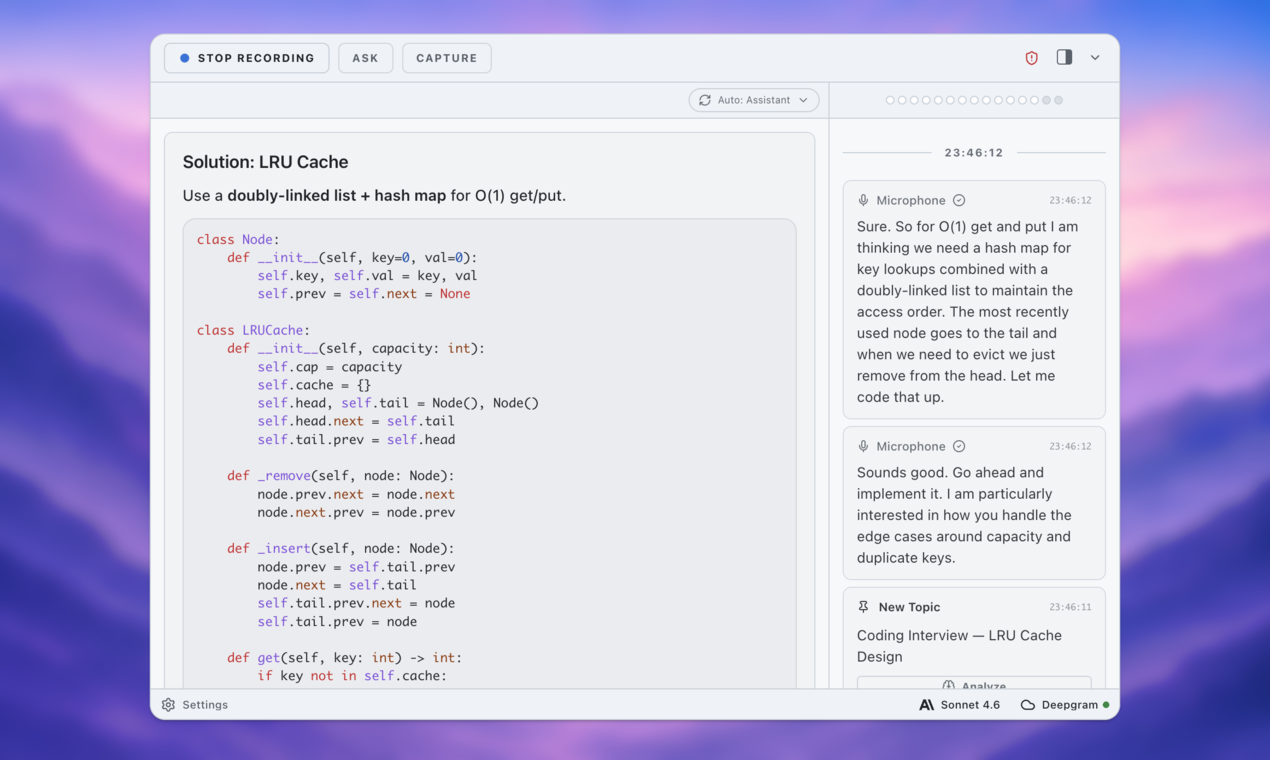
ExtraBrain is designed as a desktop AI interview copilot rather than a simple web page for practice. That difference changes the workflow. The app can support live transcription, session history, screenshots, screen-aware context, and post-session review from the same local-first workspace.
For a coding interview, that means ExtraBrain can help you reason through the prompt instead of only giving a final answer. You can ask for clarifying questions, edge cases, complexity tradeoffs, test cases, and explanation outlines. For a system design round, it can help you organize requirements, constraints, components, bottlenecks, and follow-up questions. For a behavioral interview, it can turn messy notes into a tighter STAR-style response while keeping your own experience at the center.
ExtraBrain also supports bring-your-own AI providers. That matters because candidates have different preferences for cost, model quality, privacy, and latency. ExtraBrain supports local Gemma 4 where installed and compatible, Anthropic, OpenAI, custom OpenAI-compatible endpoints, Claude Subscription, and Codex Subscription. External AI and transcription provider usage is billed separately by the providers users choose.
Live interview context matters more than canned answers
The best InterviewBee alternative should not only answer common questions. It should help you stay oriented while the interview changes direction.
A typical technical interview can move through several modes in a few minutes. The interviewer may start with a resume question, switch to a coding prompt, ask you to optimize your first solution, then ask how you would test it in production. A useful copilot has to help with all of those transitions.
ExtraBrain is strong here because it is built around live sessions. It can help you capture the transcript, reason from current context, and review the conversation later. That makes it useful before, during, and after the interview.
Before the interview, you can practice explanations and prepare examples. During the interview, you can use allowed assistance to organize thoughts and generate clarifying questions. After the interview, you can review what happened, identify weak answers, and improve your next preparation session.
Screen-aware support for coding and system design
Many AI interview tools sound useful until the interviewer shares a prompt, asks you to inspect code, or expects you to talk through a diagram. At that point, context from the screen becomes critical.
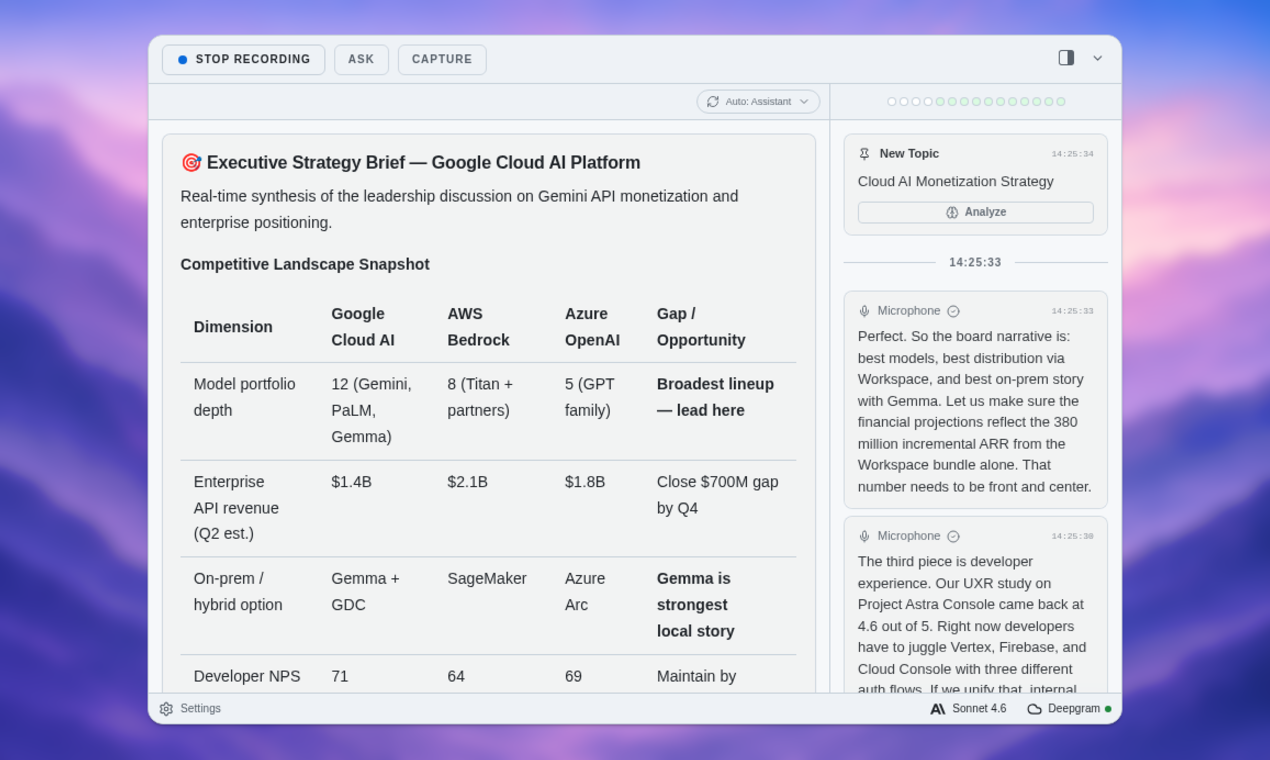
ExtraBrain includes screen-aware context so the assistant can help with what you are looking at, not just what you heard. This is especially useful for coding interviews, system design rounds, debugging exercises, product cases, and technical walkthroughs.
For example, in a coding interview, you may want help with questions like these:
- What assumptions should I clarify before solving this?
- What edge cases am I likely missing?
- How should I explain this data structure choice?
- What is the time and space complexity?
- How can I turn this into a cleaner spoken explanation?
In a system design interview, you may want help with a different set of prompts:
- What requirements should I confirm first?
- What should be in the high-level architecture?
- Where are the scaling bottlenecks?
- What tradeoffs should I mention?
- What follow-up questions might the interviewer ask?
This is where I prefer ExtraBrain over a browser-only interview helper. The interview is not only text. It is audio, screen context, timing, follow-ups, and your own memory of past work.
Privacy and local-first controls
Privacy is one of the biggest reasons to compare interview assistants carefully. Interview transcripts, resumes, screenshots, and work examples can contain sensitive personal or company information. You should understand where that information goes before you use any AI tool.
ExtraBrain is built with a local-first posture. A fully local ExtraBrain setup requires local Parakeet transcription plus local Gemma 4 on-device AI where installed and compatible, with no external provider requests. When you choose external providers, selected prompts, transcript text, screenshots, audio, or other context may leave your device depending on your configuration.
That tradeoff is clear and important. Some users may choose local-first settings for privacy. Others may choose external providers for model quality, speed, or specialized reasoning. The key is that ExtraBrain makes provider choice and data flow part of the workflow instead of hiding it behind a generic web experience.
Discretion, screen sharing, and responsible use
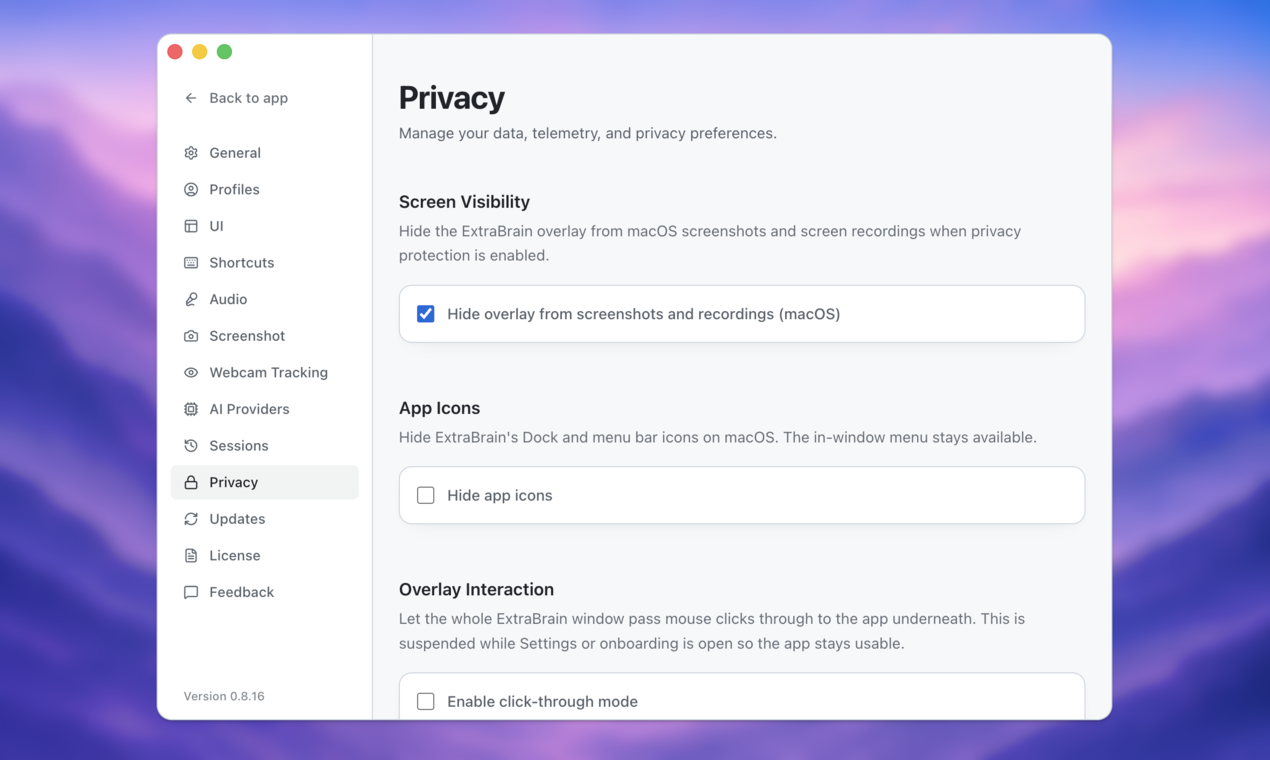
Many people searching for an InterviewBee alternative are really asking whether the tool will interfere with screen sharing or meeting software. ExtraBrain is designed to stay hidden from screen sharing and screen recording on major meeting tools. That can reduce accidental exposure of private notes, transcripts, or preparation material while presenting or interviewing.
But discretion is not permission. You are responsible for following the rules of your interview, employer, school, meeting, assessment, or platform. If AI assistance, transcription, screenshots, or notes are not allowed, do not use them. If the rules are unclear, ask before the session or use ExtraBrain only for preparation and post-session review.
The most sustainable way to use an AI interview copilot is as a thinking partner. Use it to clarify the question, structure your answer, remember relevant examples, and evaluate your own performance. Do not use it to misrepresent your skills or bypass rules.
Pricing and value
ExtraBrain has a simple value advantage for Mac users because the core Mac app is free. ExtraBrain Pro is $9.99 per month, $79 per year, or $149 Lifetime launch pricing. External AI and transcription provider usage is billed separately by the providers you choose.
That model is useful if you want to test whether an AI interview assistant fits your workflow before committing to a paid plan. It is also useful if you already have preferred AI providers and want more control over model access.
For InterviewBee, you should check its current pricing, session limits, and feature limits directly before subscribing. The important question is not only the monthly price. The important question is whether the tool supports the kind of interviews you actually face.
If your workflow is mostly mock interviews, InterviewBee may be enough. If your workflow includes live technical rounds, screen context, local-first privacy choices, and post-interview review, ExtraBrain is the stronger alternative.
When InterviewBee may still make sense
InterviewBee may be a reasonable choice if you want a simple web-based practice tool. It can make sense when you mainly need mock interview repetition, answer rehearsal, or a lightweight way to practice speaking.
It may also fit candidates who do not want to install a desktop app. A browser-based workflow can be convenient for short sessions and early-stage preparation.
The tradeoff is that web-based tools can feel less connected to the full interview environment. If your interview includes a shared screen, technical prompt, code editor, or diagram, you may want a richer desktop workflow.
When I would choose ExtraBrain
I would choose ExtraBrain when the interview is live, technical, high-context, or worth reviewing afterward. That includes coding interviews, system design interviews, product manager interviews, behavioral rounds, customer-facing role plays, and important recruiter screens.
I would also choose ExtraBrain when privacy controls matter. The combination of local Parakeet transcription, local Gemma 4 where installed and compatible, and bring-your-own provider setup gives you more control over how the assistant works.
Finally, I would choose ExtraBrain if I wanted one app for more than interviewing. Because ExtraBrain is also a meeting copilot, it can support lectures, research calls, internal meetings, customer conversations, and other live sessions where transcription and context are useful.
Practical setup checklist
Before using any InterviewBee alternative in a serious interview, test your workflow in a realistic practice session. A good tool should reduce stress, not create a new source of risk.
Use this checklist before the real session:
- Confirm whether AI assistance, transcription, screenshots, or notes are allowed.
- Test your microphone and transcription setup.
- Decide whether you want local-first settings or an external AI provider.
- Practice with the same meeting platform you expect to use.
- Prepare a few personal stories for behavioral questions.
- Practice explaining technical answers out loud instead of silently reading notes.
- Review one practice transcript and identify what you need to improve.
This preparation matters more than any single feature. The best AI interview assistant should help you sound more like yourself on a good day. It should not turn you into someone who cannot explain their own work.
Final recommendation
ExtraBrain is my preferred InterviewBee alternative for Mac users who want a real-time AI interview assistant with live transcription, screen-aware context, local-first options, provider control, and post-session review. InterviewBee can still be useful for mock interviews and simple answer practice. But if you want a more complete desktop workflow for coding, system design, behavioral interviews, and meetings, ExtraBrain is the better fit.
The biggest difference is context. InterviewBee can help you practice answers. ExtraBrain helps you work with the live session itself. That makes it a stronger choice when the interview is complex, technical, or important enough to review afterward.
FAQ
What is the best InterviewBee alternative?
ExtraBrain is a strong InterviewBee alternative for Mac users who want a free core desktop app, live transcription, screen-aware context, local-first options, and bring-your-own AI provider control.
Is ExtraBrain free?
Yes. The core ExtraBrain Mac app is free. ExtraBrain Pro is available for users who want paid features, and external AI or transcription usage is billed separately by the providers users choose.
Does ExtraBrain support coding interviews?
Yes. ExtraBrain can help with coding interview prompts, clarifying questions, edge cases, technical explanations, complexity discussion, debugging context, and post-session review.
Can ExtraBrain run fully local?
A fully local ExtraBrain posture requires local Parakeet transcription plus local Gemma 4 on-device AI where installed and compatible, with no external provider requests. Local Gemma 4 availability depends on installation, hardware, and environment compatibility.
What platforms does ExtraBrain support?
ExtraBrain is available for macOS today, including Apple Silicon and Intel Macs. Windows and Linux are planned future platforms.
How should I use ExtraBrain responsibly?
Use ExtraBrain only where interview, employer, school, workplace, meeting, and platform rules allow AI assistance, transcription, screenshots, or notes. Use it to clarify your thinking, structure real experience, and improve after the session.