
ExtraBrain Blog
The Sensei AI Alternative I Would Choose for Live Interview Support

Compare Sensei AI with ExtraBrain for live interview help, mock practice, screen context, privacy controls, platform fit, and overall value.
If you are looking for a Sensei AI alternative, the real question is not just which tool can produce interview answers fastest. The better question is which tool fits the way modern interviews actually happen: live calls, screen sharing, coding tasks, system design prompts, behavioral follow-ups, and post-interview review.
Sensei AI can be useful for interview practice, especially when you want structured mock sessions and real-time prompts. But if your priority is a desktop interview copilot with live transcription, screen-aware context, local-first options, bring-your-own provider control, and a free core Mac app, ExtraBrain is the alternative I would put first.
This comparison looks at Sensei AI and ExtraBrain through the same practical lens candidates usually care about: live interview support, mock practice, usability, privacy posture, platform fit, customization, pricing, and responsible use.

Sensei AI vs ExtraBrain at a glance
Sensei AI and ExtraBrain both sit in the broad AI interview assistant category. They are not identical products. Sensei AI is often discussed as an interview preparation and copilot tool, while ExtraBrain is a local-first desktop AI interview assistant and meeting copilot for Mac.
Here is the short version.
| Category | Sensei AI | ExtraBrain |
|---|---|---|
| Core use case | Interview practice and AI copilot support | Live interviews, meetings, lectures, research calls, and post-session review |
| Live transcription | Available in the interview copilot category | Available with local NVIDIA Parakeet and optional Deepgram |
| Screen context | Depends on workflow and product setup | Screen-aware context for live desktop sessions |
| Platform model | Often used through browser-oriented workflows | Native Mac desktop app today, with Windows and Linux planned |
| AI providers | Check the current product details before choosing | Local Gemma 4 where installed and compatible, Anthropic, OpenAI, custom OpenAI-compatible endpoints, Claude Subscription, and Codex Subscription |
| Local-first posture | Verify current product architecture | Local Parakeet transcription plus local Gemma 4 can keep transcription and AI prompts local where installed and compatible |
| Pricing model | Check current Sensei AI pricing before purchase | Core Mac app is free, with ExtraBrain Pro options for power users |
| Best fit | Candidates who want guided practice and mock interview structure | Mac users who want a desktop copilot for live context, privacy controls, technical interviews, and review |
The important difference is that ExtraBrain is not only an interview answer generator. It is built around the full session workflow: listening, understanding what is on screen, helping structure answers, supporting coding and system design rounds, and letting you review transcripts and notes afterward.
Why I would choose ExtraBrain as a Sensei AI alternative
The best AI interview assistant should reduce cognitive load without replacing your own judgment. It should help you notice the question, organize your answer, explain your reasoning, and recover when a follow-up catches you off guard.
That is where ExtraBrain is especially useful. It combines live transcription with screen-aware context, so it can help with what is being said and what is being shown. That matters in real interviews because the hardest moments are rarely isolated text prompts. They are messy moments where the interviewer is talking, the shared editor is changing, a diagram is half complete, and you need to explain your tradeoffs clearly.
ExtraBrain is also useful beyond interviews. Because it is a desktop AI meeting copilot, the same workflow can support product calls, research conversations, lectures, customer interviews, and internal meetings. That makes it easier to justify learning one tool instead of using one app for mock interviews, another for calls, another for notes, and another for review.
Live interview support: what matters most
Sensei AI is useful when you want structured guidance
Sensei AI can be attractive if your main goal is guided preparation. A structured interview copilot can help you practice common questions, organize behavioral stories, and rehearse answers before a real call.
That matters because many candidates do not fail interviews because they know nothing. They fail because they ramble, miss the question, forget the relevant example, or fail to connect their experience to the role.
A practice-focused assistant can help with that. But live interviews introduce a different problem: you need context, speed, and a calm workflow while the conversation is happening.
ExtraBrain is stronger for live desktop context
ExtraBrain is designed as a Mac desktop app for live sessions. It can use live transcription, screen context, profiles, and provider settings to help you respond to what is happening now.
For a coding interview, that may mean helping you reason through an algorithm, explain complexity, or identify the next edge case. For a system design interview, that may mean turning a broad prompt into requirements, APIs, data models, scaling tradeoffs, and follow-up questions. For a behavioral interview, that may mean shaping a story into a STAR-style outline without losing your own voice.
The key is that ExtraBrain is not just reacting to a pasted prompt. It is built around the live session itself.
Screen sharing and visibility considerations
A lot of candidates search for Sensei AI alternatives because they are worried about how an interview copilot behaves during screen sharing. That concern is understandable, but it should be handled responsibly.
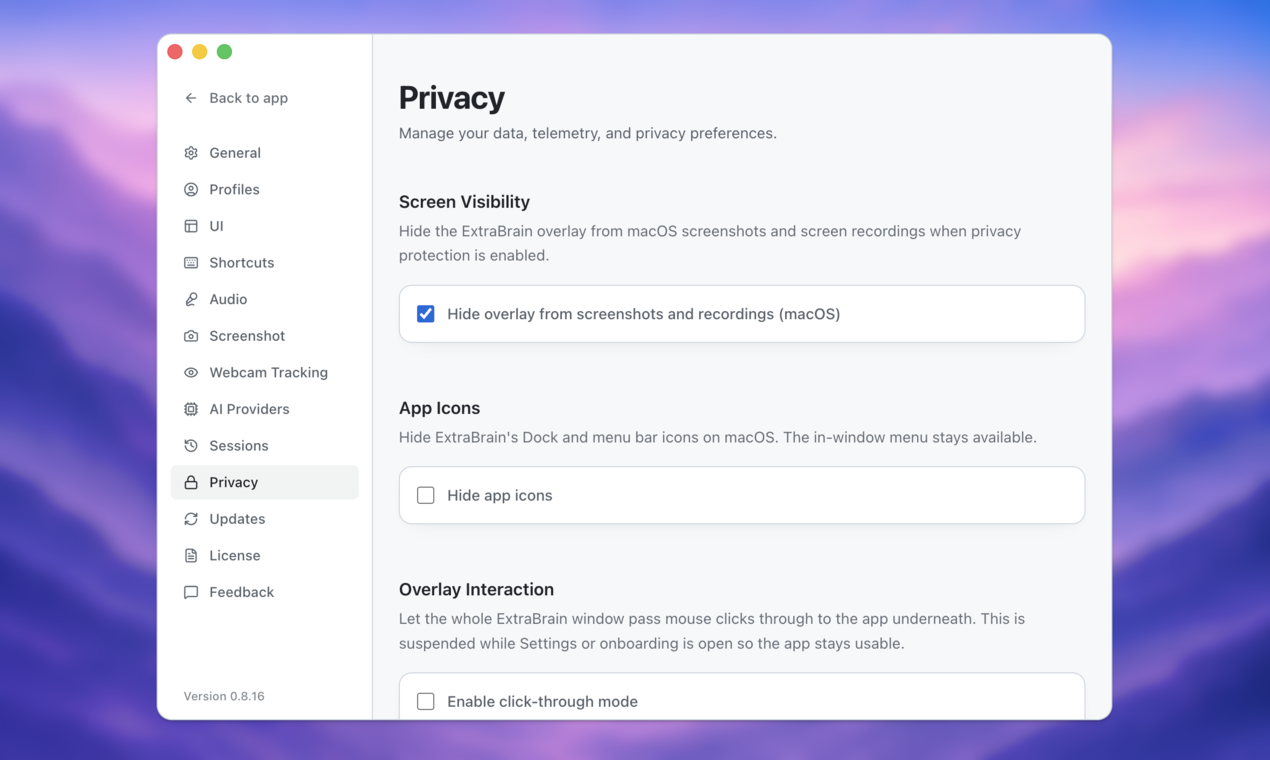
ExtraBrain is designed to stay hidden from screen sharing and screen recording on major meeting tools. That does not mean every use is automatically allowed. You are responsible for following interview, employer, school, workplace, meeting, and platform rules around AI assistance, transcription, screenshots, and notes.
The best way to think about this is simple. Use AI assistance only where it is allowed. Use it to organize your thinking, practice communication, remember your own experience, review sessions, and prepare better. Do not use it to misrepresent your abilities or violate a hiring process.
Mock interview practice vs real interview workflow
When Sensei AI may be enough
If you only want a practice environment, Sensei AI may cover a lot of what you need. A mock interview workflow can help you get comfortable with common prompts, rehearse answers, and identify weak spots before the actual call.
That can be valuable for candidates who freeze during behavioral questions or who have not interviewed in a long time. Mock practice is also helpful when you need repetition more than live context.
When ExtraBrain becomes the better fit
ExtraBrain becomes more compelling when your needs extend beyond mock practice. It is built for the before, during, and after of real sessions.
Before an interview, you can prepare context, choose providers, set up profiles, and practice explaining your experience. During the session, you can use live transcription and screen-aware context to keep track of the conversation. After the session, you can review what happened, capture follow-up notes, and improve for the next round.
That full workflow is why ExtraBrain works well as a Sensei AI alternative for candidates who want more than a rehearsal tool.
Coding interviews: where screen context helps
Coding interviews are not just about producing the final answer. Interviewers usually care about how you clarify requirements, choose data structures, handle edge cases, reason about complexity, and debug under pressure.
ExtraBrain can help with that process by using live transcript and screen context to support technical reasoning. For example, if you are working through an LRU cache problem, it can help you outline the hash map plus doubly linked list approach, explain operations, and think through edge cases.
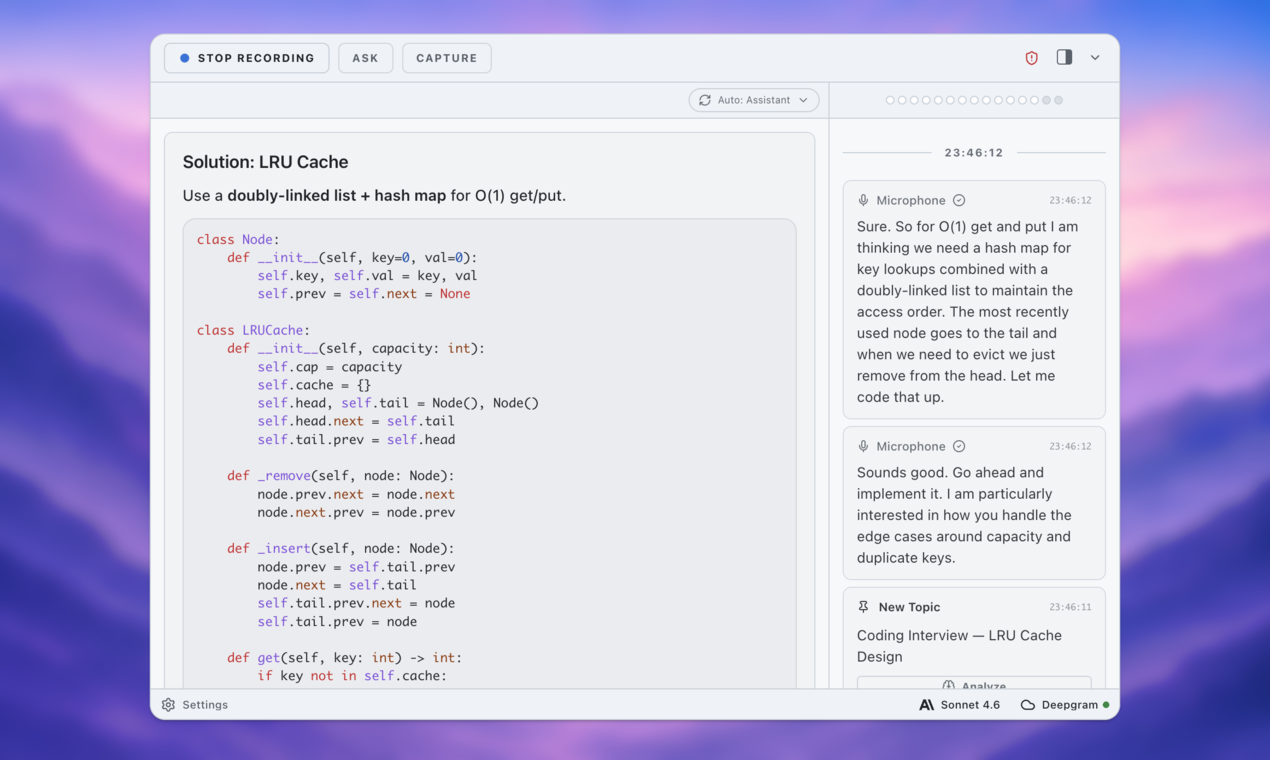
That support is most useful when you still drive the conversation. You should be the one asking clarifying questions, talking through choices, and demonstrating understanding. The assistant should help you stay organized, not pretend to be you.
System design interviews: better prompts, better tradeoffs
System design interviews are often where generic AI answers fall apart. A polished answer is not enough if it does not match the actual prompt, scale, constraints, and follow-up questions.
ExtraBrain can help you structure the conversation as it unfolds. A strong system design flow usually includes:
- Clarifying the product goal.
- Identifying users and key workflows.
- Defining functional and non-functional requirements.
- Sketching APIs and data models.
- Choosing storage and queueing patterns.
- Discussing bottlenecks, reliability, observability, and tradeoffs.
- Asking follow-up questions when the prompt is underspecified.
Because ExtraBrain is screen-aware, it can be useful when diagrams, notes, or shared docs are part of the interview. That makes it a stronger fit for real system design conversations than a tool that only responds to isolated text.
Behavioral interviews: use AI without sounding scripted
Behavioral interviews are where many candidates overuse AI badly. They paste a question into a tool, read a perfect answer, and sound nothing like themselves. That is not convincing.
A better use of ExtraBrain is to organize your own experience. For example, if an interviewer asks about conflict, ambiguity, leadership, or failure, ExtraBrain can help you quickly shape the answer around:
- Situation: what was happening.
- Task: what you were responsible for.
- Action: what you personally did.
- Result: what changed because of your work.
- Reflection: what you learned and how you would apply it now.
This is especially useful when you have good stories but struggle to retrieve them under pressure. The goal is not to invent a story. The goal is to make your real story easier to explain.
Integration and usability comparison
Sensei AI usability
Sensei AI may be easier to understand if you want a focused interview prep product. If your workflow starts inside a browser or a guided mock interview flow, that can feel straightforward.
The tradeoff is that browser-centered tools can feel less natural when your real interview uses a mix of Zoom, Teams, Google Meet, shared documents, code editors, diagrams, and screen sharing. That is where a desktop assistant can be more flexible.
ExtraBrain usability
ExtraBrain is designed for the desktop session rather than only one browser tab. That is important because real interviews and meetings rarely stay inside one clean page.
You may be listening to the interviewer, looking at a coding environment, switching between a job description and a portfolio note, or answering follow-ups from a shared document. A Mac desktop copilot can support that broader context.
ExtraBrain also supports custom profiles and provider choices, which helps you adapt the assistant to different interview types. A product management interview, a senior engineering system design round, and a behavioral recruiter screen should not all use the same guidance.
Privacy and provider control
Privacy is one of the strongest reasons to consider ExtraBrain. The core product is local-first, and a fully local posture is possible when you use local Parakeet transcription plus local Gemma 4 on-device AI where installed and compatible. In that setup, transcription and AI prompts can stay local.
That said, privacy depends on configuration. If you choose external providers, selected prompts, transcript text, screenshots, audio, or context may be sent to those providers depending on your settings.
This is why ExtraBrain’s bring-your-own provider model matters. You can choose the provider setup that matches your needs, budget, performance expectations, and privacy requirements.
Pricing and value
Pricing pages change, so you should check Sensei AI’s current pricing before making a purchase decision. The more useful comparison is value structure.
ExtraBrain’s core Mac app is free. ExtraBrain Pro is available for users who want paid features, with regular monthly, Monthly, yearly, and Lifetime launch pricing options. External AI and transcription usage is billed separately by the providers you choose.
That model is useful if you want control. You are not locked into one bundled model choice. You can start with the free app, choose local options where compatible, connect external providers if needed, and decide whether Pro features are worth it for your workflow.
Who should choose ExtraBrain over Sensei AI?
ExtraBrain is the better Sensei AI alternative if you are a Mac user and you want:
- A free core desktop app.
- Live transcription for interviews and meetings.
- Screen-aware context for coding, system design, and shared documents.
- Local Parakeet transcription.
- Local Gemma 4 on-device AI where installed and compatible.
- Bring-your-own AI providers.
- Privacy controls that make data flow easier to reason about.
- Support for behavioral, coding, product, and technical interviews.
- A tool that also works for meetings, lectures, research calls, and post-session review.
Sensei AI may still be worth considering if your main need is a guided practice environment and you are comfortable with its current workflow, pricing, and platform model. But if you want a broader desktop copilot for real sessions, ExtraBrain is the stronger fit.
A practical decision checklist
Before choosing any AI interview assistant, ask these questions:
- Does it support the interview types I actually face?
- Does it work with my meeting tools, coding environment, and screen sharing workflow?
- Can I control which AI and transcription providers receive my data?
- Can I use local transcription or local AI when privacy matters?
- Does it help me think better, or does it tempt me to read scripted answers?
- Does the pricing make sense after provider costs are included?
- Am I allowed to use this tool under the rules of the interview, workplace, school, or platform?
For many Mac users, ExtraBrain answers those questions better than a narrow interview prep tool.
FAQ
What is the best Sensei AI alternative?
ExtraBrain is a strong Sensei AI alternative for Mac users who want a free, local-first desktop AI interview assistant with live transcription, screen-aware context, provider control, local AI options, and privacy settings.
Is ExtraBrain only for interviews?
No. ExtraBrain is also a meeting copilot for lectures, research calls, customer conversations, product discussions, and other live sessions where transcripts, notes, and context are useful.
Can ExtraBrain run fully local?
A fully local ExtraBrain posture requires local Parakeet transcription plus local Gemma 4 on-device AI where installed and compatible. If you use external providers, selected prompts, transcript text, screenshots, audio, or context may be sent to those providers depending on your configuration.
Does ExtraBrain support coding interviews?
Yes. ExtraBrain can help with coding interviews by using live transcript and screen context to support explanations, edge cases, complexity analysis, debugging, and follow-up questions.
Does ExtraBrain support behavioral interviews?
Yes. ExtraBrain can help structure behavioral answers using your own experience, including STAR-style outlines, follow-up prompts, and post-interview review.
Is ExtraBrain available on Windows?
ExtraBrain is available for macOS today, including Apple Silicon and Intel Macs. Windows and Linux are planned future platforms.
How should I use AI interview assistance responsibly?
Use ExtraBrain only where interview, employer, school, workplace, meeting, and platform rules allow AI assistance, transcription, screenshots, or notes. Use it to prepare, organize your thinking, and review your performance, not to misrepresent your skills.